Correction (2026-07-23): An earlier version of this article said English learners ranked fifth-lowest among reportable subgroups and sat just above the male student rate. English learners rank fourth-lowest, behind only Asian, gifted, and migrant students.
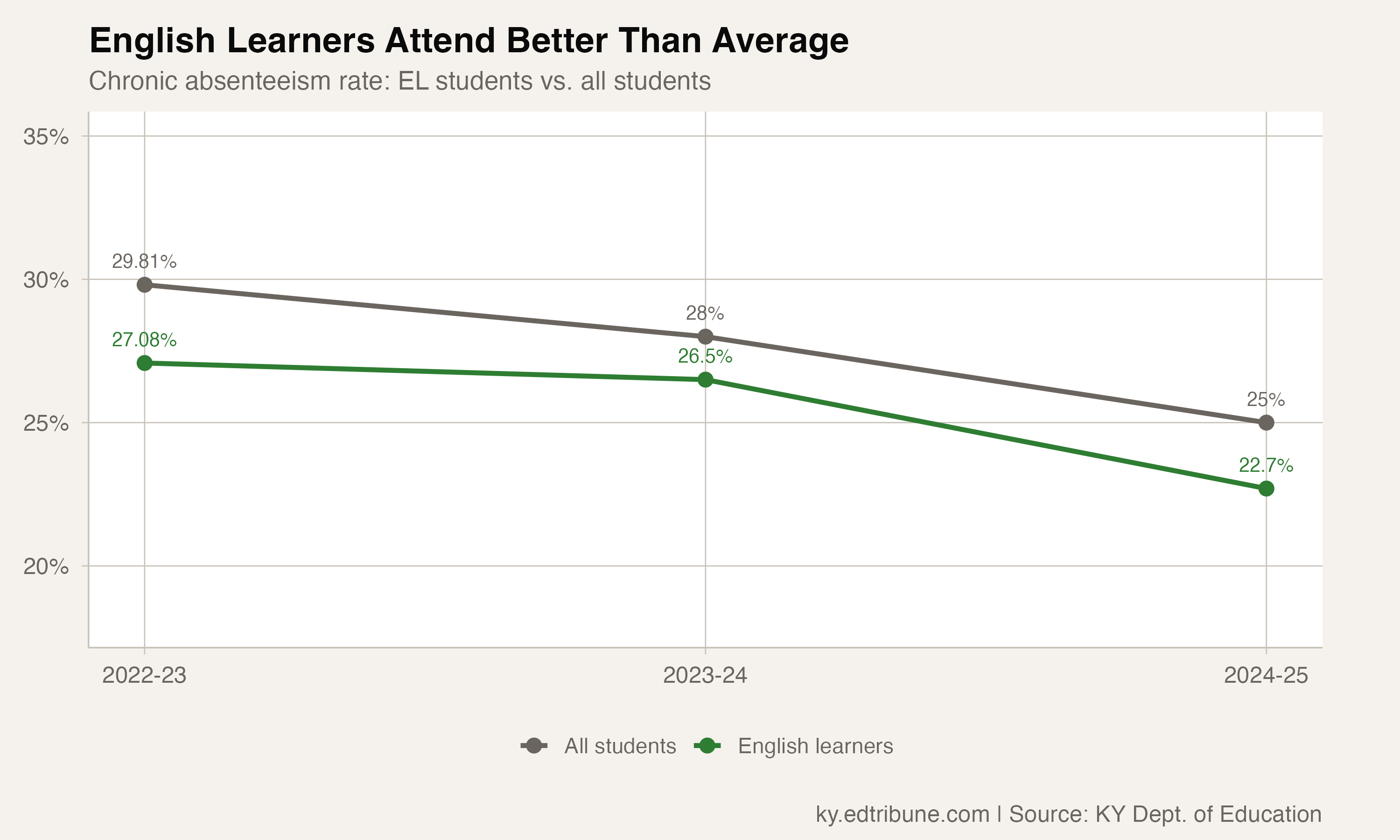
In most states, English learner students have higher chronic absenteeism than the general population. Language barriers, immigration-related stress, family work schedules, and a fear of institutional contact -- particularly in the current enforcement climate -- all predict higher absence rates. Kentucky's 54,712 English learners are chronically absent at 22.7%, 2.3 percentage points below the statewide average.
They have been below average every year Kentucky has tracked the data.
A consistent pattern, not a one-year blip
In 2022-23, English learners were at 27.1% compared to 29.8% statewide -- a 2.7-point advantage. In 2023-24, 26.5% versus 28.0% -- a 1.5-point advantage. In 2024-25, 22.7% versus 25.0% -- a 2.3-point advantage. The gap has been consistent, and the improvement has been faster than the state's: EL students dropped 4.4 points over two years, compared to 4.8 for all students.
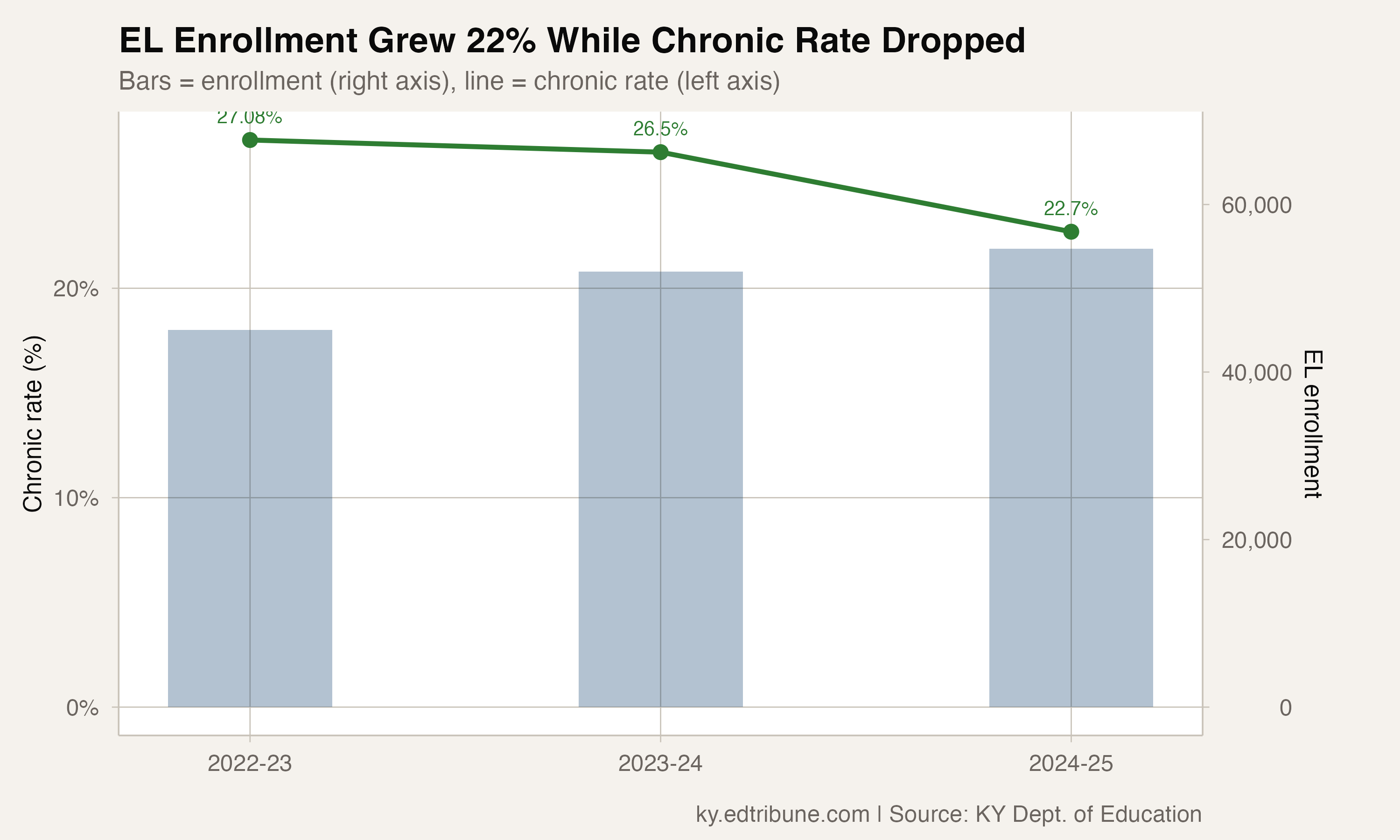
What makes this more striking is the denominator. Kentucky's EL enrollment grew from 45,016 in 2022-23 to 54,712 in 2024-25 -- a 21.5% increase. The state is not seeing better attendance from a shrinking pool of long-established families. Nearly 10,000 additional EL students entered the system over two years, and the chronic rate still fell.
Where English learners rank
Among Kentucky's reportable subgroups, English learners rank fourth-lowest in chronic absenteeism, behind only Asian students (9.7%), gifted students (14.4%), and migrant students (22.2%). They rank lower than white students (24.3%), the general male population (24.7%), well below Hispanic students (25.7%), and far below the economically disadvantaged population (31.2%) -- despite significant overlap between the EL and economically disadvantaged categories.
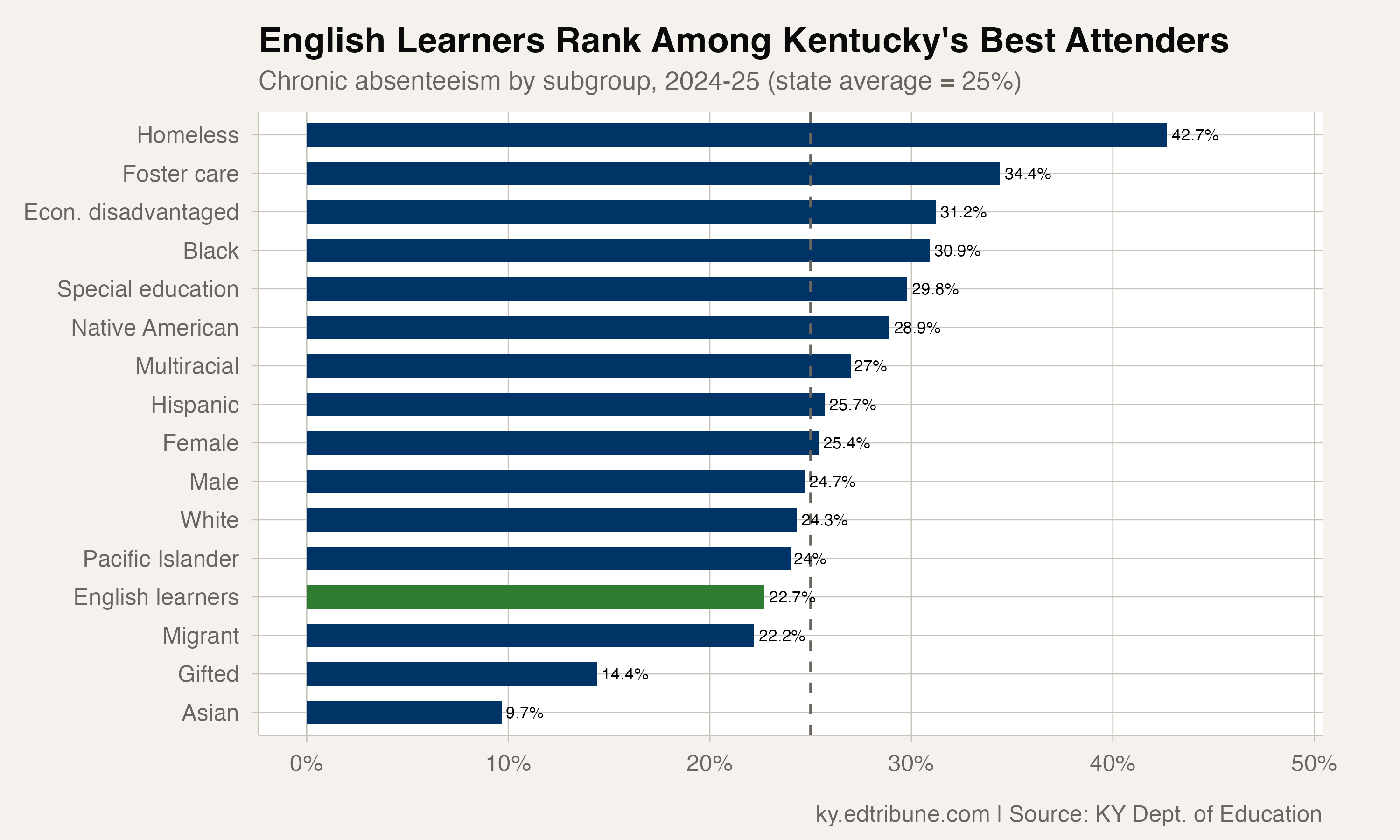
The contrast with students who are currently homeless (42.7%) and foster care students (34.4%) is particularly sharp. English learners often face economic instability comparable to these groups, yet their attendance outcomes are fundamentally different. The implication is that economic disadvantage alone does not determine chronic absenteeism. Something about EL families' relationship with school operates differently.
The district picture
The best EL attendance in the state comes from districts with large, established immigrant communities. Bowling Green Independent, with 1,165 EL students, posts a 9.6% EL chronic rate. Warren County is at comparable levels. Jefferson County, with 22,223 EL students -- the largest EL population in the state -- has a 31.0% EL rate, higher than the statewide average but still below JCPS's 33.1% overall rate.
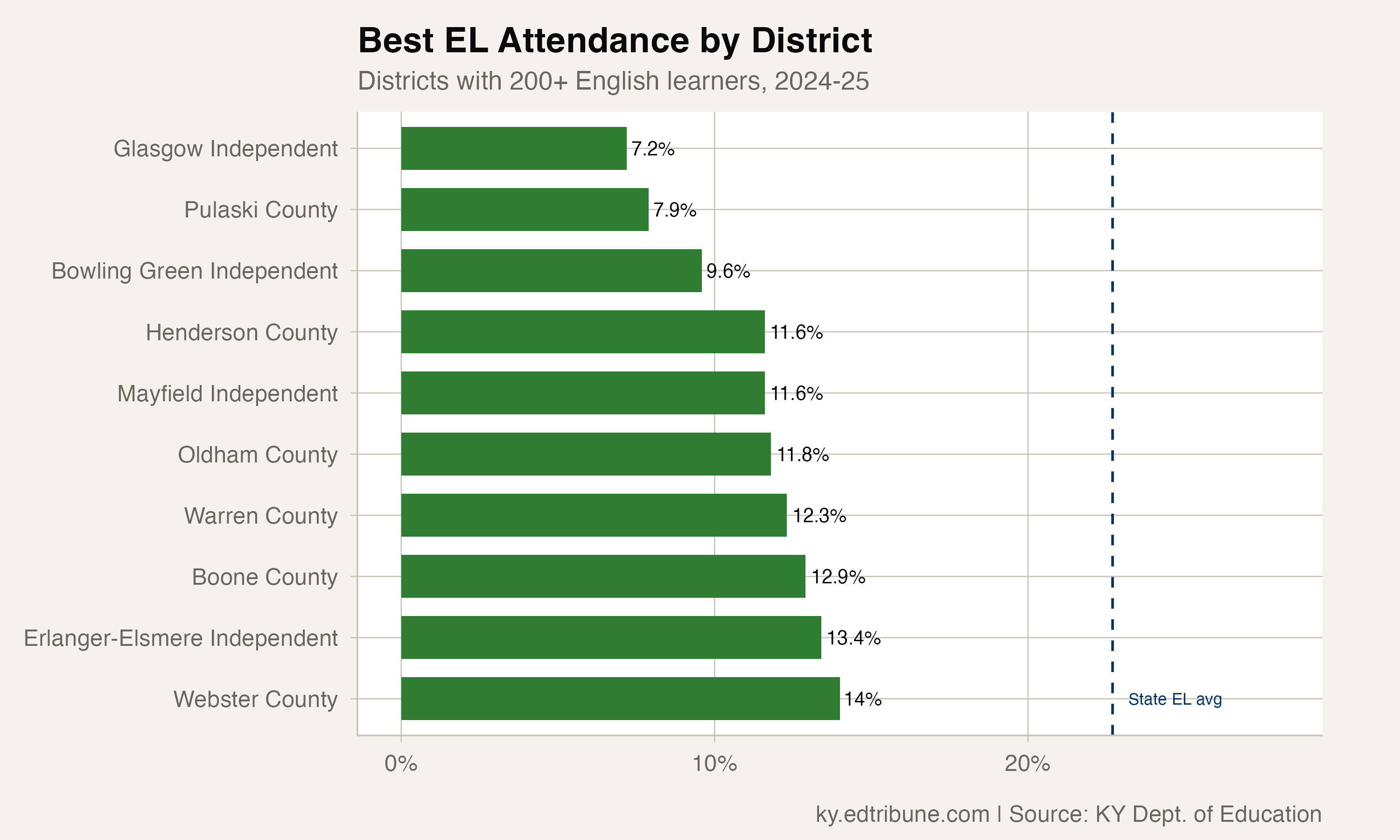
The variation across districts suggests that while the overall EL pattern is positive, it is not uniform. In districts with established resettlement infrastructure and bilingual family engagement, EL attendance is exceptional. In larger urban districts, EL students attend better than their peers but still face elevated chronic absence.
Why English learners might attend better
Several mechanisms could explain the pattern, and they are not mutually exclusive.
Immigrant families, particularly those who have recently arrived, may prioritize school attendance more highly than the general population. For many, school represents stability and opportunity in a way that longer-established residents may not experience. Research from other states has found that first-generation immigrant students tend to have higher attendance than second or third generation, suggesting a cultural commitment to schooling that attenuates over time.
The refugee resettlement infrastructure in Kentucky, particularly in Bowling Green and Louisville, provides family support services that may reduce some barriers to attendance. Resettlement agencies help families navigate school enrollment, transportation, and health care -- all factors that can prevent chronic absence.
"Kentucky's English learner population is growing faster than almost any other student group. Their strong attendance suggests that the barriers to school participation for these families are being addressed, even as the population expands." -- Kentucky Department of Education, Annual Attendance Report, 2025
A less optimistic interpretation is selection bias. Families who enroll their children in school and maintain the EL classification may be a self-selected group that is more committed to formal education. Children whose families are avoiding institutional contact due to immigration concerns may not appear in enrollment data at all. The 22.7% rate might apply only to the EL students who are already connected to the school system, not to the full population of school-age English learners in Kentucky.
The generation that still shows up
There is a less comfortable version of this story. Research from other states consistently finds that first-generation immigrant students attend better than second or third generation -- that the attendance advantage is strongest in families who remember what it cost to get here and weakest in families who have been here long enough to take school for granted. If that pattern holds in Kentucky, the 22.7% rate is partly a snapshot of a population in transition. As the EL kindergarteners counted in this data become native-English-speaking high schoolers, the advantage may erode.
Immigration enforcement adds another variable. Families avoiding institutional contact may not enroll their children at all -- meaning the 22.7% rate applies only to the EL students visible to the system, not to the school-age English learners who have disappeared from it. Kentucky gained nearly 10,000 EL students in two years. How many it lost to fear is a number no attendance report can capture.
Detailed code that reproduces the analysis and figures in this article is available exclusively to EdTribune subscribers.
Discussion
Sign in to join the discussion.
Loading comments...