The national consensus on chronic absenteeism holds that Black students are absent more than white students. Kentucky's statewide data confirms it: a 6.6 percentage point gap, 30.9% to 24.3%. The data from seven large Kentucky districts contradicts it.
In Franklin County, Black students have a 16.0% chronic absenteeism rate. White students have 21.1%. The gap is 5.1 points -- in the opposite direction from what research predicts. In Warren County, it is 12.9% versus 15.8%. In Bullitt County, 16.1% versus 19.7%. Each of these districts has more than 5,000 students. Each shows Black students attending school more reliably than white students.
The seven districts
The reversed-gap districts span Kentucky's geography: Franklin County (Frankfort, the state capital), Warren County (Bowling Green area), Boone County (Northern Kentucky suburbs), Bullitt County (Louisville exurbs), Christian County (Fort Campbell military community), Hardin County (Fort Knox area), and Pulaski County (Somerset, south-central Kentucky).
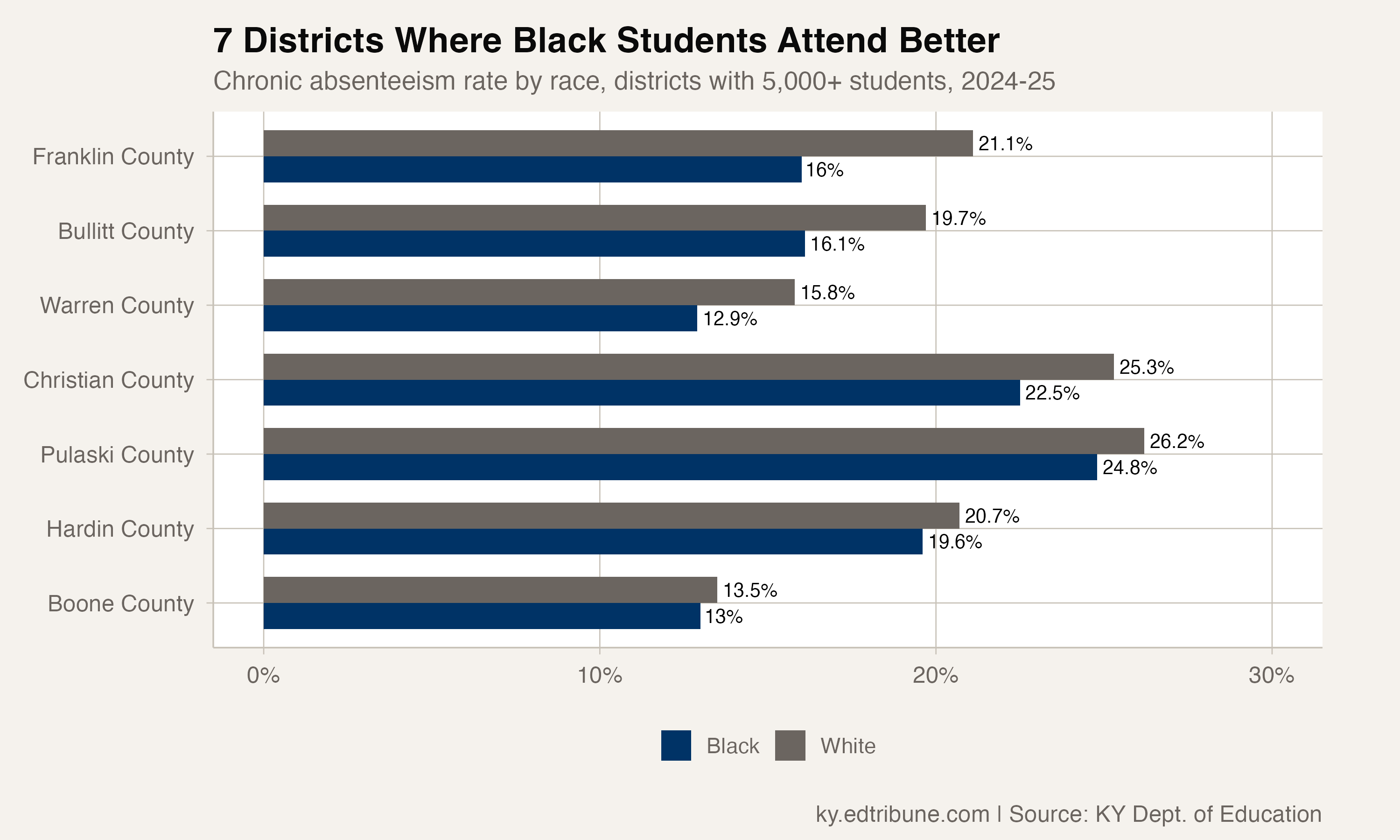
The magnitude of the reversal varies. Franklin County's 5.1-point gap and Bullitt County's 3.6-point gap are substantial. Boone County's 0.5-point gap is narrow enough that a handful of students could flip it. But the pattern -- seven districts, consistent direction -- is not likely to be noise.
What might explain it
The list offers clues. Christian County and Hardin County are military communities anchored by Fort Campbell and Fort Knox respectively. Military families -- including a disproportionate share of the Black families in these communities -- tend to have structured schedules, stable employment, and access to base services that reduce the common barriers to school attendance. The military context may not eliminate racial disparities, but it creates conditions where the socioeconomic factors that typically correlate with race are more evenly distributed.
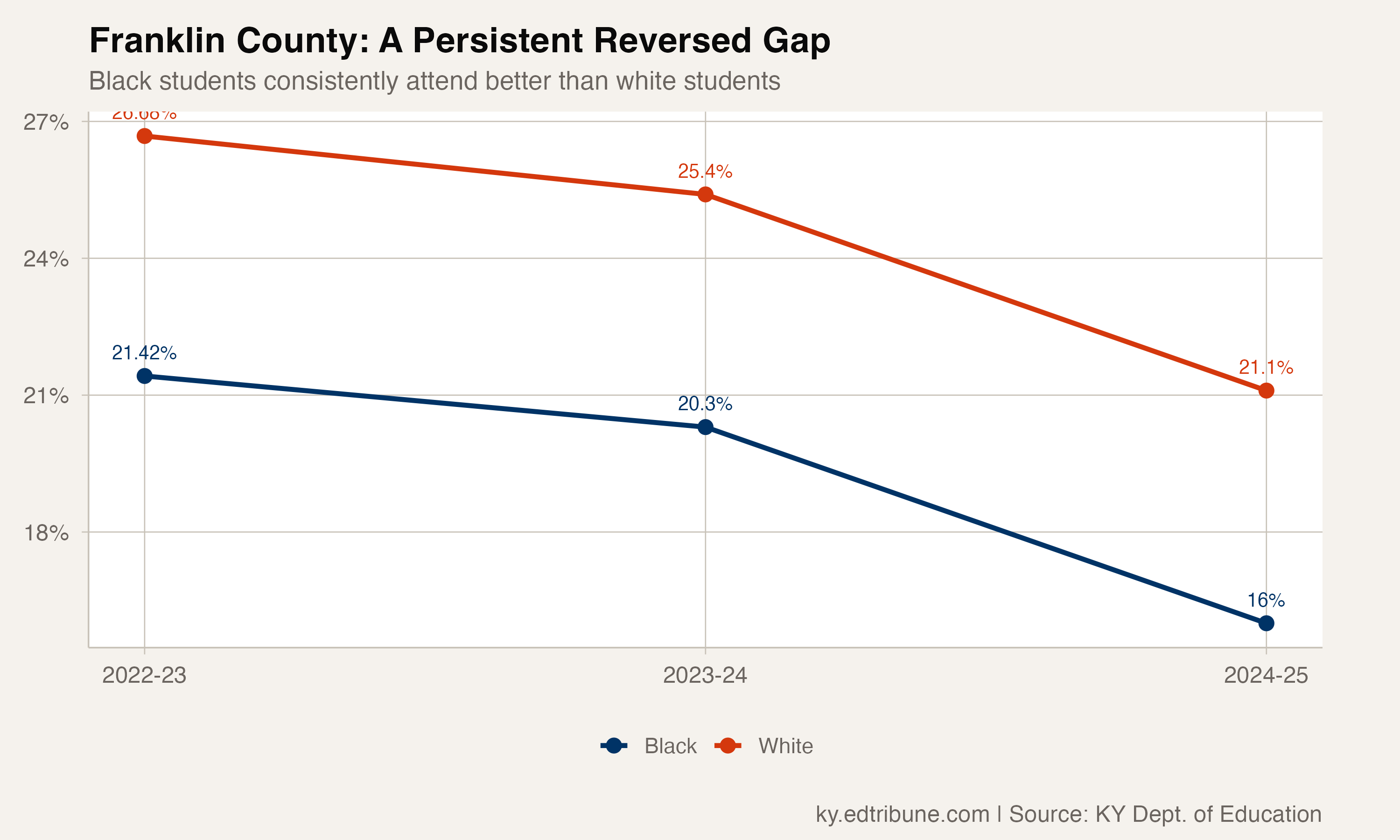
Franklin County, as the state capital, has a Black population concentrated in state government and the public sector -- again, a community where the economic instability that often underlies chronic absenteeism may be less concentrated among Black families than in other settings. Warren County's reversal may relate to Bowling Green's refugee communities, where immigrant families -- many of whom are classified as Black in federal reporting -- bring cultural attitudes toward education that differ from the general population.
These explanations are speculative. The data identifies where the reversal happens. Understanding why requires knowing the demographics, employment patterns, and community structures of these specific Black populations -- information the chronic absenteeism data does not contain.
The contrast with Louisville
The distance between Franklin County's reversed gap and JCPS's 10.4-point gap in the traditional direction is the distance between two different Black experiences in the same state.
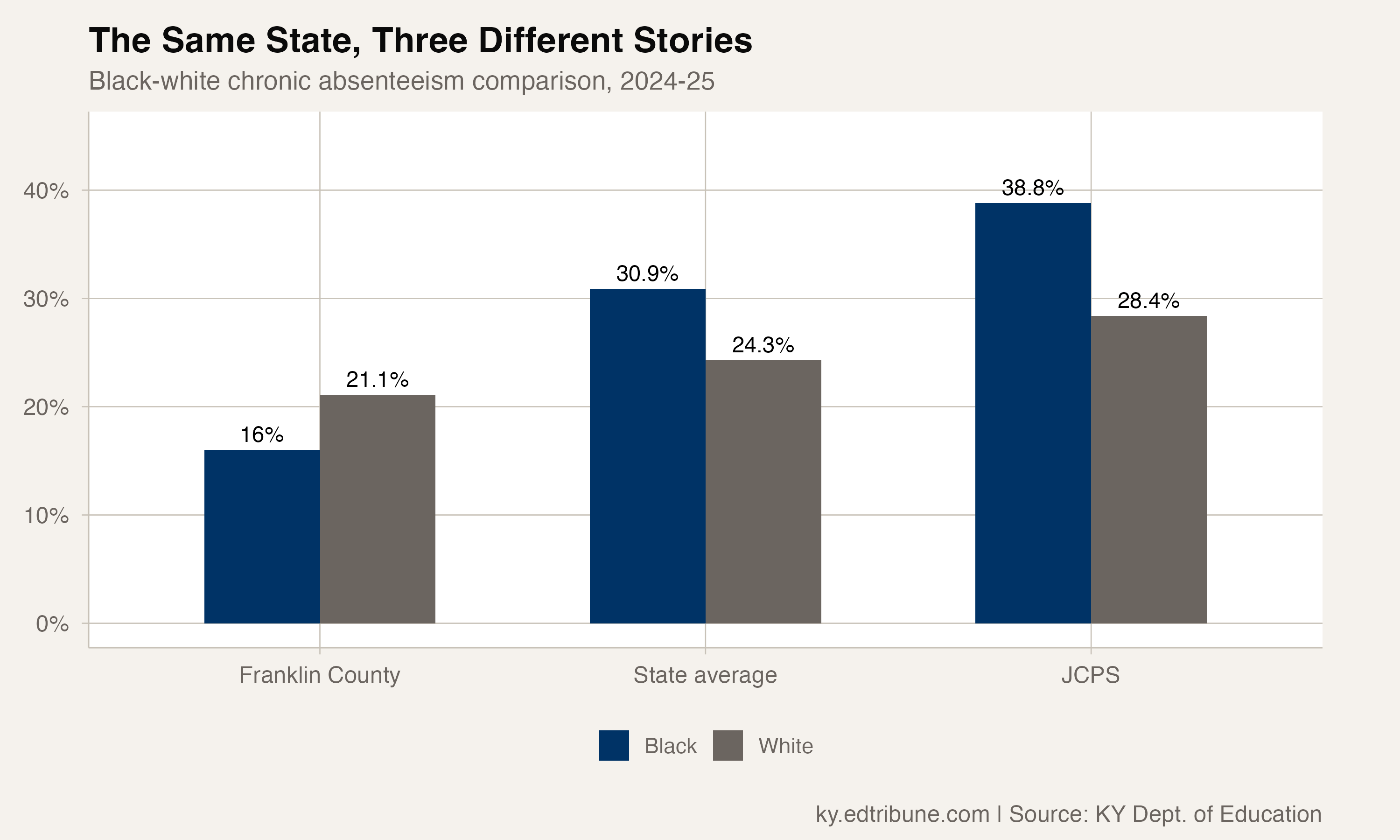
In JCPS, 35,284 Black students face concentrated urban poverty, historical segregation patterns, housing instability, and the cascading effects of decades of disinvestment. In Franklin County, 6,399 students attend a smaller system where the Black community is anchored by state employment. These are not the same populations, and comparing their attendance rates without acknowledging that context would be misleading.
What the comparison does establish is that race alone does not determine attendance outcomes. The same racial group, in the same state, in the same year, produces a 5.1-point advantage in one district and a 10.4-point disadvantage in another. The variable is not race. It is everything else.
"Racial attendance gaps are really gaps in access to the conditions that make regular attendance possible -- stable housing, reliable transportation, family economic security, and trust in the school system." -- Kentucky Center for Education Equity, 2025
Fort Campbell and Frankfort are not Louisville
The simplest reading of the seven reversals is that they reflect who lives there, not what schools do. Military families at Fort Campbell and Fort Knox -- structured schedules, stable paychecks, base housing, a command culture that treats school attendance as non-negotiable. State employees in Frankfort -- white-collar jobs with regular hours and health insurance. Refugees in Bowling Green whose families crossed continents to access American schools and do not take a single day for granted.
None of these communities resemble the west end of Louisville, where JCPS's Black students face generational poverty, segregated housing patterns, and a school system large enough that a chronically absent sixth-grader can go unnoticed for weeks. The seven reversals do not prove that racial gaps are fixable everywhere. They prove that race is a proxy, not a cause -- that the gap tracks economic stability, housing, and community structure more than skin color. That distinction matters. It means the interventions that would close Louisville's 10.4-point gap are not attendance interventions at all. They are housing interventions, employment interventions, and transportation interventions that happen to show up in school data.
Detailed code that reproduces the analysis and figures in this article is available exclusively to EdTribune subscribers.
Discussion
Sign in to join the discussion.
Loading comments...