Jefferson County Public Schools sent 4.5 million text messages about attendance in 2024-25. The Jefferson County Attorney's office reviewed more than 4,000 truancy referrals for elementary students alone. The district partnered with EVOLVE 502 for wraparound services.
The chronic absenteeism rate: 33.1%.
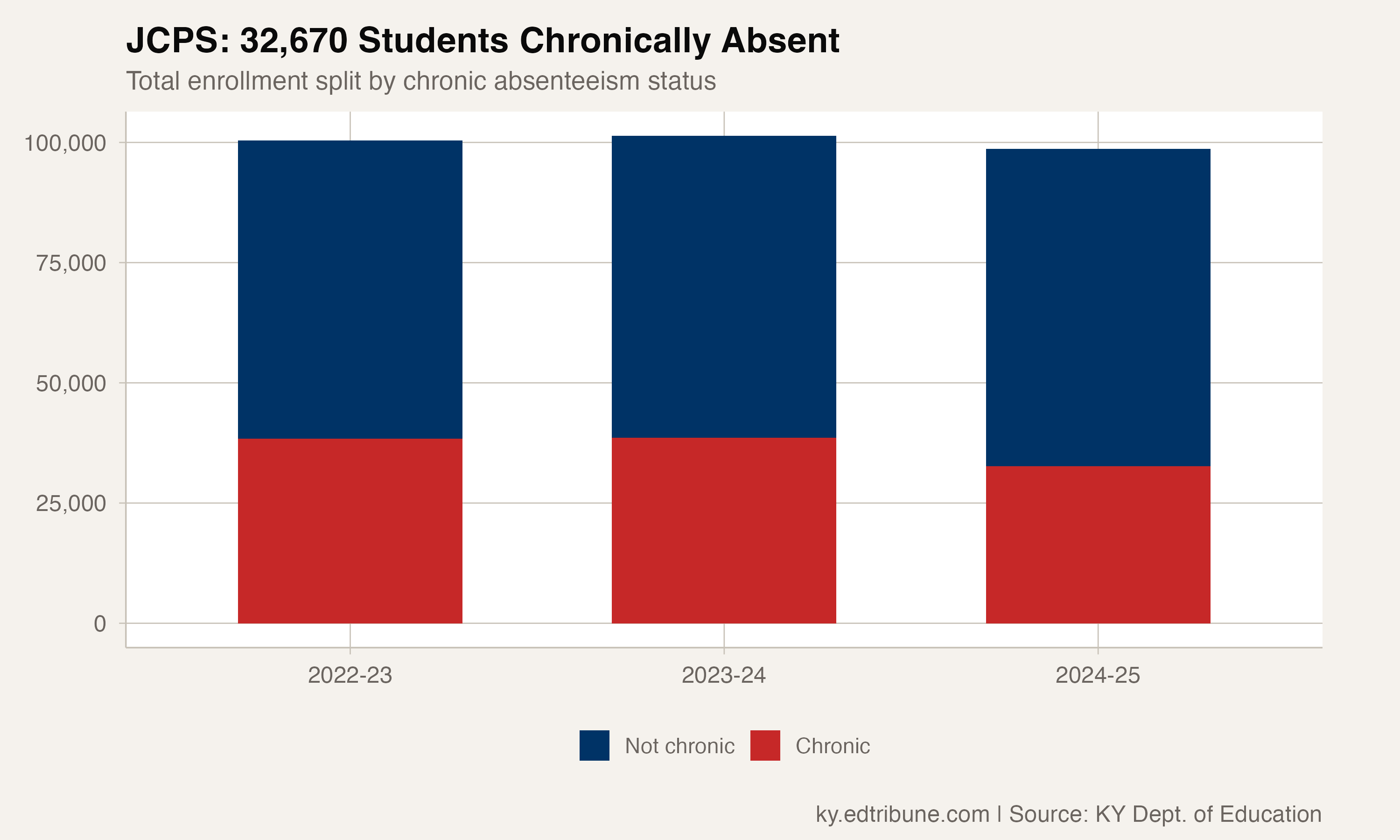
One in three JCPS students missed at least 10% of the school year. That is 32,670 children in the state's largest district, more chronically absent students than the total enrollment of all but four Kentucky districts. JCPS accounts for 15.1% of the state's enrollment but 20.0% of its chronically absent students.
A district stuck at a higher altitude
JCPS improved from 38.3% in 2022-23 to 33.1% in 2024-25 -- a 5.2-point drop that matches the statewide pace. But the district started higher and remains higher. While the state average fell to 25.0%, JCPS sits 8.1 points above.
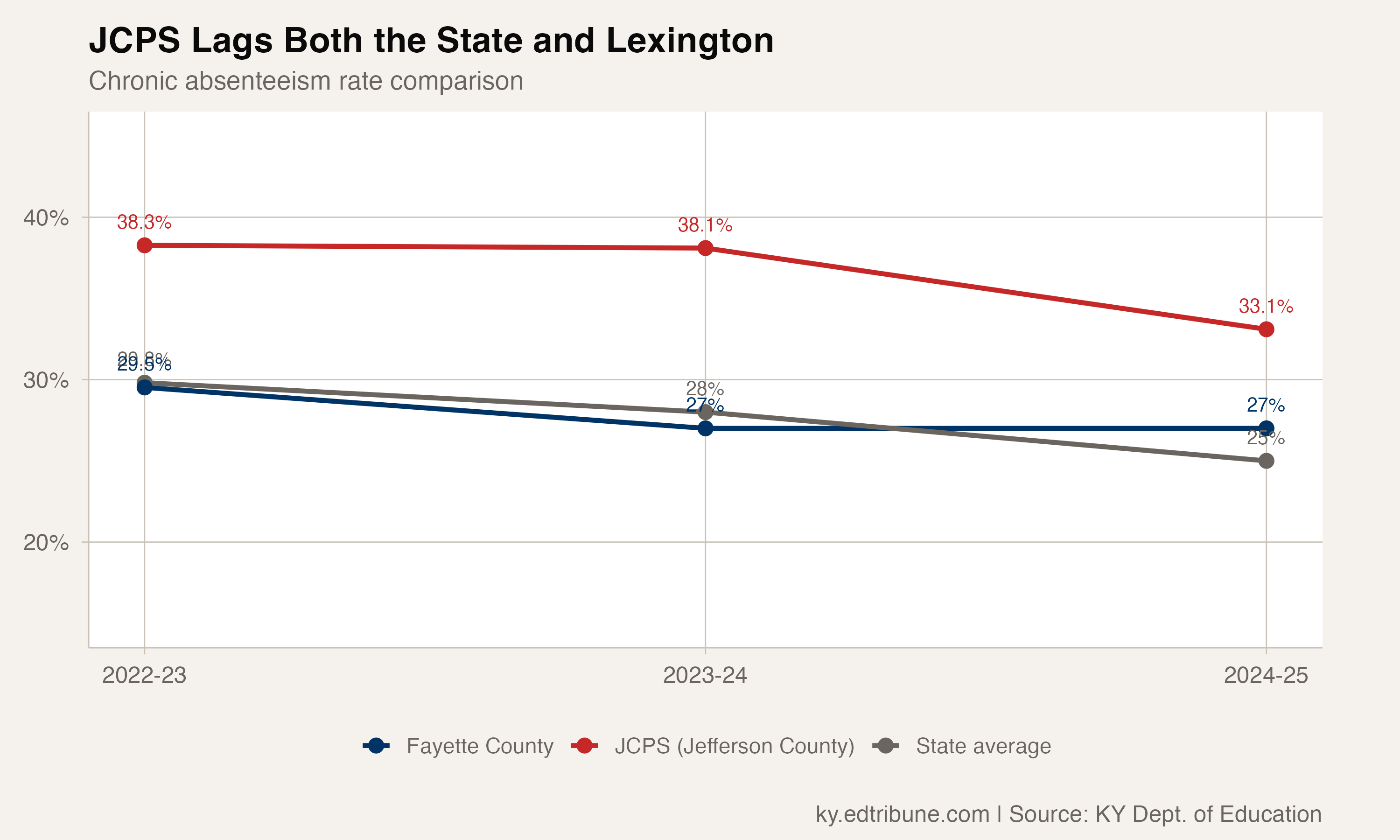
Fayette County, home to Lexington and the state's second-largest district at 42,291 students, dropped to 27.4% -- still above the state average but 5.7 points better than Louisville. The comparison matters because both are large, diverse urban districts with similar demographic profiles. Something about Louisville's scale, geography, or population dynamics produces worse attendance outcomes.
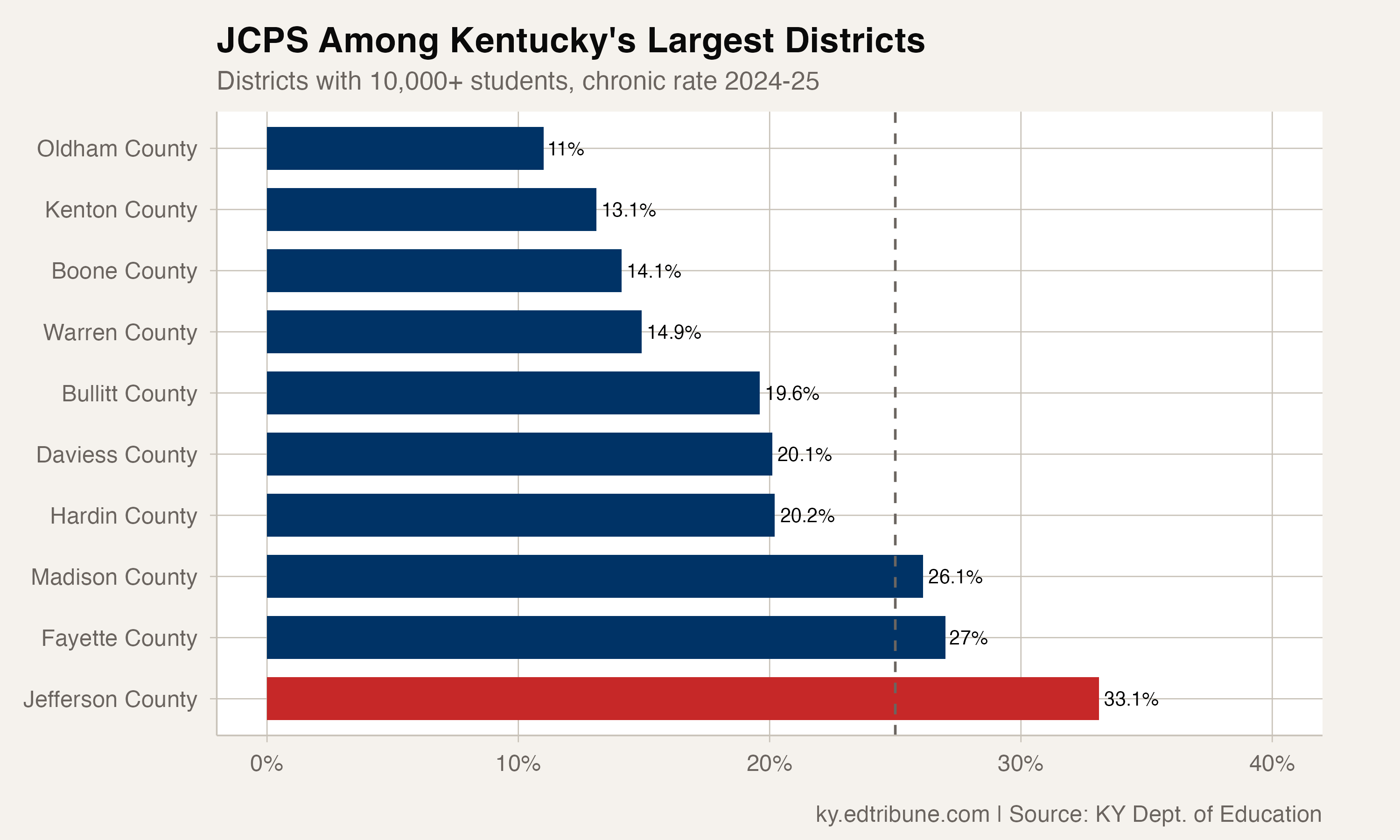
Among districts with at least 10,000 students, JCPS has the highest chronic rate. Oldham County, immediately adjacent to Jefferson County in the Louisville metro, sits at 11.0% -- a 22-point gap between neighboring districts that share a media market and a labor market but not an attendance reality.
The racial dimension
The numbers behind JCPS's overall rate tell a sharper story. Black students -- 35.8% of JCPS enrollment -- have a 38.8% chronic rate. White students -- 33.1% of enrollment -- have a 28.4% rate. The 10.4-point gap is the widest of any large Kentucky district.
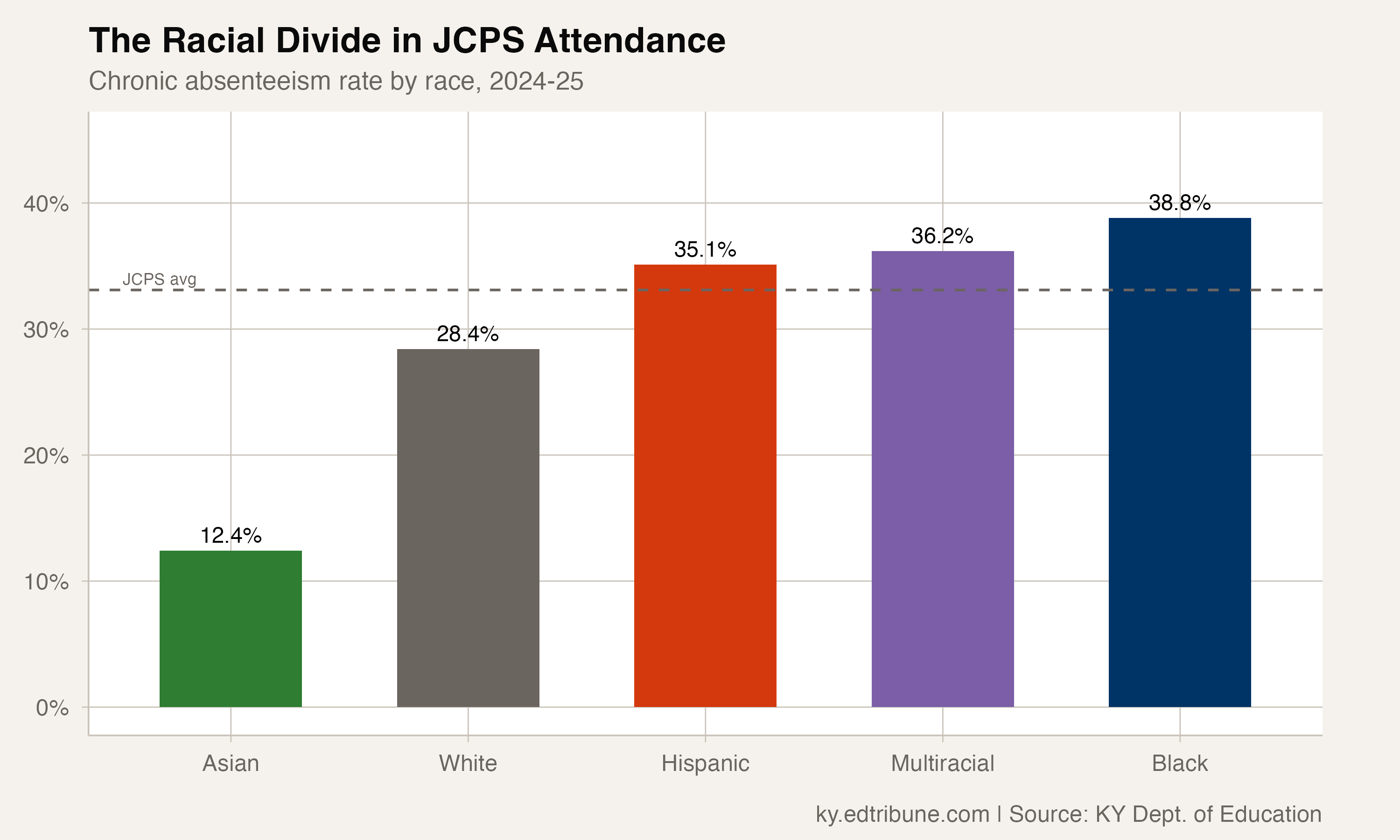
Hispanic students (35.1%) and multiracial students (36.2%) also exceed the district average. Asian students, at 12.4%, are the only racial group below the statewide average. The pattern is familiar from large urban districts nationally, but the magnitude of JCPS's racial gap -- wider than the gap between the state's best and average districts -- suggests that the attendance crisis in Louisville is distributed unevenly even within the same school buildings.
The subgroup data deepens the picture further. Economically disadvantaged students -- 66% of JCPS enrollment -- have a 38.5% chronic rate. Special education students reach 41.4%. Homeless students in JCPS hit 52.9%, the highest rate for any subgroup in any large district in the state.
The fiscal and operational weight
JCPS's 32,670 chronically absent students represent a significant operational challenge. The district has reported investing heavily in attendance interventions, but the scale of the problem -- a third of the student body -- means that targeted interventions must operate at a scale that approaches universal programming.
Under Kentucky's SEEK formula, chronic absenteeism directly reduces the district's per-pupil funding. Each chronically absent student represents fewer ADA dollars flowing into the district budget. For a district already navigating the fiscal pressures of its size and demographics, the attendance-revenue cycle compounds every other challenge.
"Attendance is an investment in a child's future. When students are in school, they have access to meals, mental health services, and the academic instruction they need to succeed." -- JCPS Superintendent Marty Pollio, Courier-Journal, 2025
The math problem inside the attendance problem
JCPS serves 15.1% of Kentucky's students but produces 20.0% of its chronically absent population. That imbalance means the state cannot hit its 15% target without Louisville moving substantially. If every other district in Kentucky reached 15% while JCPS stayed at 33%, the state average would still sit near 18%.
Oldham County -- 11.0%, right next door, sharing a media market and a labor market -- is a 22-point rebuke. Superintendent Pollio's 4.5 million texts and 4,000 truancy referrals are the largest attendance operation in the state. The rate is also the highest among large districts. At some point the volume of intervention becomes its own evidence: the tools are reaching the families they can reach, and the remaining 32,670 chronically absent students need something those tools do not provide.
Detailed code that reproduces the analysis and figures in this article is available exclusively to EdTribune subscribers.
Discussion
Sign in to join the discussion.
Loading comments...