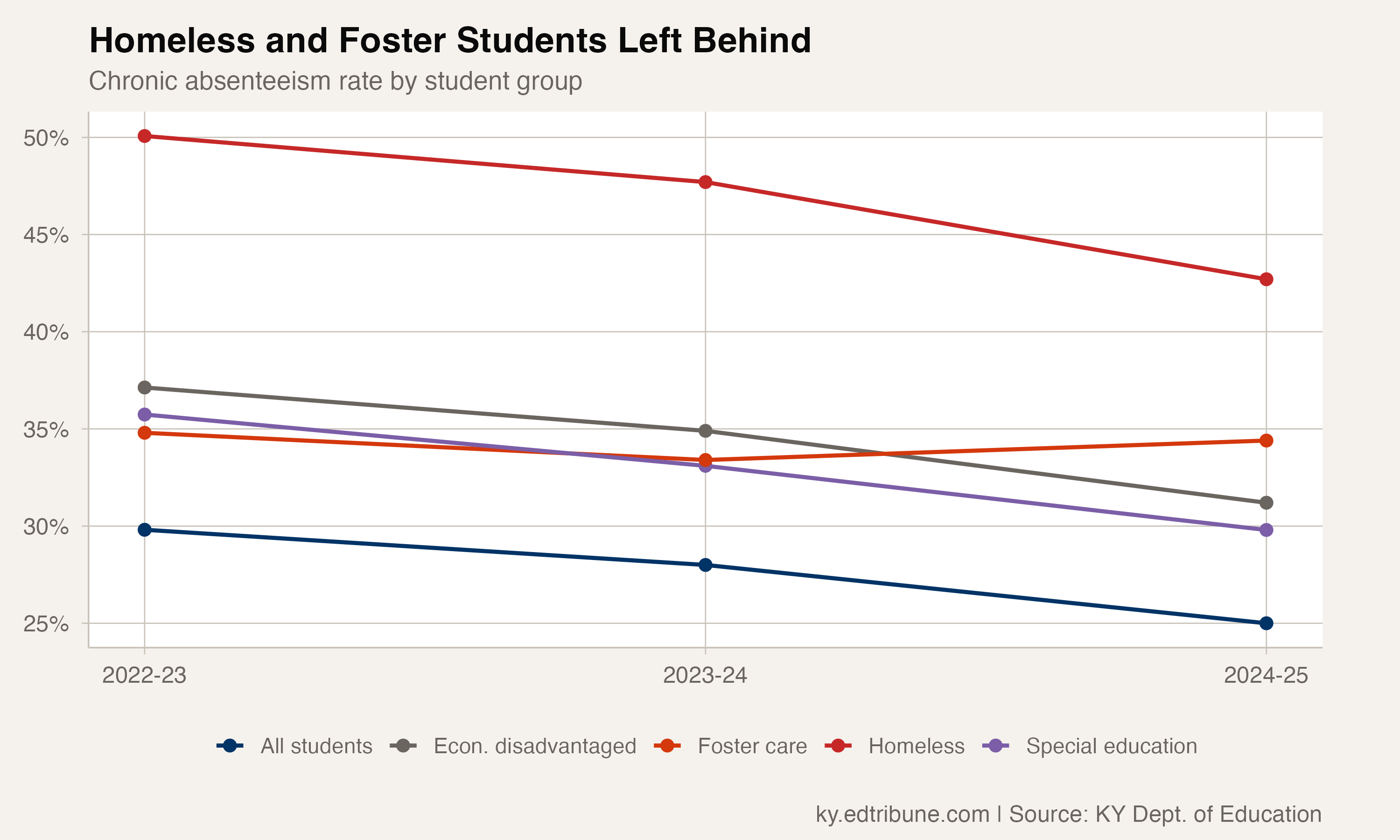
In 2022-23, more than half of Kentucky's students who are currently homeless were chronically absent. The rate has since dropped 7.4 percentage points to 42.7% -- the largest improvement of any student group in the state. And still, nearly 9,300 students who are currently homeless are missing at least 10% of the school year.
Then there are the foster care students. Their chronic absenteeism rate was 34.8% in 2022-23. In 2024-25, it is 34.4%. A 0.4-point change in two years while every other subgroup improved by at least 4 points. Kentucky's 9,010 foster care students are essentially frozen at pandemic-era attendance levels.
The hierarchy of vulnerability
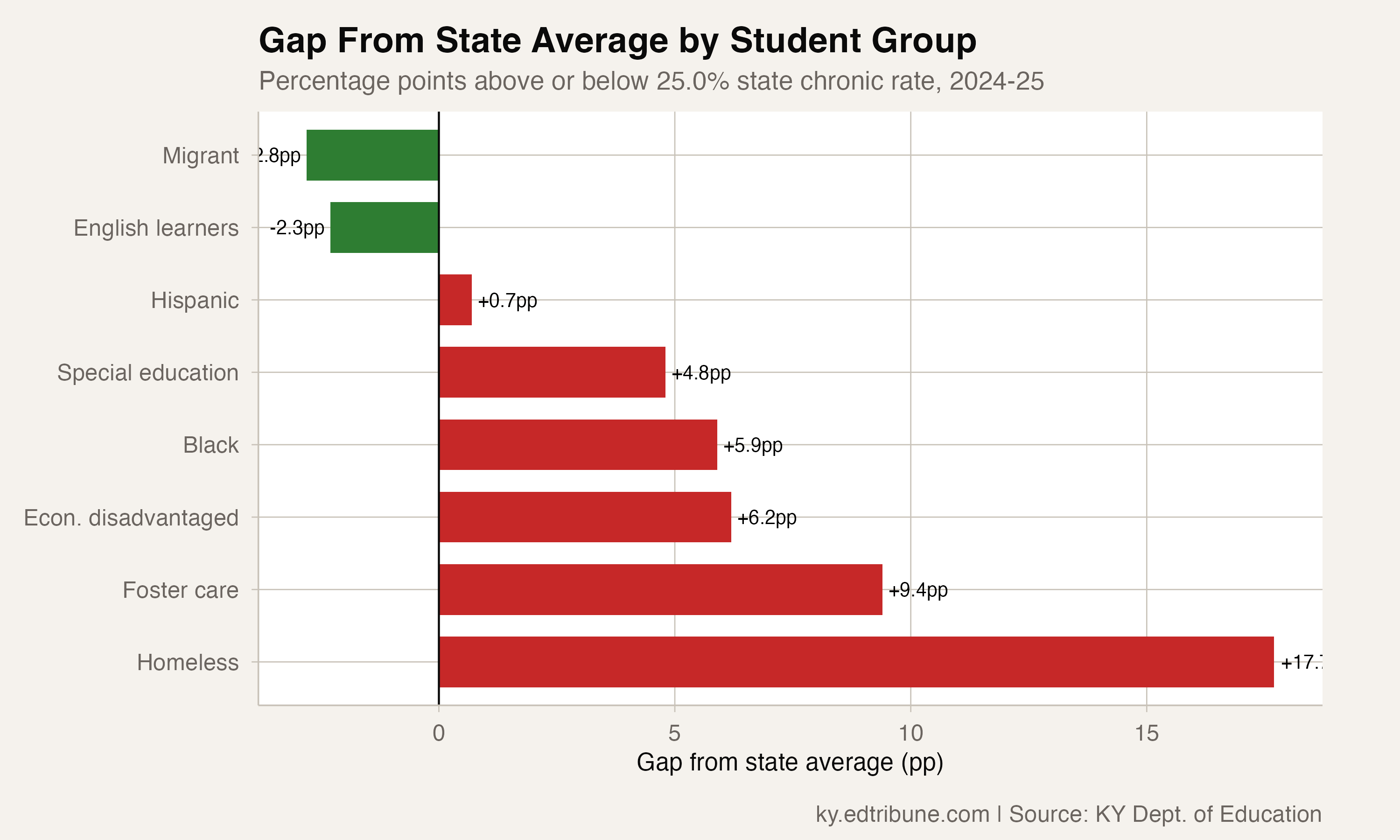
Kentucky's chronic absenteeism data reveals a clear hierarchy of risk. At the top, students who are currently homeless at 42.7%. Below them, foster care at 34.4%, special education at 29.8%, and economically disadvantaged at 31.2%. At the bottom, the statewide average of 25.0%, English learners at 22.7%, and Asian students at 9.7%.
The gap between students who are currently homeless and the state average -- 17.7 percentage points -- is wider than the gap between Kentucky's best-performing districts and its worst. Students who are currently homeless in 2024-25 attend school at roughly the rate the overall student body did at the pandemic peak.
Foster care's frozen numbers
Every major student group in Kentucky improved over the past two years. White students dropped 5.1 points. Economically disadvantaged students dropped 5.9 points. Even students who are currently homeless, starting from the highest baseline, dropped 7.4 points. Foster care moved 0.4 points.
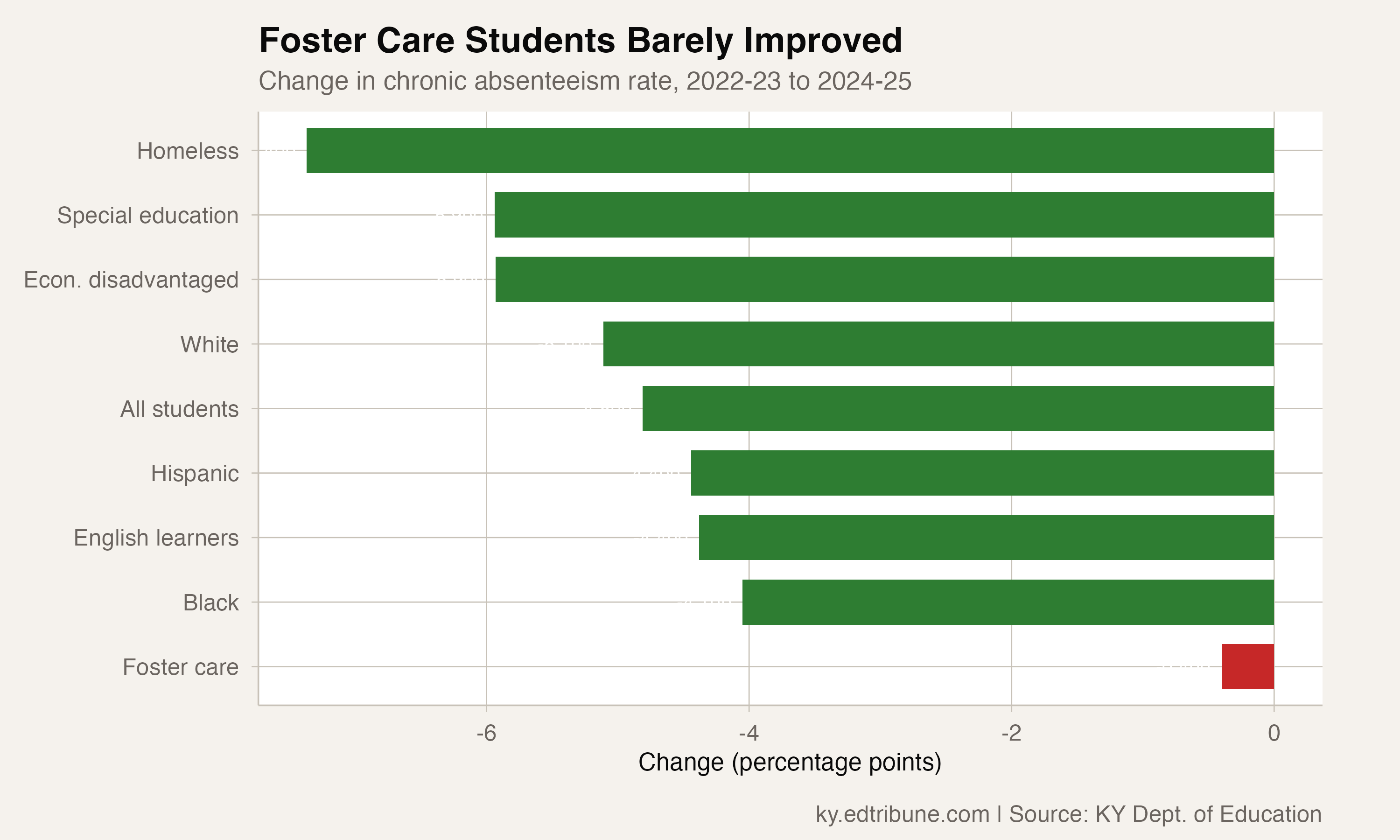
This near-zero improvement is difficult to explain as random variation. It suggests that the statewide forces driving improvement -- HB 611's truancy enforcement, the SEEK funding incentive, the normalization of post-pandemic attendance -- are not reaching foster care students. The mechanisms are different for this population. Children in foster care face placement instability, school transfers, trauma responses, and a system of caregivers who may not have the same incentives or capacity to enforce attendance as biological parents. A truancy law that escalates to county attorneys may have limited relevance when the student's housing situation changed twice in a semester.
Kentucky's 9,010 foster care students represent 1.4% of total enrollment but 1.9% of chronically absent students. The disproportion is modest in aggregate but severe in human terms: 3,100 students in state care are missing enough school to fall behind academically, and two years of statewide improvement have not changed that number.
Louisville's compounding crisis
Jefferson County Public Schools, the state's largest district, amplifies every statewide disparity. JCPS has 4,030 students who are currently homeless with a 52.9% chronic absence rate -- more than half. Its 1,474 foster care students have a 34.7% rate, consistent with the statewide pattern of non-improvement. The district's overall 33.1% chronic rate makes it Kentucky's most challenged large system, and its vulnerable populations drive that figure.
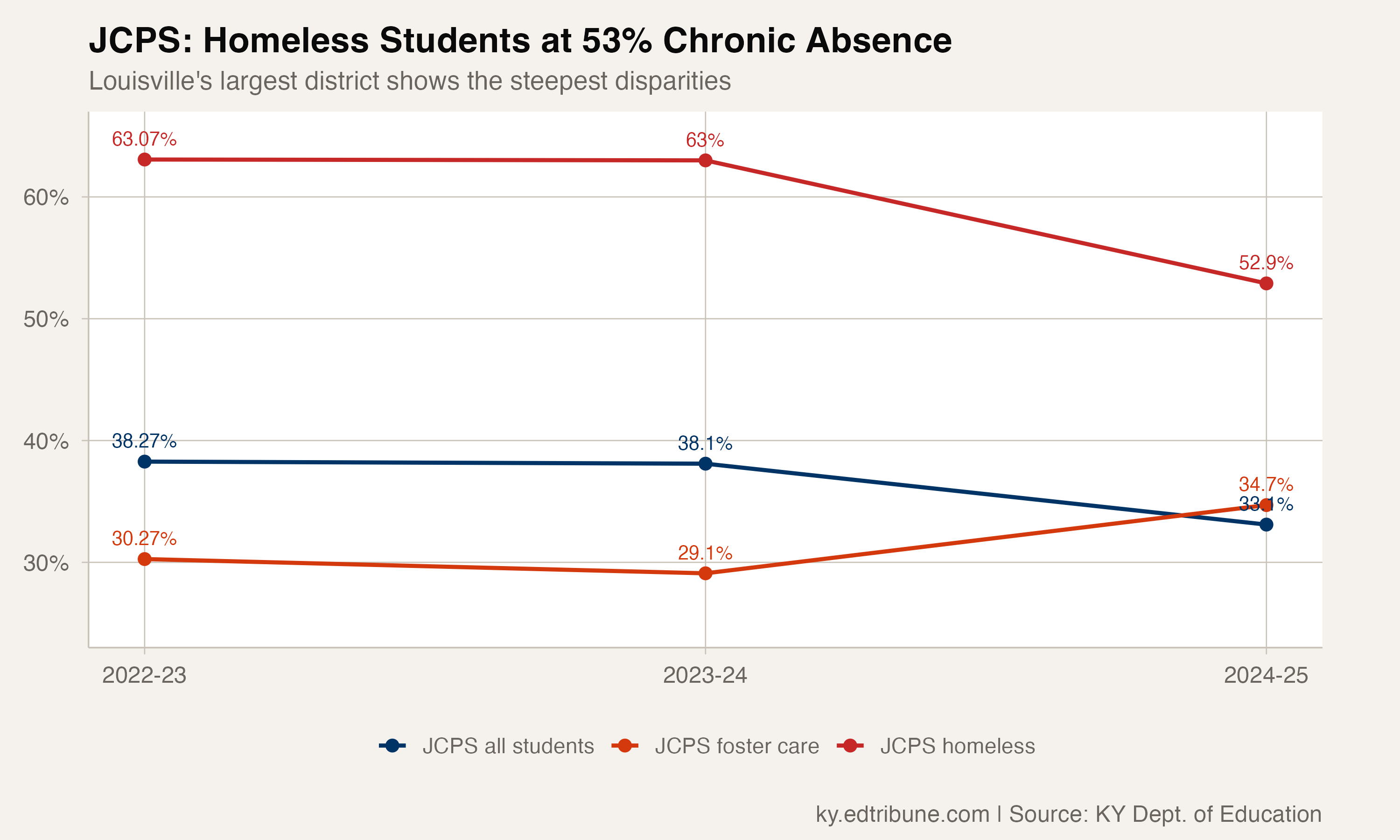
JCPS has invested heavily in attendance infrastructure. The district sent 4.5 million text messages to families about attendance in 2024-25, and the Jefferson County Attorney's office reviewed more than 4,000 truancy referrals for elementary students alone. The EVOLVE 502 partnership provides wraparound services. But for students whose primary barrier to attendance is housing instability or placement changes, texting campaigns and truancy referrals address symptoms rather than causes.
"We cannot improve attendance without addressing the root causes of housing instability, trauma, and poverty that keep our most vulnerable students from school." -- Kentucky Youth Advocates, Policy Brief on Chronic Absenteeism, 2025
A system designed for a different student
Kentucky's attendance machinery -- SEEK funding tied to daily presence, HB 611 truancy referrals, the "You Belong" campaign on billboards and streaming services -- was built for families with a fixed address and a consistent school. Foster care students often have neither. A child who changes placements mid-semester may attend every day of both placements and still be coded as chronically absent because the transfers create gaps. A truancy referral escalated to the county attorney assumes a parent who can be held accountable; foster parents rotate through the system faster than truancy paperwork.
The 3,100 chronically absent foster care students represent a population that Kentucky's primary attendance tools were not designed to reach. Two years of statewide improvement that left their numbers unchanged is not a timing issue. It is a design issue.
Detailed code that reproduces the analysis and figures in this article is available exclusively to EdTribune subscribers.
Discussion
Sign in to join the discussion.
Loading comments...