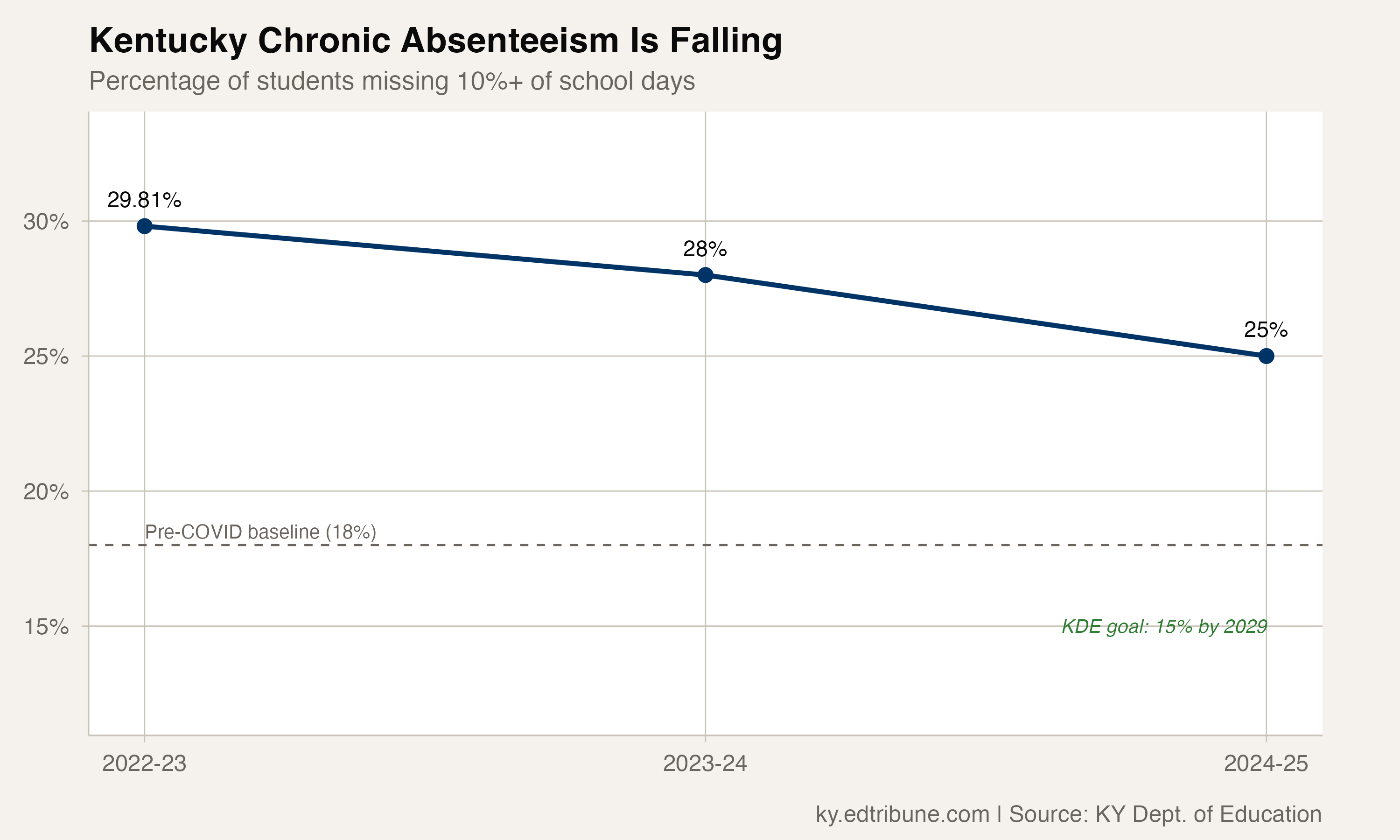
In the 2022-23 school year, nearly one in three Kentucky students was chronically absent. Two years later, the rate has dropped to one in four. The improvement is real, it is accelerating, and it still leaves roughly 163,000 students missing at least 10% of the school year.
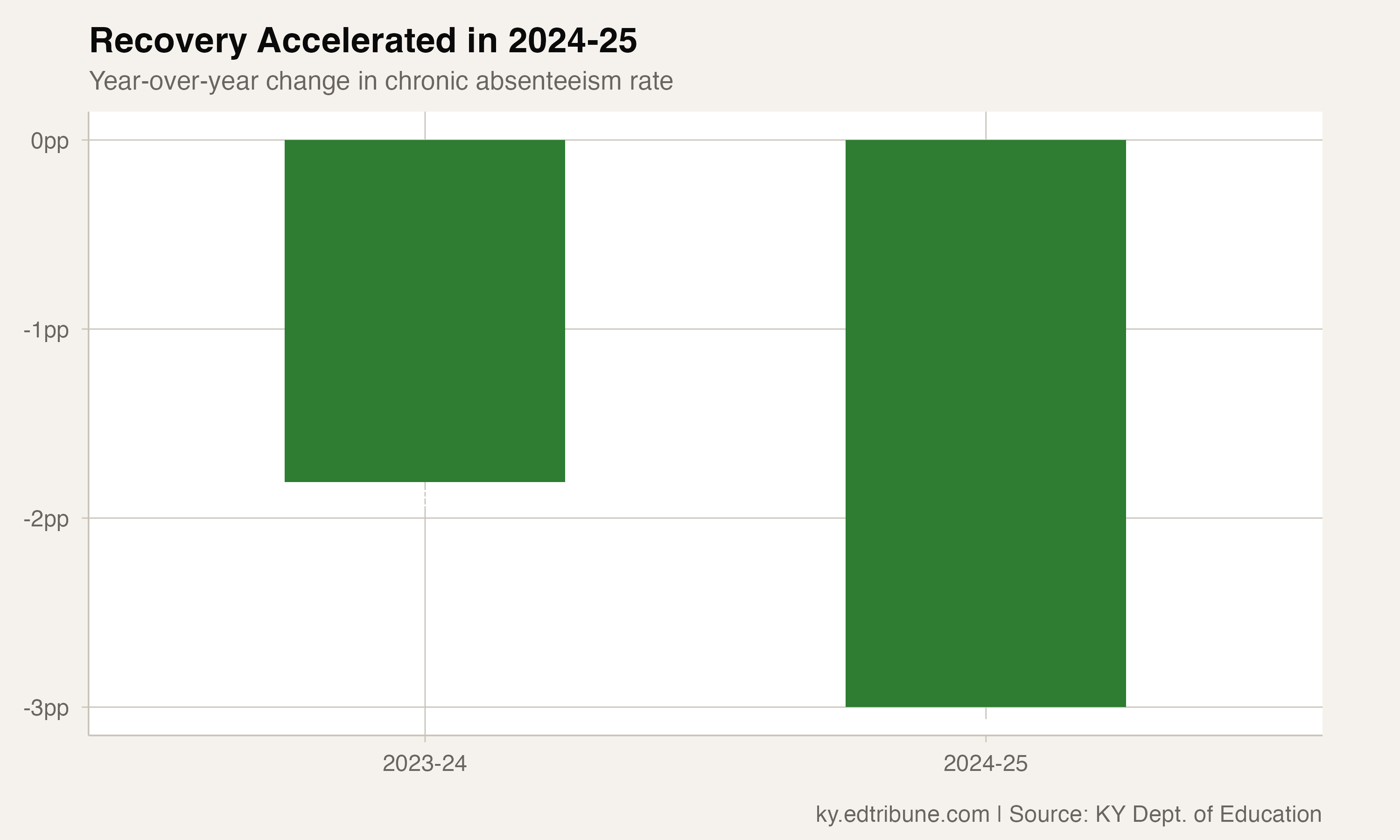
Kentucky's chronic absenteeism rate fell from 29.8% in 2022-23 to 25.0% in 2024-25, a 4.8 percentage point drop that brought the state back below its first year of pandemic-era reporting. The improvement nearly doubled in the second year: a 1.8-point drop in 2023-24, then a 3.0-point drop in 2024-25. That acceleration is what separates Kentucky's trajectory from states where initial gains have already flattened.
The distance still to travel
The numbers look better against the recent past. They look worse against the longer view.
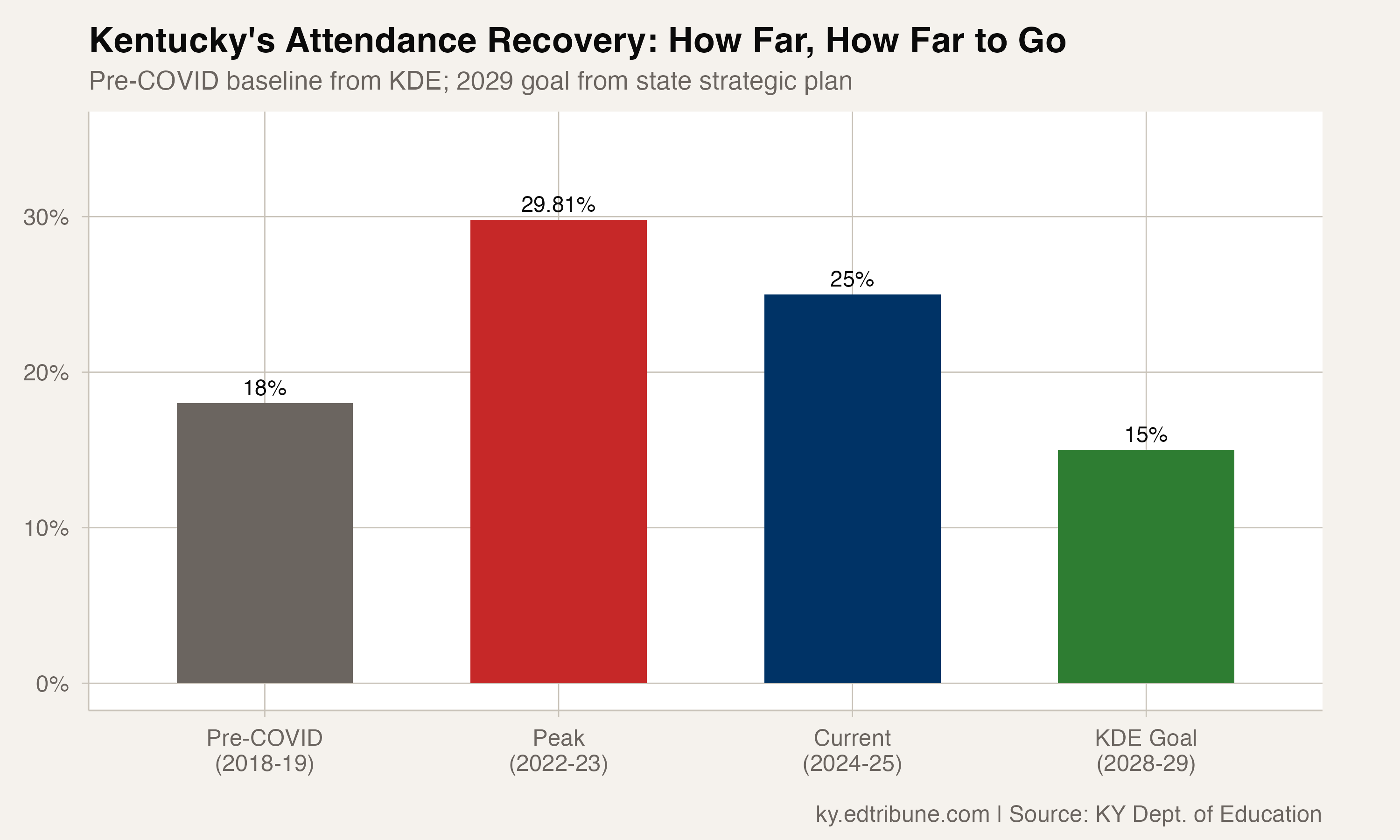
Before the pandemic, Kentucky's chronic absenteeism rate was approximately 18%, according to the Kentucky Department of Education. At 25%, the state has recovered roughly 40% of the pandemic-era surge. The KDE has set a goal of reaching 15% by the 2028-29 school year, which would require sustaining the current pace of improvement for four more years and then some.
The raw numbers tell their own story. In 2022-23, 198,524 students were chronically absent. By 2024-25, that number dropped to 163,177 -- a reduction of 35,347 students. But total enrollment also fell, from 665,962 to 651,776, meaning the denominator shrank alongside the numerator. Some of the rate improvement reflects fewer students in the system, not just better attendance among those who remain.
Who is still missing school
The statewide average flattens a landscape of extremes. Homeless students carry a 42.7% chronic rate, down from 50.1% two years earlier but still nearly double the statewide figure. Foster care students sit at 34.4%, essentially unchanged since 2022-23, the one major subgroup where improvement has barely registered. Economically disadvantaged students -- 61% of Kentucky's enrollment -- have a 31.2% rate, 6.2 points above the state average.
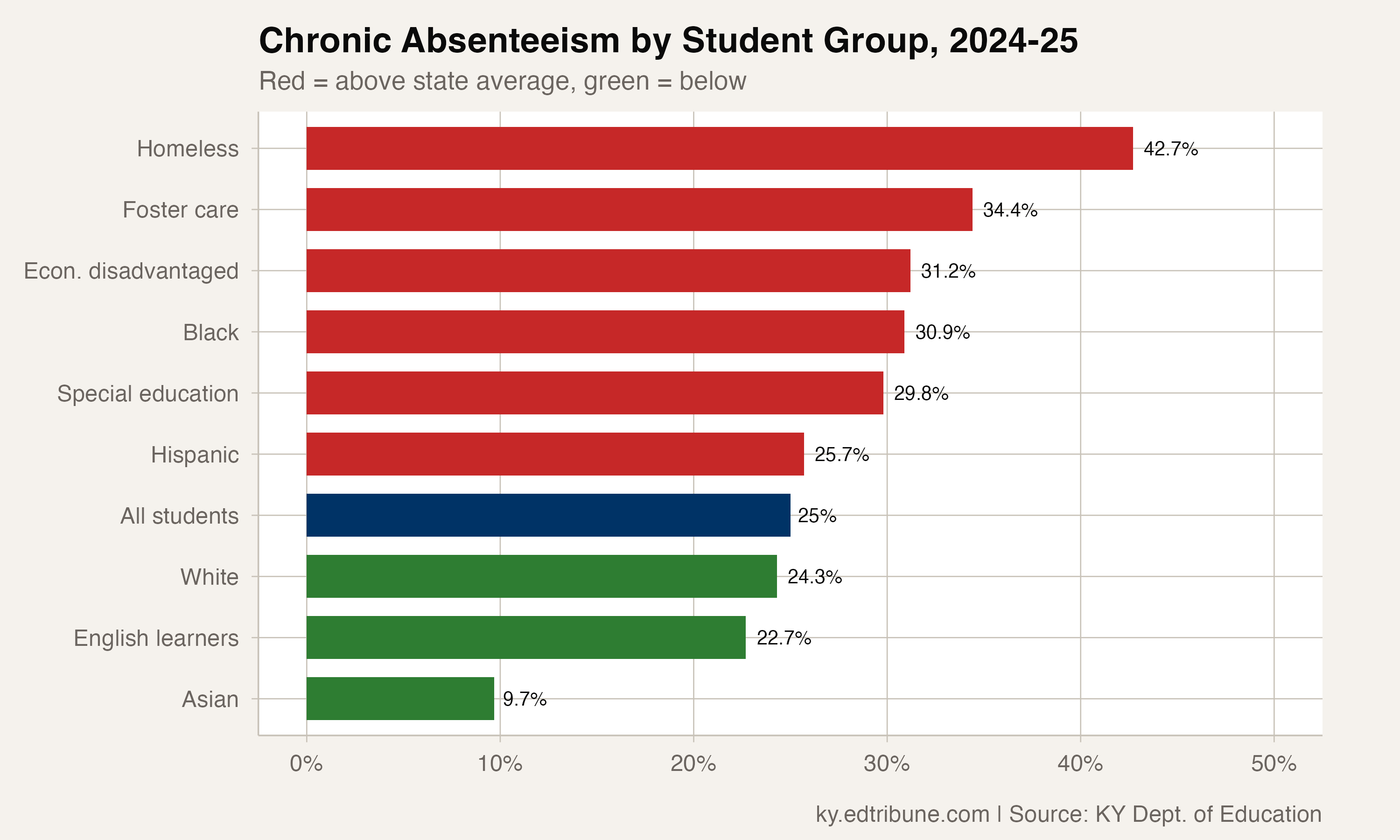
The racial gap tells a more complicated story. Black students improved from 35.0% to 30.9%, a 4.1-point gain. White students improved faster, dropping 5.1 points to 24.3%. The gap between them widened from 5.5 to 6.6 percentage points even as both groups got better. English learners, at 22.7%, are one of the few subgroups performing below the state average -- a reversal of national patterns where language barriers typically predict higher absence.
"These results are encouraging, but we know there is still much work to do, particularly for our most vulnerable student populations." -- KDE Commissioner Jason Glass, Kentucky Department of Education, 2025
What may be driving the improvement
Kentucky enacted HB 611 in July 2024, a truancy law requiring directors of pupil personnel to report 15 or more unexcused absences to the county attorney and extending diversion agreements to 12 months. The law's timing aligns with the acceleration in improvement, though disentangling its effect from broader post-pandemic normalization is difficult with only one year of post-enactment data.
The state's SEEK funding formula, which ties district revenue to average daily attendance, creates a fiscal incentive that most states lack. Every chronically absent student reduces district funding directly. That makes attendance not just an educational metric but a budget line item -- a dual pressure that may explain why improvement has been so broad. Of 174 districts, 168 improved their chronic rate over the two-year period.
KDE also launched its "You Belong" campaign in 2025, placing messaging about school attendance on streaming services, billboards, and public transit. Whether public messaging campaigns can reach the families of the 163,000 students still chronically absent -- disproportionately low-income, homeless, and in foster care -- is an open question.
The distance between a rate and a reality
KDE wants 15% by 2029. Getting there from 25% at the current pace would take four more years of 3-point annual drops -- a pace no state has sustained. The pre-COVID baseline of 18% comes from KDE reports, not from the same data system that produced the 2023-2025 figures, making precise recovery calculations approximate.
Meanwhile, Kentucky's 163,000 chronically absent students still outnumber the total enrollment of Louisville. The foster care system has barely budged. Fourteen Appalachian districts remain above 40%. The acceleration is real, but so is the arithmetic: at 25%, Kentucky still has more chronically absent students than it had total enrollment in its 80 smallest districts combined.
Detailed code that reproduces the analysis and figures in this article is available exclusively to EdTribune subscribers.
Discussion
Sign in to join the discussion.
Loading comments...