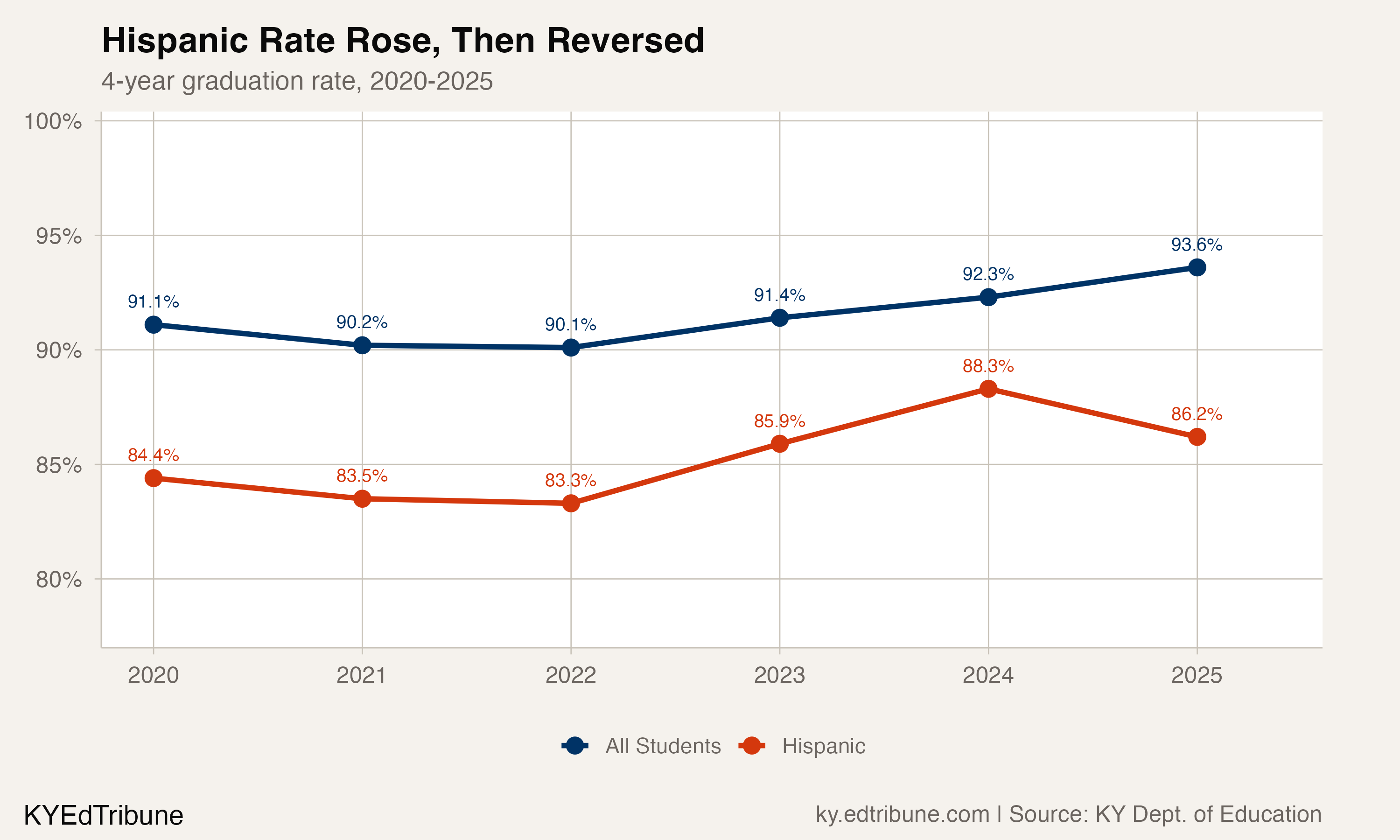
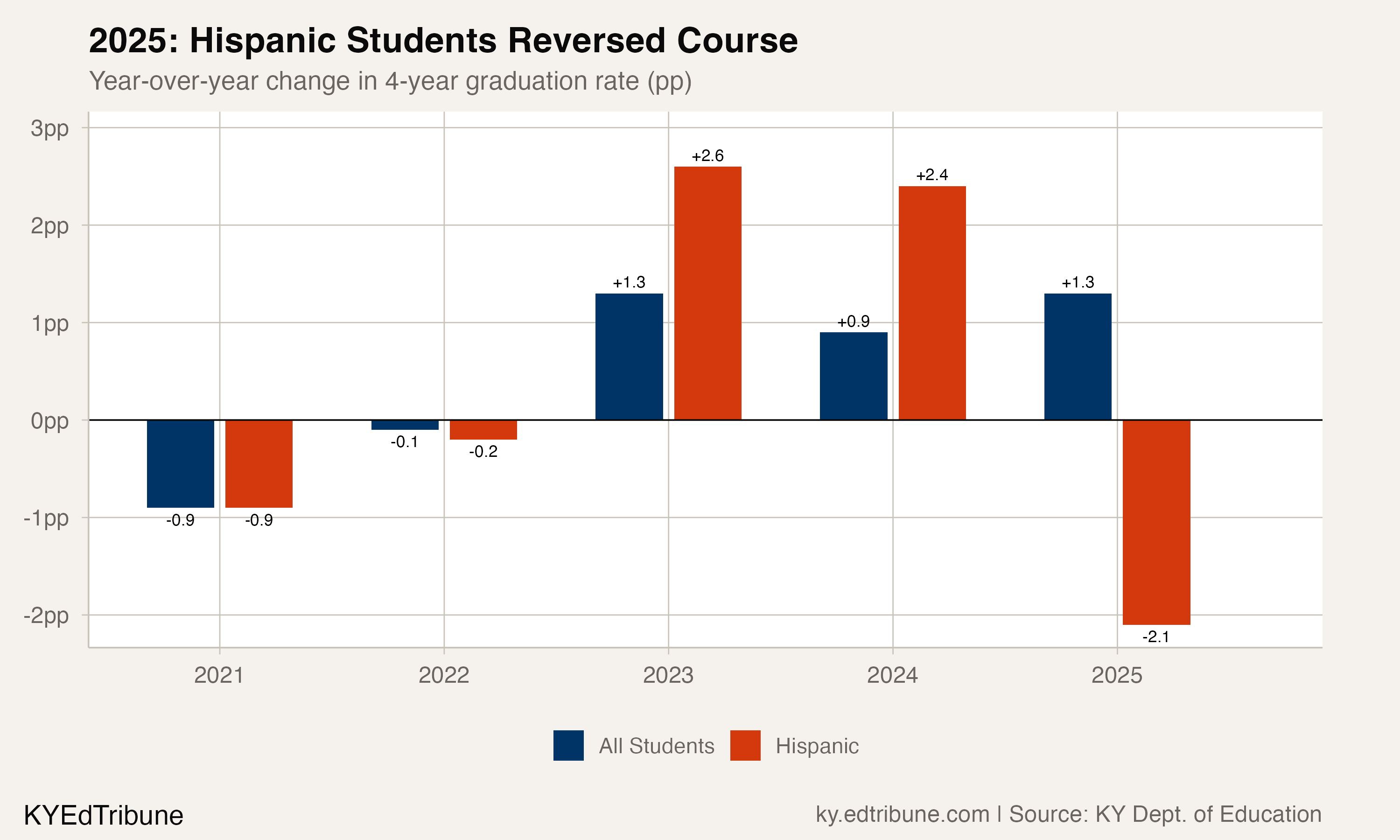
In 2024, Kentucky's Hispanic four-year graduation rate hit 88.3%, the highest on record and the product of a two-year climb that outpaced every other racial subgroup. One year later, it fell to 86.2%. A 2.1-point reversal that erased nearly half the progress, landed in a year when every other racial group in the state improved, and widened the white-Hispanic graduation gap to its largest point in the six years of available data.
The rest of Kentucky's graduation story in 2025 is unambiguously good. The statewide rate reached 93.6%. Black students gained 2.3 points. White students gained 1.7. Multiracial students gained 2.7. Hispanic students went the other direction, alone.
Two years up, one year down
The trajectory matters more than the endpoint. From 2020 to 2022, the Hispanic graduation rate drifted downward, slipping from 84.4% to 83.3%. Then it surged: 2.6 points in 2023, another 2.4 in 2024. That 5-point gain over two years was the fastest improvement of any racial subgroup in the state, more than double the statewide gain over the same period.
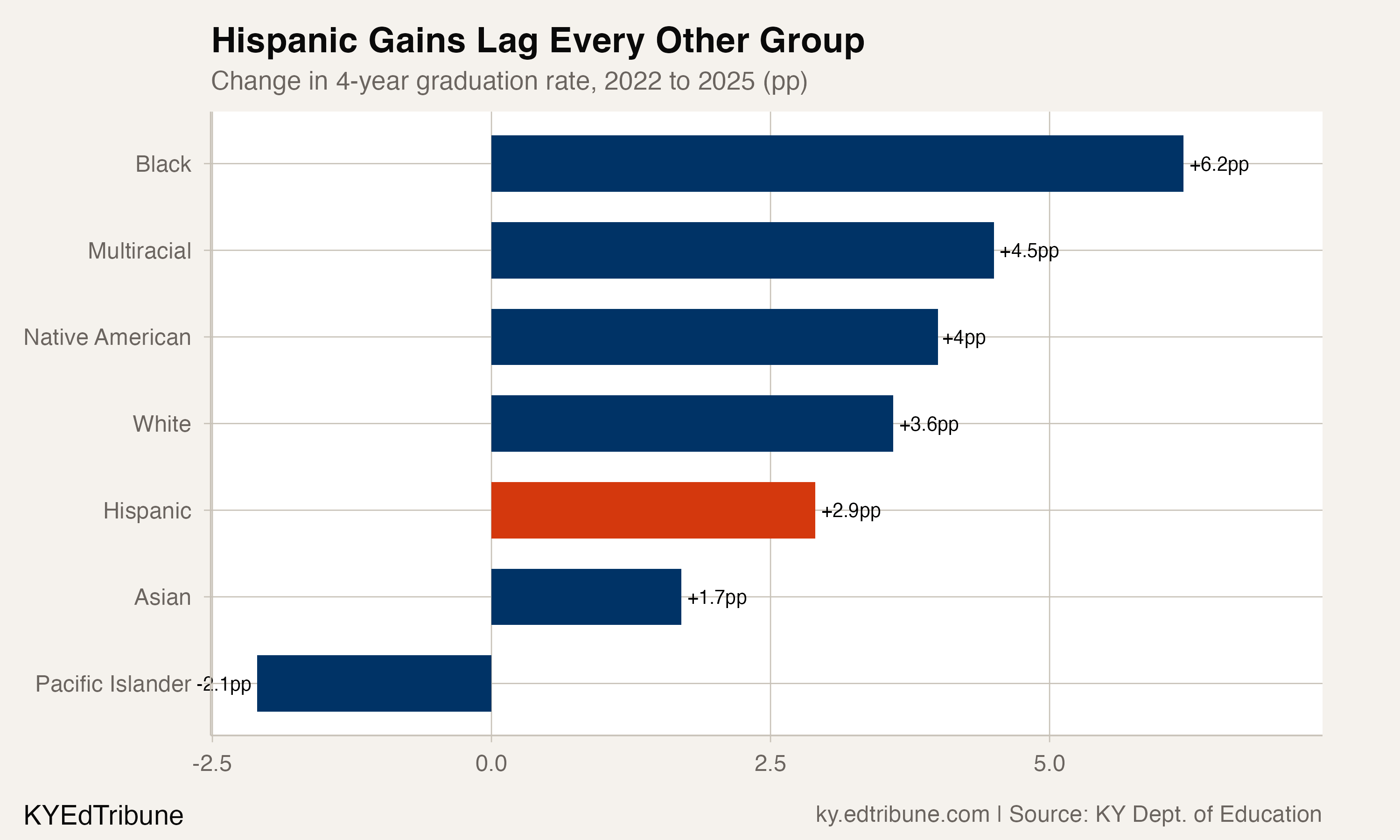
Then 2025 hit. The 2.1-point drop left the Hispanic rate at 86.2%, still 2.9 points above its 2022 low but 2.1 points below where it stood a year earlier. The net five-year gain is 1.8 points. Among racial subgroups with data in both years, only Asian students gained less (1.7 points), and they started at 94.3% with less room to climb.
For context, Black students gained 7.8 points over the same five years. Multiracial students gained 4.9. White students gained 2.2. The Hispanic trajectory is the only one that went backward after making progress.
Where Covington tells one story and Louisville tells another
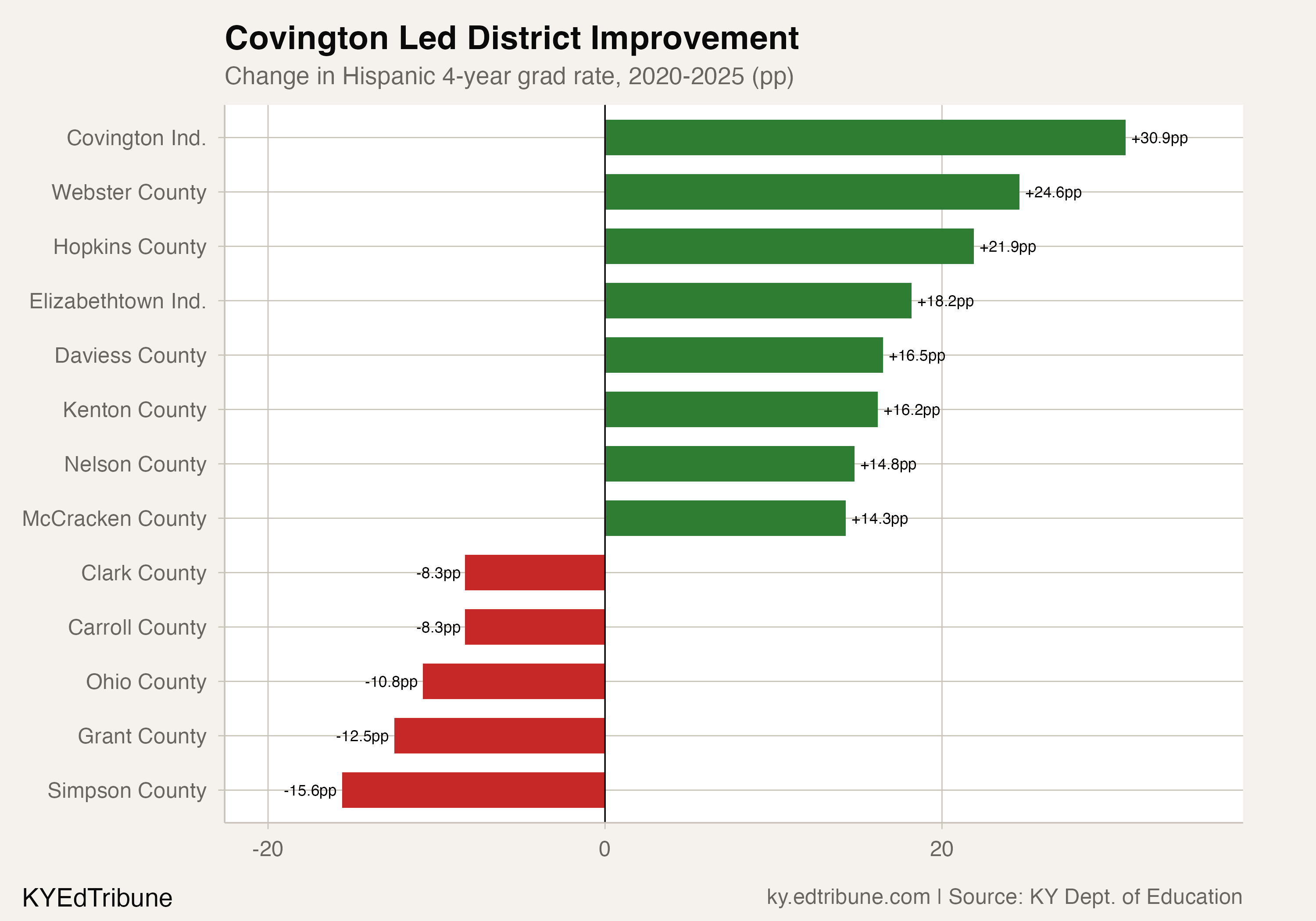
In Covington, the Hispanic four-year graduation rate was 55.0% in 2020. By 2025, it reached 85.9%, a 30.9-point gain that represents the largest Hispanic improvement of any district in the state. Holmes High School, which three years ago carried a state-assigned low rating of 35.2 that triggered targeted assistance for its Hispanic and special education populations, has climbed from a "red" to a "yellow" accountability rating over three consecutive years. The district's student body is roughly 29% Hispanic.
Jefferson County, which enrolls the largest Hispanic cohort in the state, tells a different story. Its Hispanic graduation rate dropped from 81.1% in 2024 to 77.6% in 2025, a 3.5-point decline. Over five years, it has barely moved: 77.1% in 2020 to 77.6% in 2025, a gain of half a point while the state improved by 1.8.
Fayette County, the second-largest cohort, mirrored the statewide reversal. Its Hispanic rate jumped from 83.2% to 91.3% between 2022 and 2024, then fell back to 84.9% in 2025, a 6.4-point single-year drop. Bowling Green Independent, home to one of Kentucky's largest refugee resettlement communities, saw a steeper fall: from 96.6% to 84.9%, an 11.7-point decline that erased years of steady gains.
The English learner signal
The most likely explanation for the 2025 reversal connects to English learner classification. The statewide EL graduation rate dropped 3.4 points in 2025, from 82.4% to 79.0%, the only other subgroup besides Hispanic to decline. Hispanic students account for a large share of Kentucky's English learner population, and the simultaneous drop in both groups strongly suggests a common factor.
Research from the Migration Policy Institute has documented how the four-year adjusted cohort graduation rate creates particular challenges for English learners, especially recently arrived students who may need additional time to develop English proficiency while completing coursework. Some students who arrive as older teenagers need a fifth or sixth year to finish. Under the standard four-year cohort calculation, they count as non-graduates even if they are still enrolled and progressing.
Kentucky's five-year Hispanic graduation rate tells a more encouraging story. It rose from 86.1% in 2020 to 90.6% in 2025, a gain of 4.5 points, and unlike the four-year rate, it did not reverse in 2025. This gap, 4.4 points between the four-year and five-year Hispanic rate in 2025, is the widest in the data and suggests that an increasing share of Hispanic students are graduating, just not within the four-year window.
Immigration drove more than 80% of Kentucky's population growth in 2024, with the state gaining a net 31,430 residents from other countries that year alone. Census estimates put the five-year total at 81,800 international residents added between 2020 and 2025. An influx of newly arrived students entering high school with limited English proficiency and interrupted formal education would depress the four-year rate without representing any failure in the schools serving them. Bowling Green Independent, where a Teranga Academy program designed for students new to the country offers three levels of literacy and language support, saw one of the steepest Hispanic declines despite being a national model for refugee education.
The gap that widened
The white-Hispanic graduation gap had been closing. From 8.4 points in 2020, it narrowed to 5.0 points in 2024. Then it snapped back to 8.8 points in 2025, wider than at any point in the six years of available data, because white students improved 1.7 points in the same year Hispanic students fell 2.1.
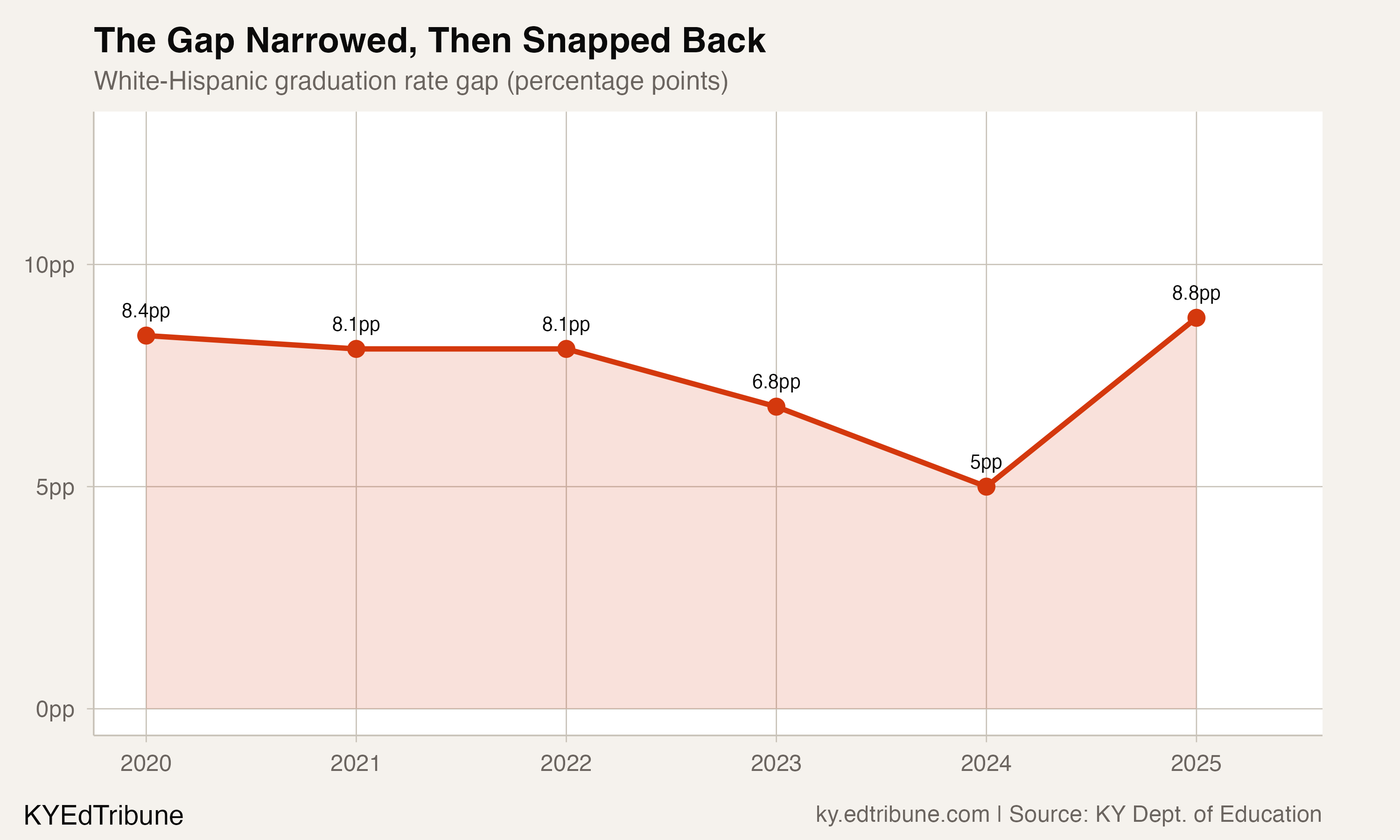
The reversal stands out because it happened against a backdrop of broad-based progress. Black students, who started at 83.3% in 2020, one point below Hispanic students, are now at 91.1%, 4.9 points ahead. Economically disadvantaged students sit at 92.7%, just 0.9 points below the state average. From 2022 to 2025, Black, multiracial, Native American, and white students all gained more than Hispanic students' 2.9 points. Only Asian students (1.7 points) and Pacific Islanders (-2.1 points) gained less.
The question this data cannot answer is whether the 2025 decline reflects a temporary cohort effect, driven by the composition of the Class of 2025, or a structural shift as Kentucky's Hispanic student population grows and includes more recently arrived families. If the five-year rate is the better measure of these students' actual outcomes, then the schools are doing their job. If the four-year rate is what drives accountability pressure, some schools may be penalized for serving the students who need the most time.
Detailed code that reproduces the analysis and figures in this article is available exclusively to EdTribune subscribers.
Discussion
Sign in to join the discussion.
Loading comments...