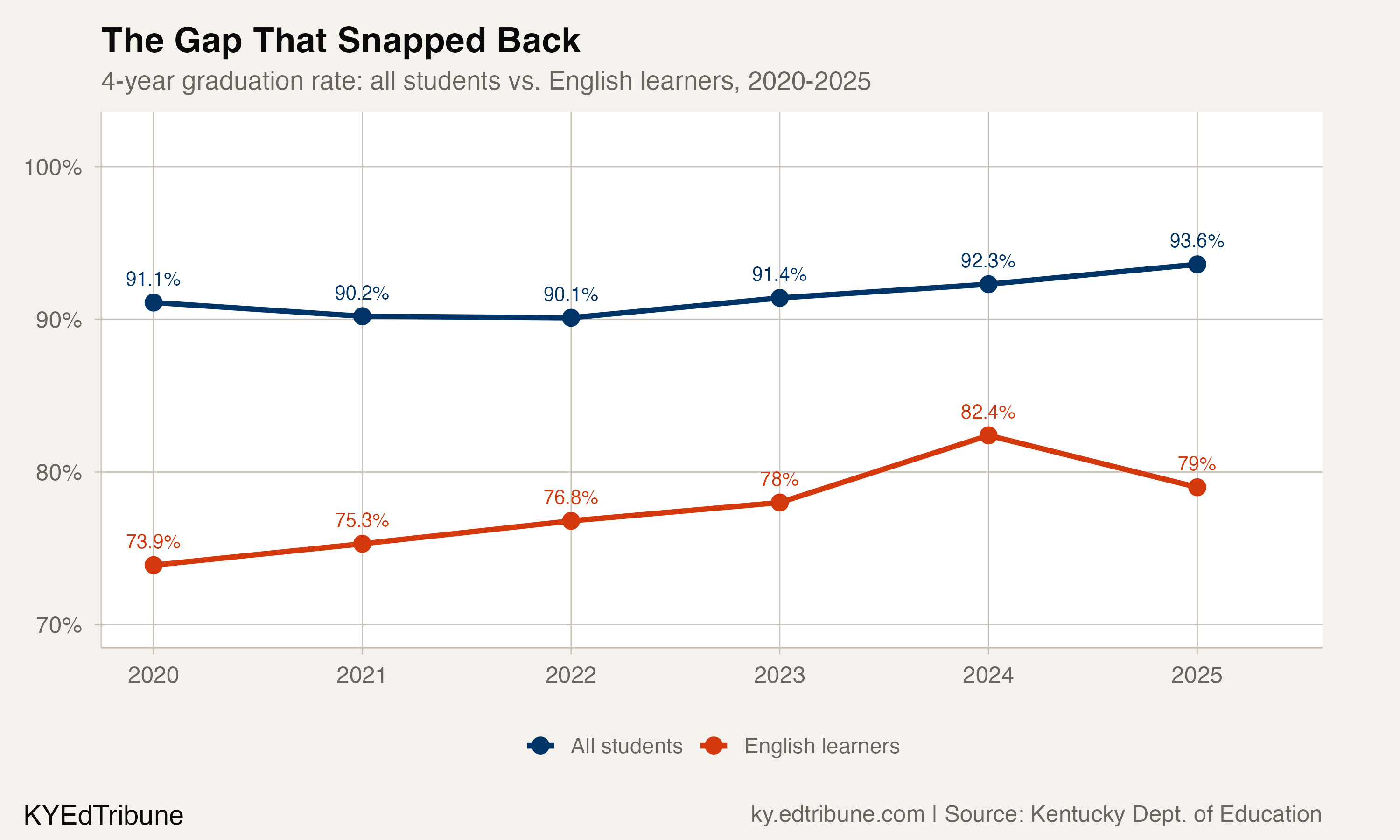
In 2024, Kentucky's English learners graduated at 82.4%, the highest four-year rate on record for the group. The gap with all students had shrunk to under 10 percentage points for the first time, and the trajectory looked like a success story four years in the making.
Then the 2025 numbers arrived. The English learner rate dropped to 79.0%. The statewide rate climbed to 93.6%. The gap widened to 14.6 percentage points, making it the largest equity gap in Kentucky's graduation data, wider than the gaps for students in foster care (11.1 points), students with disabilities (10.5 points), or any racial or ethnic subgroup.
A reversal concentrated in Kentucky's largest districts
The 2025 setback was not spread evenly. Jefferson County Public Schools, the state's largest district, saw its English learner graduation rate fall from 79.1% to 73.8%, a 5.3 percentage-point drop that returned the district to its 2021 level. Fayette County, the second largest, dropped from 86.9% to 78.7%, an 8.2-point decline.
Across the 23 districts with comparable data in both years, 13 saw their English learner rate fall. The declines were steepest in mid-sized suburban districts: Scott County fell 19.4 points (from 100% to 80.6%), Bowling Green Independent fell 15.7 points, and Oldham County fell 15.7 points.
The pattern suggests that small cohort sizes drive some of the volatility. When a district's English learner graduating class numbers in the dozens rather than the hundreds, a handful of students who do not finish can swing the rate by double digits. But at Jefferson County, where the English learner cohort is the state's largest, the decline was not a rounding error. The 14.9-point gap between JCPS's overall rate (88.7%) and its English learner rate (73.8%) mirrors the statewide pattern almost exactly.
What the gap looks like across subgroups
English learners occupy a singular position in Kentucky's graduation data. No other subgroup comes close to the 14.6-point gap.
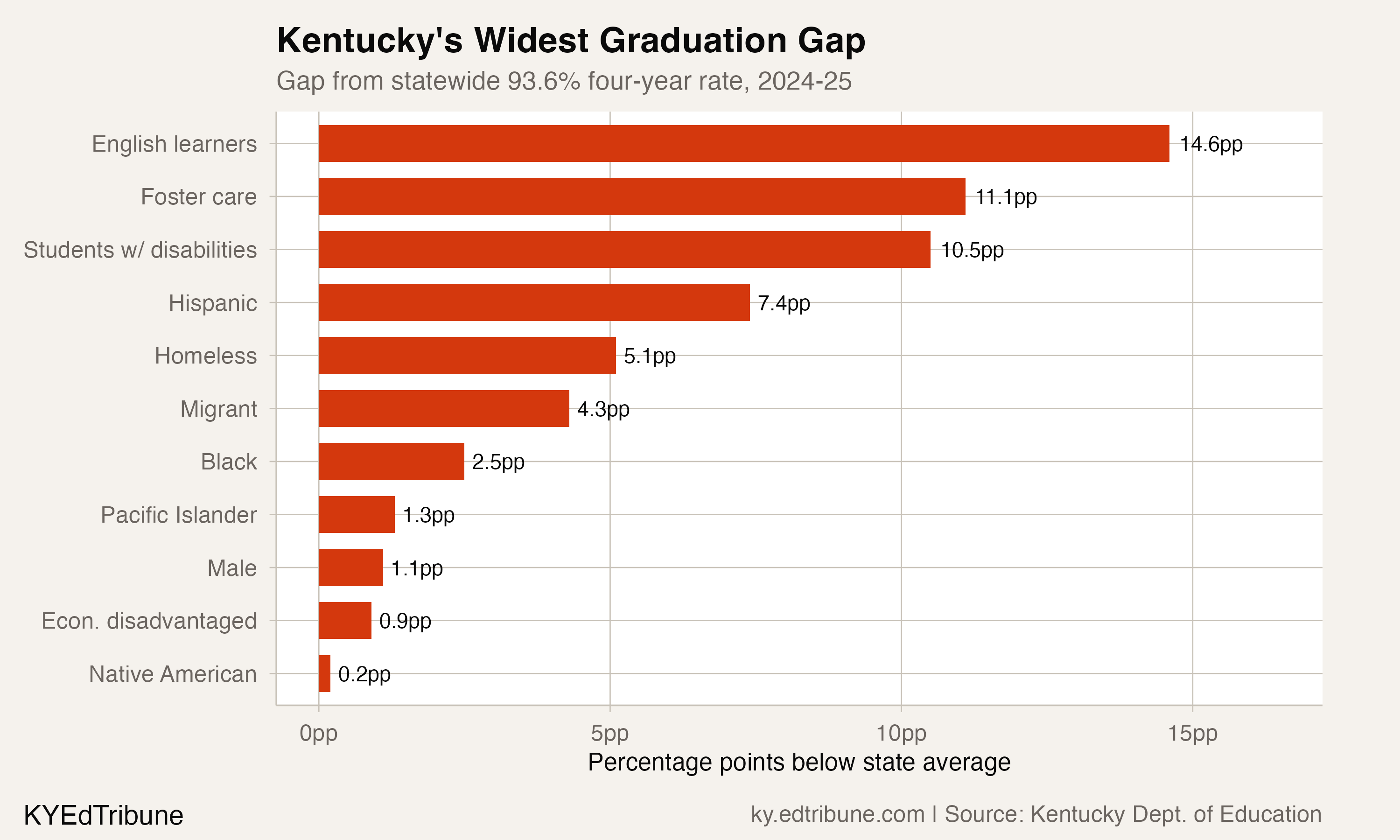
Foster care students, at 82.5%, sit 11.1 points below the state average. Students with disabilities graduate at 83.1%, a 10.5-point gap. Hispanic students, a group that overlaps substantially with the English learner population, graduate at 86.2%, a 7.4-point gap. The difference matters: Hispanic students who are proficient in English graduate at rates much closer to the state average than those still classified as English learners, suggesting that language proficiency itself, not ethnicity, is the primary barrier.
The five-year rate tells a different story
Kentucky tracks both four-year and five-year cohort graduation rates for English learners. The five-year rate measures students who take an additional year to finish, and the gap between the two rates reveals how much extra time changes outcomes.
In 2025, the English learner five-year rate reached 85.7%, a 6.7 percentage-point boost over the four-year rate. That boost is the largest in the six-year data window and nearly triple the 2.3-point boost from 2023.
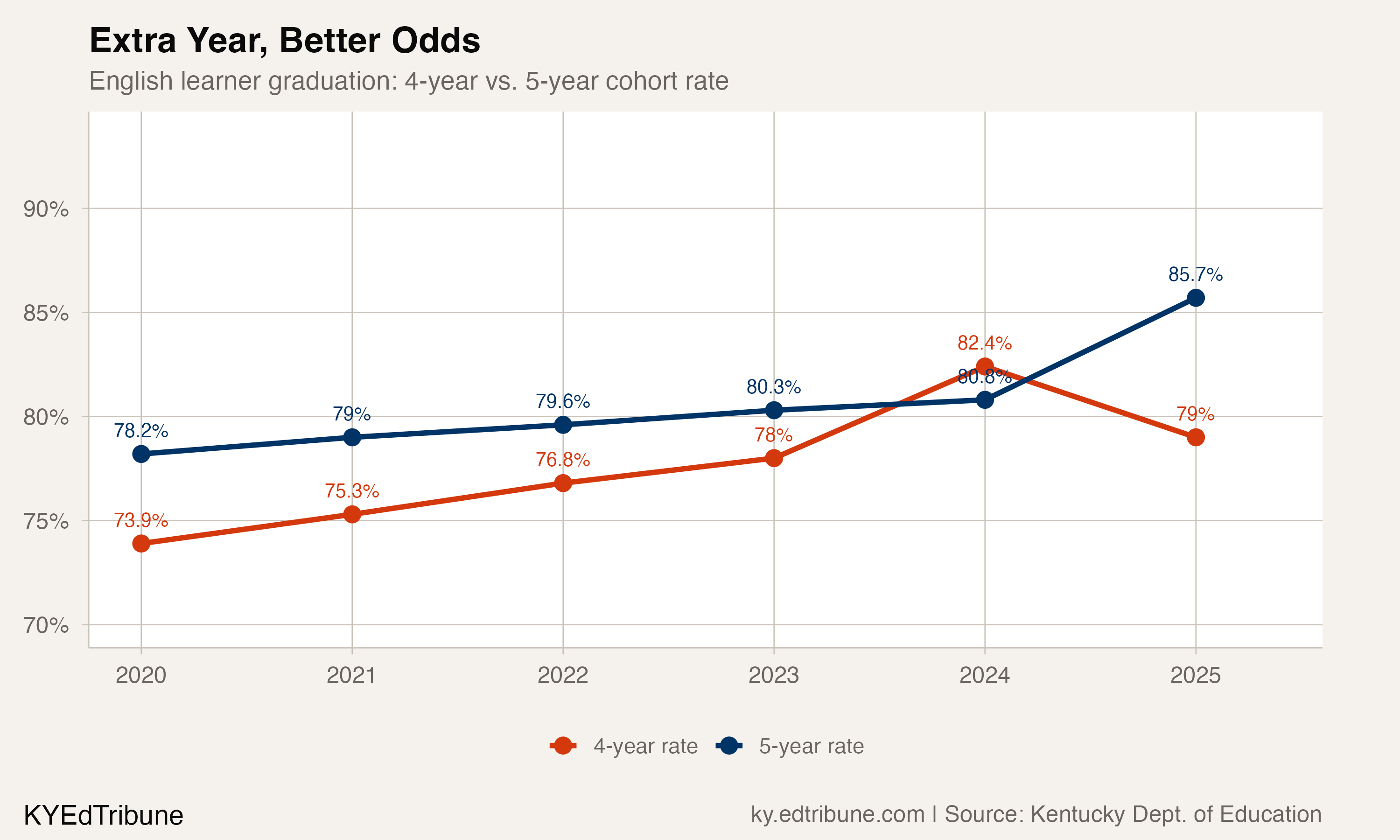
The implication is straightforward: a substantial share of English learners who do not graduate in four years are not dropping out. They are finishing in year five. The five-year rate suggests that many are academically capable but need more time to complete requirements, particularly if they arrived in the United States during high school and began with limited English.
What might explain the reversal
The most plausible explanation involves cohort composition. English learners are not a static population. Each year's graduating class includes students who entered the school system at different ages, with different levels of prior education and English proficiency. A cohort with more recently arrived students, those who enrolled in high school with little or no English, will produce a lower graduation rate than a cohort dominated by students who entered elementary school as English learners and had years of instruction.
Kentucky's foreign-born population has been growing. According to Census Bureau estimates, about 238,000 immigrants lived in the state in 2024, representing 5.2% of the population, up from 3.7% in 2014. More than 80% of Kentucky's population growth in 2024 was attributable to international migration. The Lexington metro area has the state's highest foreign-born share at 8.2%.
A second factor is the staffing pipeline. Kentucky lists English learner instruction among its critical teacher shortage areas, and only 30% of principals report having enough qualified applicants for open positions. When districts cannot hire enough qualified ESL instructors, the students most dependent on language support absorb the consequences.
A third possibility is that the 2024 rate was the outlier, not 2025. The 82.4% figure may have reflected an unusually well-prepared cohort rather than a durable improvement, and the 2025 rate represents a reversion to the trend line. Between 2020 and 2023, the English learner rate climbed steadily from 73.9% to 78.0%, an annual gain of roughly 1.4 points. The 2024 spike to 82.4% broke that pattern with a 4.4-point jump in a single year. If 2024 was the anomaly, the current 79.0% rate is roughly where the pre-2024 trendline would have placed it.
Funding pressure at the statehouse
The financial infrastructure supporting these students faced its own disruption during the 2025 legislative session. In March 2025, Kentucky House lawmakers proposed capping state SEEK funding for multilingual learners at four years per student, a change to Senate Bill 6 that passed the House Appropriations and Revenue Committee. The state allocated $18.6 million in SEEK add-ons for multilingual learners in 2024-25. Jefferson County estimated the cap would cost the district roughly $2.2 million.
The tension is plain: research cited in the legislative debate shows most multilingual learners need four to seven years to reach English proficiency. A four-year funding cap would cut support precisely when students enter the period most critical for graduation.
"Students might take more than four years, so we wouldn't be able to have extra support for that." -- Rep. Tina Bojanowski, Louisville, March 2025
Where the gap is widest on the ground
The 29 districts reporting English learner graduation data in 2025 reveal enormous local variation. Danville Independent, a district of roughly 1,700 students in central Kentucky, posted a 31-point gap: its overall rate was 94.6% while its English learner rate was 63.6%. Oldham County, a high-performing suburban district northeast of Louisville, had a nearly identical 30.9-point gap (96.5% vs. 65.6%).
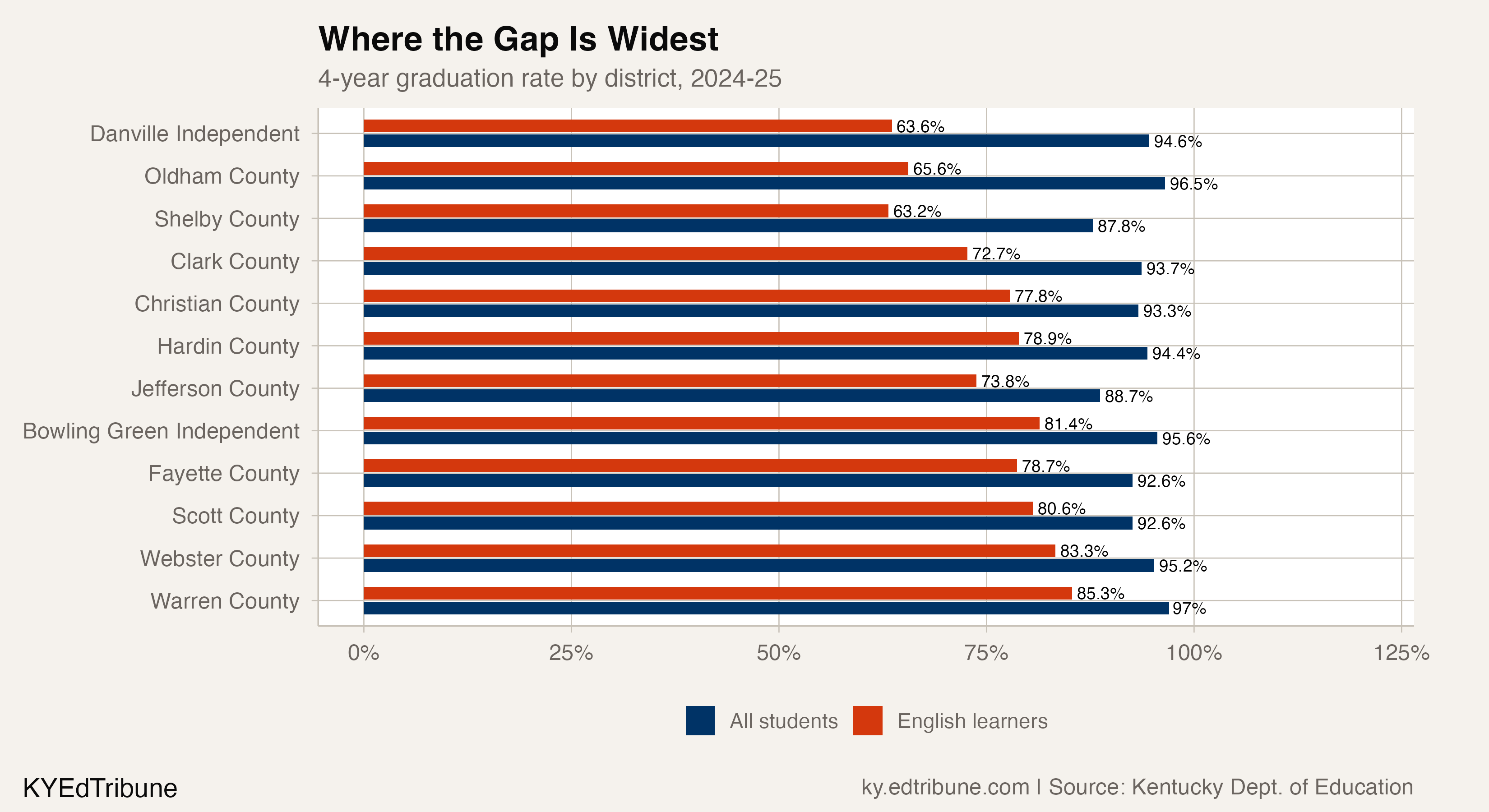
At the other end, a handful of smaller districts have effectively closed the gap. Jessamine County's English learner rate (97.0%) nearly matches its overall rate (97.4%). Boone County, which borders Cincinnati and has a growing immigrant population including Congolese, Somali, and Chin communities, posted a 93.4% English learner rate against a 96.1% overall rate, a gap of just 2.7 points. What separates Boone County's outcomes from Danville's is not obvious from the graduation data alone, but the question is worth asking: is the difference about program design, cohort composition, community support structures, or some combination?
What to watch
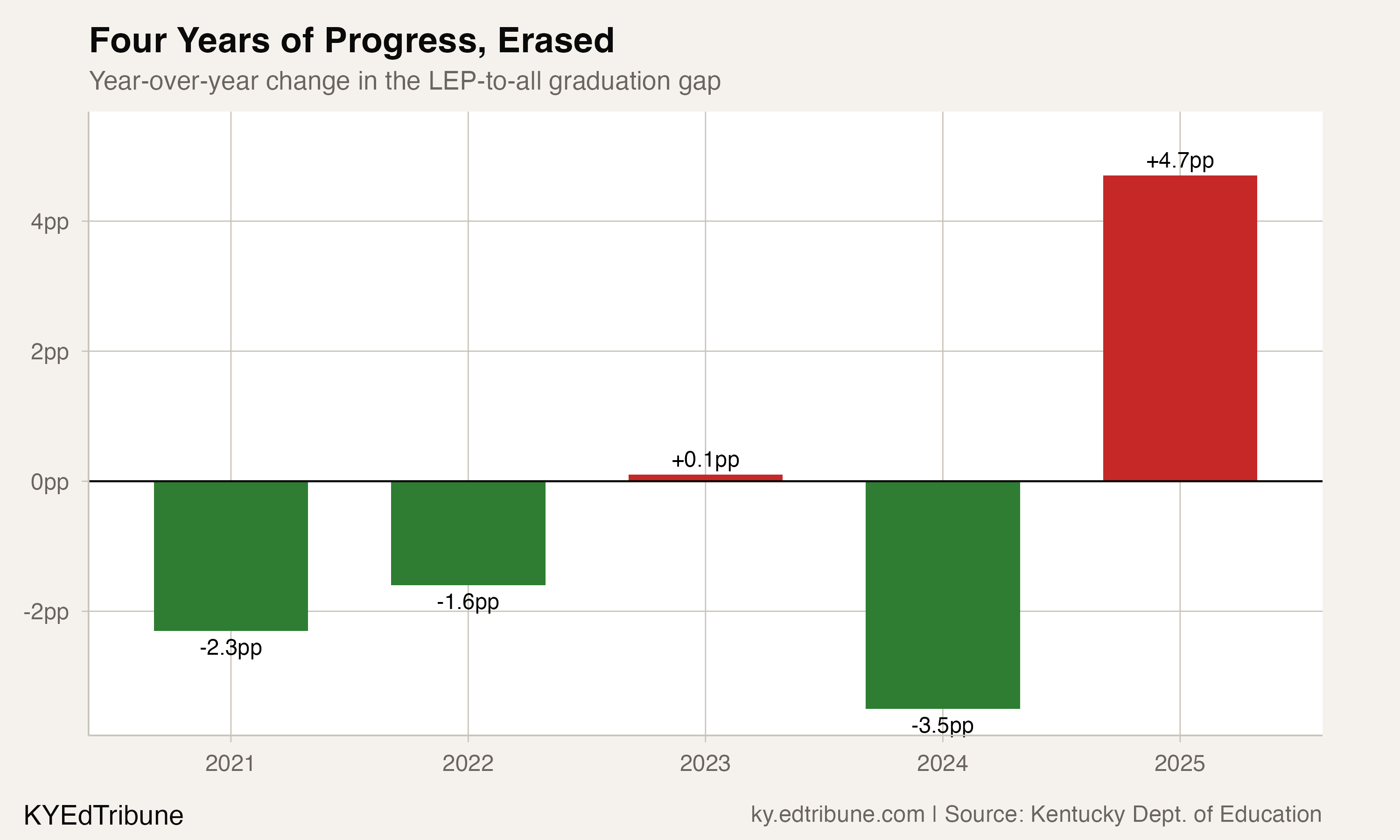
The 2025 data raise a question that will take several more years of results to answer: was 2024 a genuine inflection point that got disrupted, or a statistical blip in a gap that remains stubbornly wide? The gap narrowed from 17.2 points in 2020 to 13.3 points by 2022, a real if modest improvement. It then leapt to 9.9 points in 2024 before snapping back to 14.6 points. The trajectory is unstable, and single-year comparisons in a population this small can mislead.
The five-year cohort data, however, points to something more concrete. A 6.7-point boost from extra time suggests that the barrier for many English learners is not ability but pace. Whether Kentucky's funding formula will continue to support that extra time, or whether legislative caps will force districts to withdraw services before students are ready, is a policy decision that the 2026 graduation numbers will begin to reflect.
Detailed code that reproduces the analysis and figures in this article is available exclusively to EdTribune subscribers.
Discussion
Sign in to join the discussion.
Loading comments...