In Franklin County, Black students have a 16.0% chronic absenteeism rate. White students have 21.1%. In Jefferson County, those numbers are 38.8% and 28.4%. Same state, same school year, opposite stories.
Kentucky's statewide racial attendance gap widened from 5.5 percentage points in 2022-23 to 6.6 points in 2024-25, even as both Black and white students improved. The gap peaked at 7.1 points in 2023-24 before narrowing slightly. The math is straightforward: white students improved by 5.1 points over two years, Black students by 4.1. Both groups got better. White students got better faster.
How improvement produces inequality
This is a pattern that appears across states recovering from the pandemic attendance crisis. The students with the lowest barriers to returning -- those whose chronic absenteeism was more habit than hardship -- recover first. Those barriers tend to correlate with race, income, and housing stability. The result is a period where overall numbers improve while gaps widen, because the easiest problems get solved first.
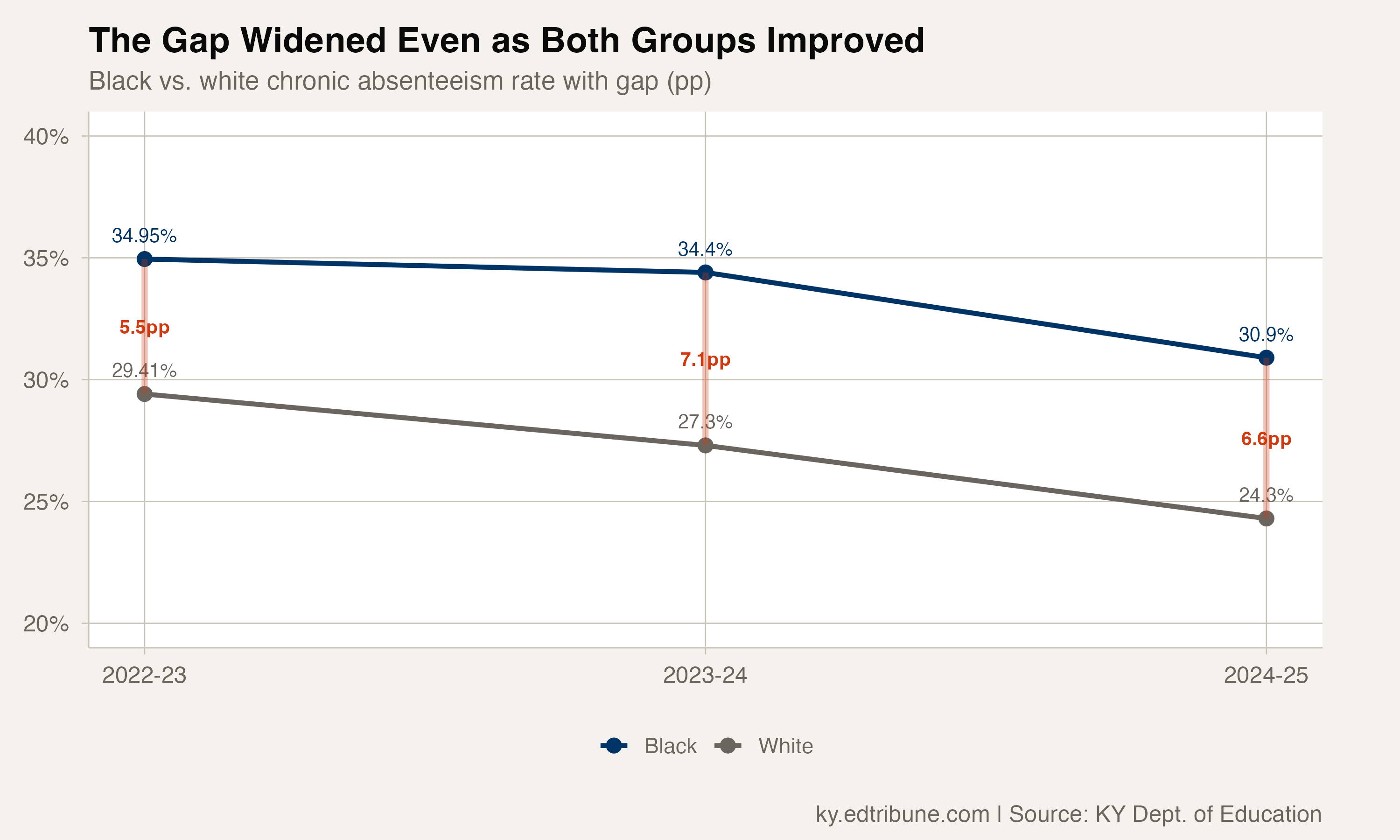
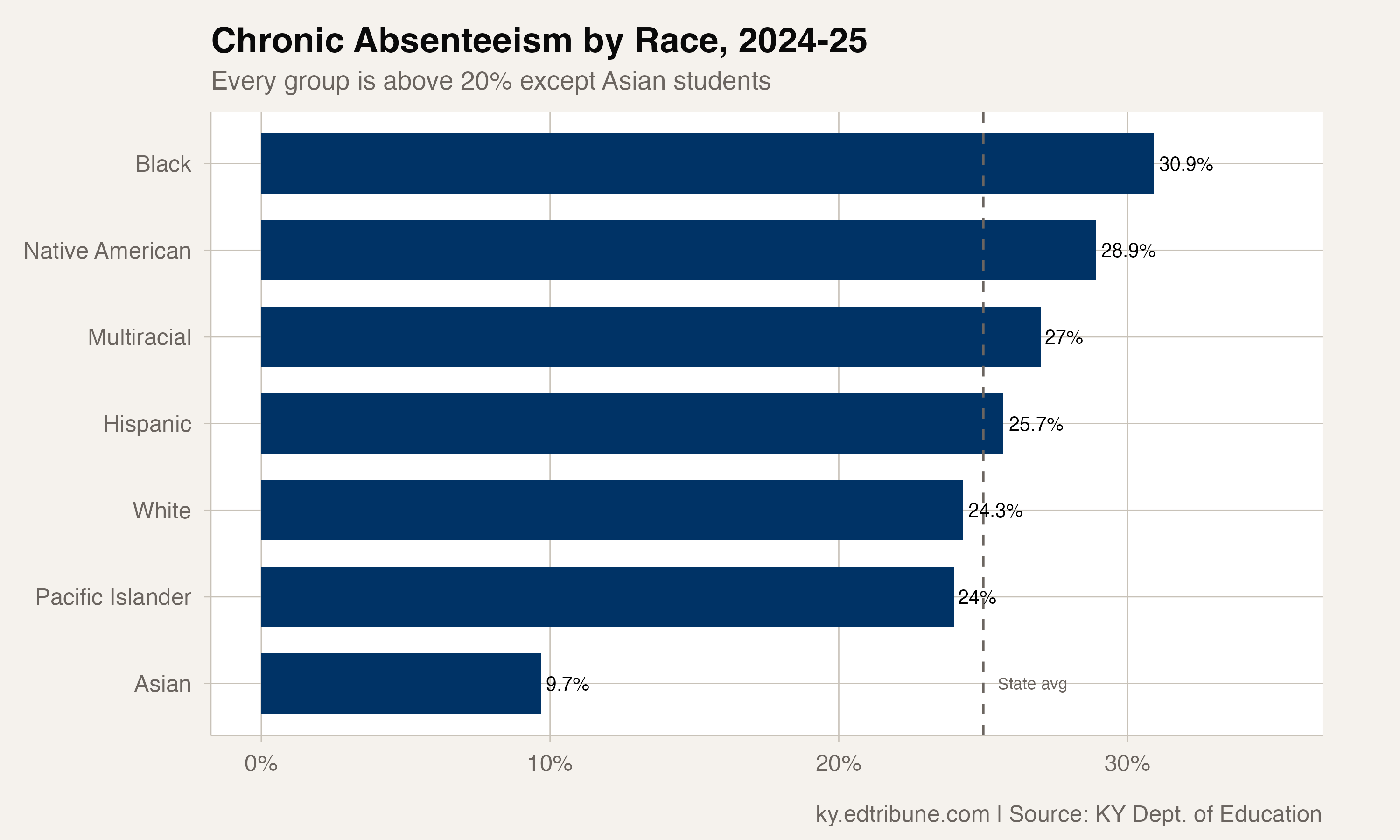
At 30.9%, nearly one in three Black students in Kentucky is chronically absent. At 24.3%, roughly one in four white students is. The absolute difference -- 6.6 points -- understates the experiential gap. In a classroom of 25 Black students, statistically 8 are chronically absent. In a classroom of 25 white students, 6 are. The gap is real but the baseline is the larger story: both rates remain far above pre-pandemic levels.
Where the gap reverses
The statewide picture, however, does not hold everywhere. In seven Kentucky districts with at least 5,000 students, Black students have lower chronic absenteeism rates than white students -- a reversal of the national norm.
Franklin County shows the widest reversal: Black students at 16.0% versus white students at 21.1%, a 5.1-point gap in favor of Black attendance. Bullitt County (-3.6pp), Warren County (-2.9pp), and Christian County (-2.8pp) also show meaningful reversals. Boone County, with 20,717 students, shows a narrow reversal of 0.5 points.
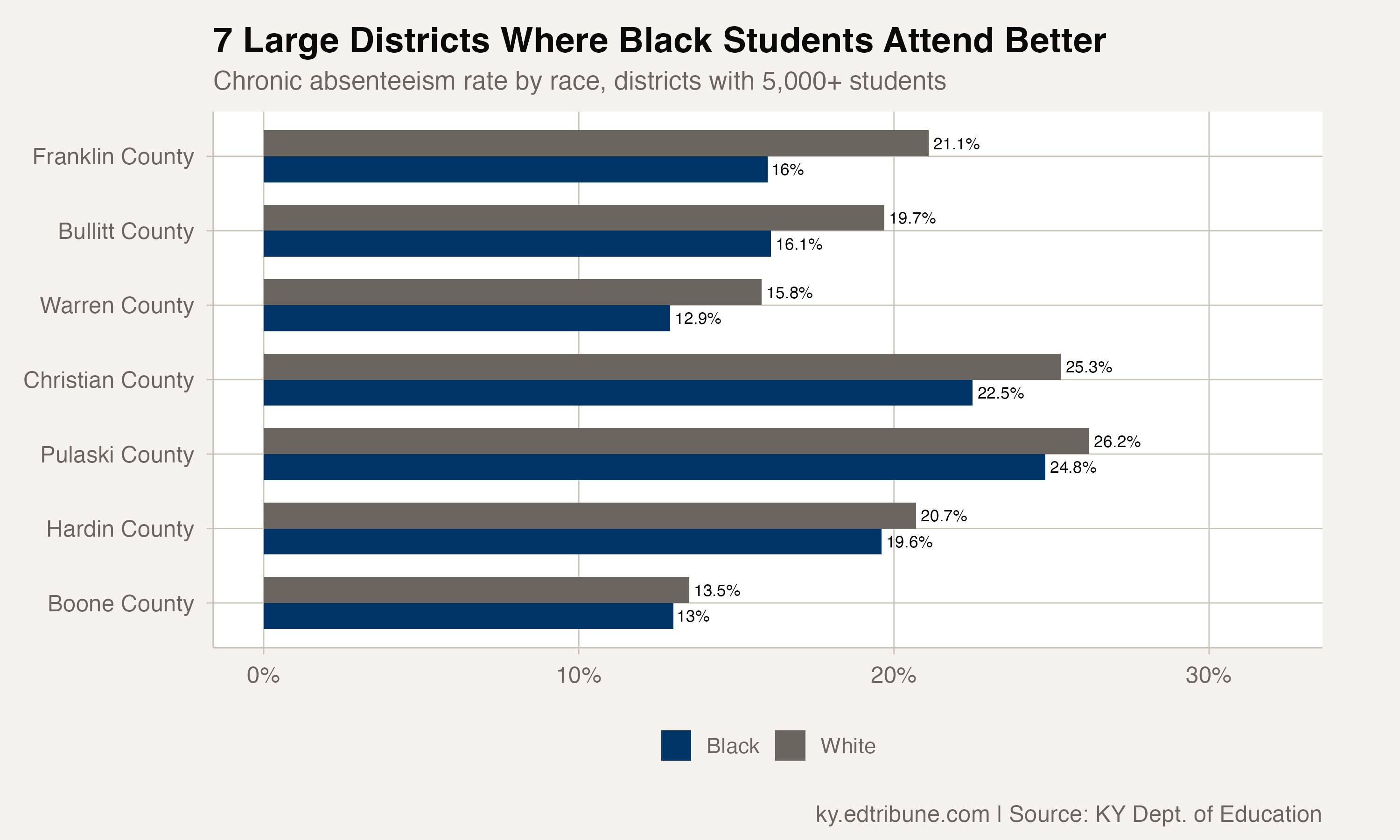
These reversals raise important questions. Are they driven by the demographics of the Black population in those districts -- military families at Fort Campbell (Christian County), college communities (Franklin County), or suburban transplants (Boone County)? Or do they reflect something about how those districts operate? The data identifies the pattern but cannot explain it. What it does establish is that the relationship between race and attendance is not deterministic. The same state produces both the widest gaps and the most dramatic reversals.
Louisville's role in the statewide gap
Jefferson County Public Schools accounts for nearly half of Kentucky's Black student enrollment and has the widest Black-white gap of any large district: 10.4 percentage points. JCPS is large enough that its gap materially affects the statewide number. If JCPS had the same 6.6-point gap as the state average instead of 10.4, the statewide gap would be narrower.
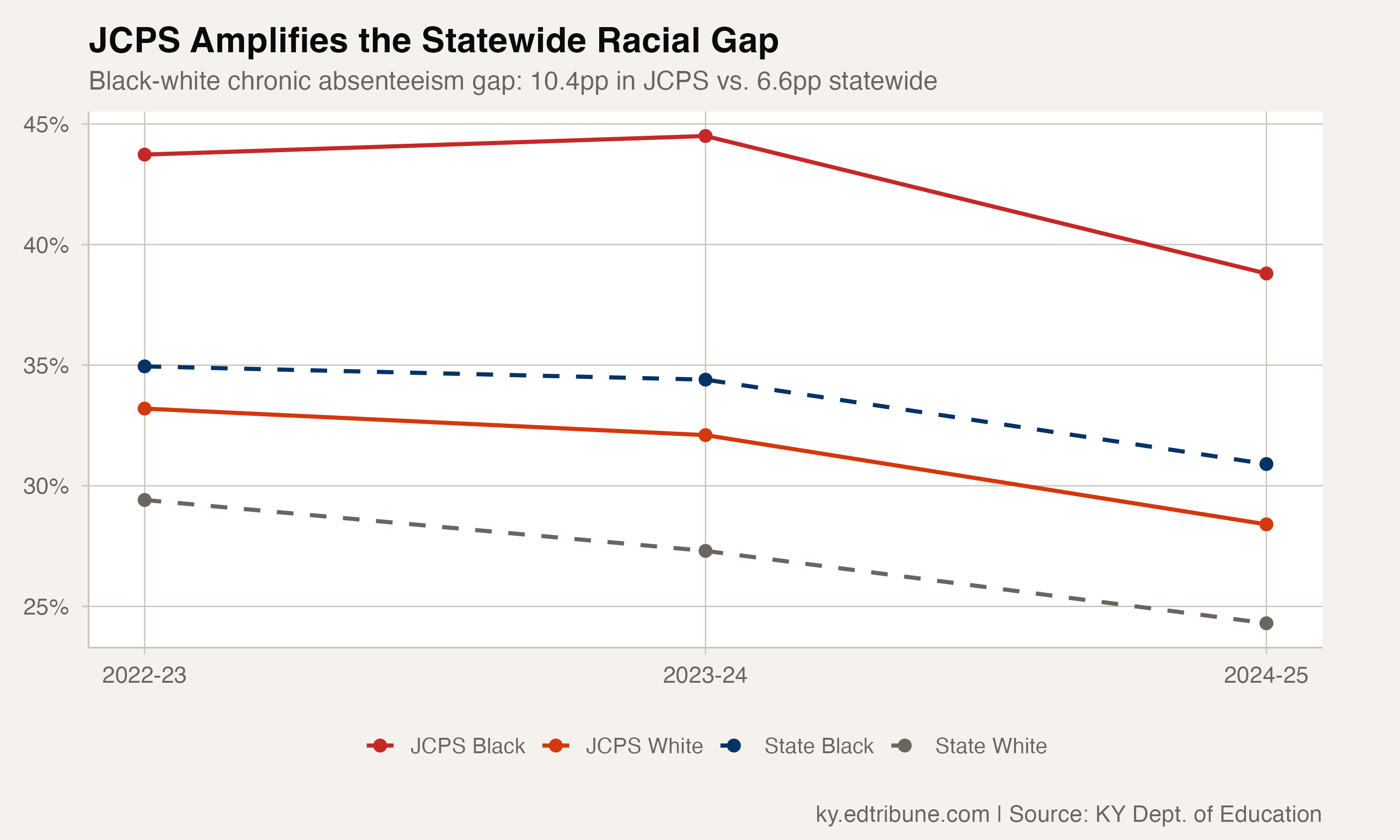
The concentration matters. In JCPS, 35,284 Black students have a 38.8% chronic rate -- roughly 13,700 chronically absent Black students in a single district. That is not a statistical artifact or a marginal difference. It represents a systematic divergence in the school experience of Black and white students within the same system.
"When we see racial gaps in attendance, we're often seeing racial gaps in access -- to stable housing, to transportation, to healthcare, to the conditions that make regular attendance possible." -- Kentucky Center for Education Equity, 2025
Two maps of the same state
The gap widened from 5.5 to 7.1 points, then narrowed to 6.6. That one-year narrowing could be the start of convergence or noise. What is not noise: Franklin County's Black students at 16.0%, JCPS's at 38.8%, and both numbers coming from the same state data system in the same school year.
Kentucky's attendance levers -- SEEK funding, HB 611 truancy enforcement, the "You Belong" billboards -- are race-neutral in design. Their effects are not. Truancy referrals assume a household stable enough to receive them. ADA-based funding rewards districts that are already retaining students. The seven reversed-gap districts share a common feature: the Black families in those communities tend to have the steady employment, housing, and institutional connections that attendance policies implicitly assume. In Louisville, 35,284 Black students live in a city where those conditions are the exception rather than the rule.
Detailed code that reproduces the analysis and figures in this article is available exclusively to EdTribune subscribers.
Discussion
Sign in to join the discussion.
Loading comments...