Correction (September 30, 2026): An earlier version of this article said Hazard and Perry County had no gap in chronic absenteeism in 2022-23. Hazard's rate was already 14.0 points lower that year (43.2% against 57.2%), and the gap grew to 20.4 points by 2024-25. It also said Hazard improved by more than twice as much as any of its neighbors. Hazard improved more than each of them, but Perry County's rate fell 14.3 points against Hazard's 20.7, so the earlier comparison was wrong. Hazard's improvement is 4.3 times the statewide drop of 4.8 points, not triple. We removed an unverified statement that 14 districts in the region were above 40%, an estimate of the district's classroom count, and several contextual figures and a state law reference that were not sourced. The article described the decline of 225 chronically absent students as 225 students returning to regular attendance; it is a net drop in the count. The article now also notes that Breathitt County's published rate includes Breathitt Regional School, whose attendance counts the state does not publish. Hazard's ranking as the largest improvement among Kentucky districts with at least 500 students is unchanged. An earlier correction, made July 23, 2026, fixed the 2022-23 count of chronically absent students (448, not 429) and the two-year decline (225, not 205).
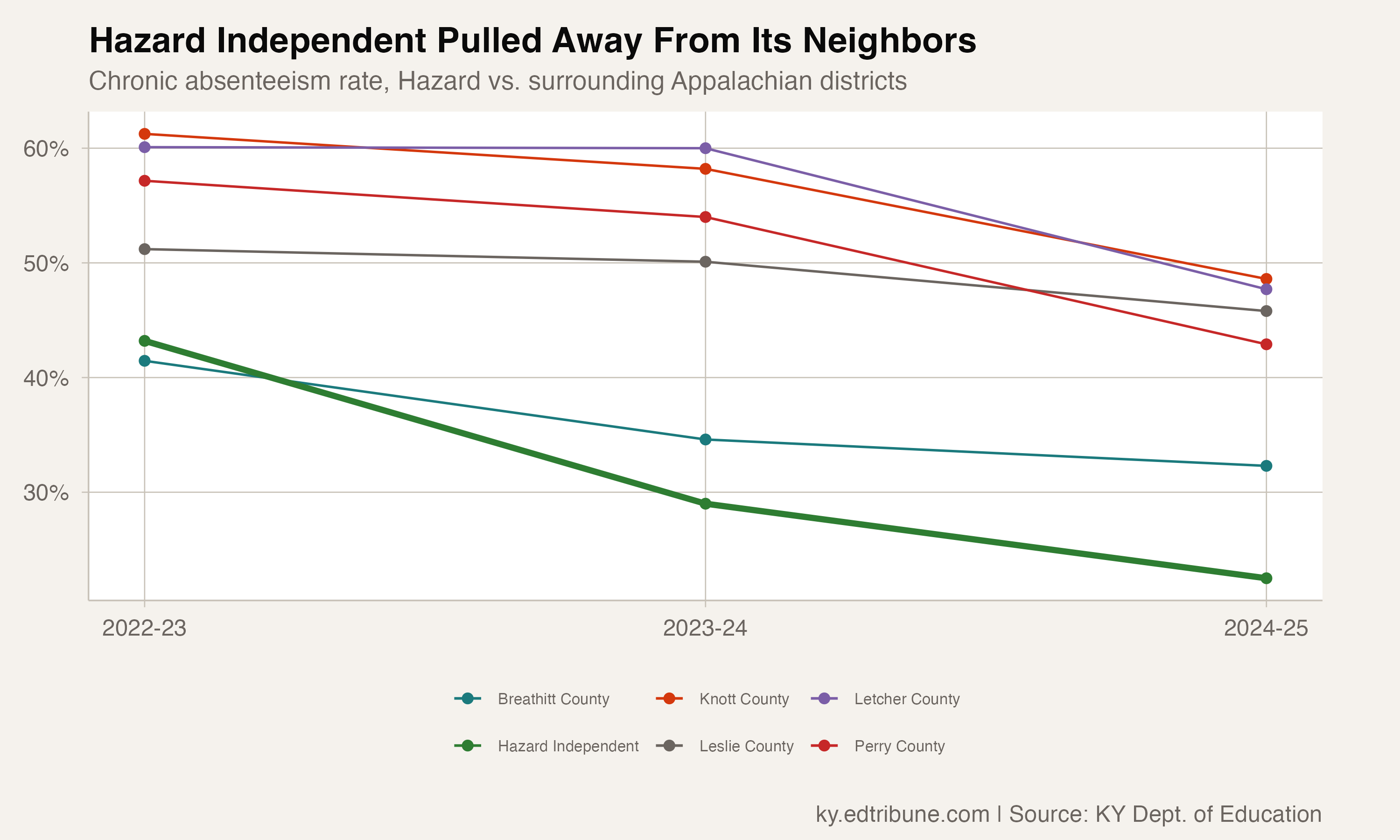
In 2022-23, Hazard Independent had a 43.2% chronic absenteeism rate. Perry County, which surrounds Hazard in eastern Kentucky, had 57.2%. Two years later, in 2024-25, the most recent year in the state's published data, Hazard was at 22.5% and Perry County at 42.9%. Same mountains, same poverty, same opioid crisis. Both districts improved, but Hazard improved faster, and a 14.0-point gap between them widened to 20.4 points.
Hazard's 20.7 percentage point improvement is the largest of any Kentucky district with at least 500 students. The next largest, Martin County's, was 19.0 points. Hazard started 13.4 points above the state average of 29.8% and finished below it. Its four county neighbors, Perry, Knott, Letcher and Leslie, all remained above 40% in 2024-25. Hazard crossed to the other side.
The numbers in context
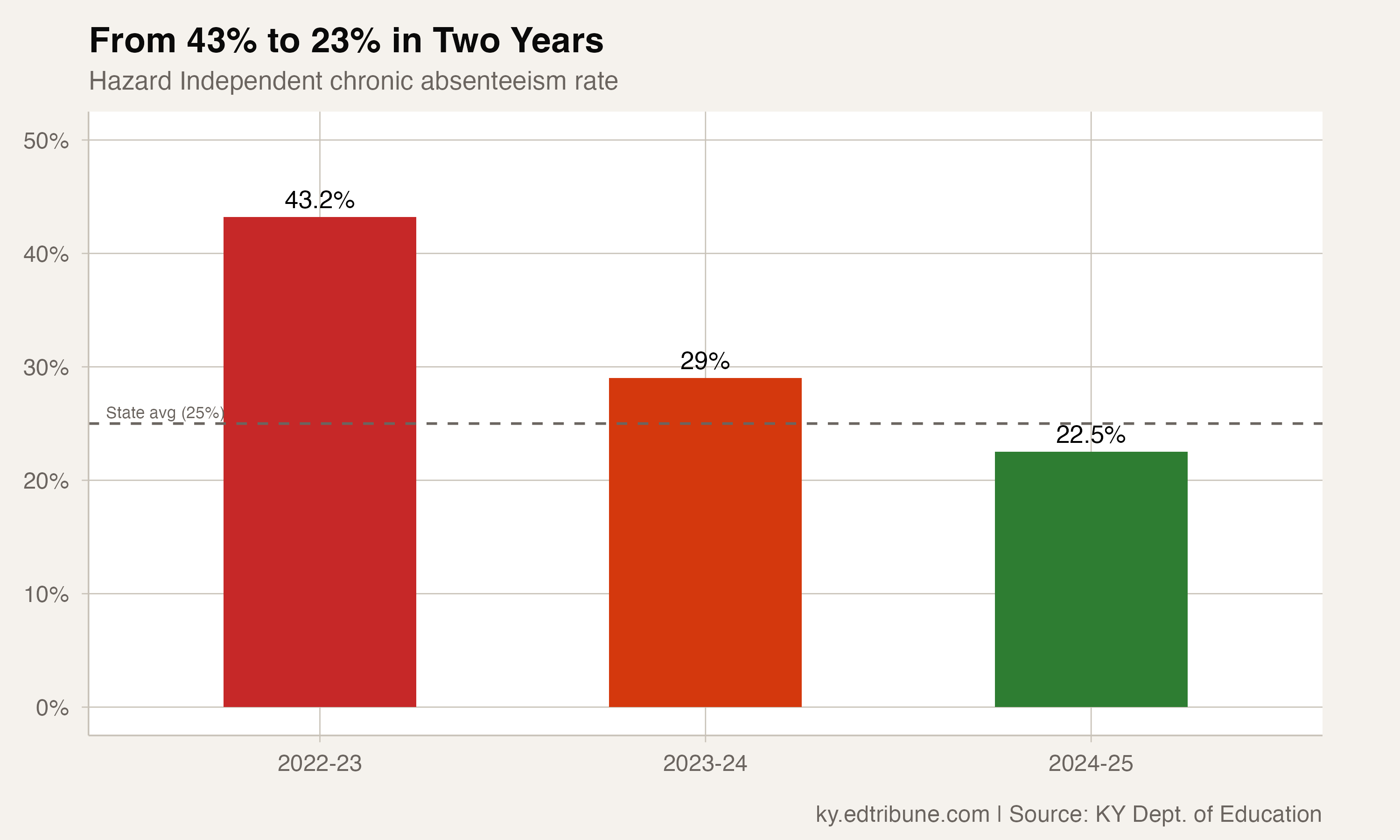
The drop was not gradual. Hazard fell from 43.2% to 29.0% in the first year, then from 29.0% to 22.5% in the second, a 14.2-point drop followed by a 6.5-point drop. Most of the gain came in the first year. By 2024-25 the district was at 22.5%, below the statewide average of 25.0%.
For a district of 993 students, that rate works out to 223 chronically absent students in 2024-25, compared with 448 of 1,037 students two years earlier. That is 225 fewer chronically absent students, in a district small enough that its staff can know many of those families by name.
The neighborhood that stayed behind
What makes Hazard's story compelling is not just the improvement but the contrast with its neighbors. Perry County, physically surrounding Hazard, was at 42.9% in 2024-25. Knott County, to the northeast, was at 48.6%. Letcher County, to the southeast, was at 47.7%. Leslie County was at 45.8%. Breathitt County, to the northwest, had a published district rate of 32.3%. That district figure includes students at Breathitt Regional School, whose attendance counts the state does not publish; across Breathitt's schools that do publish counts, the rate was 36.7%.
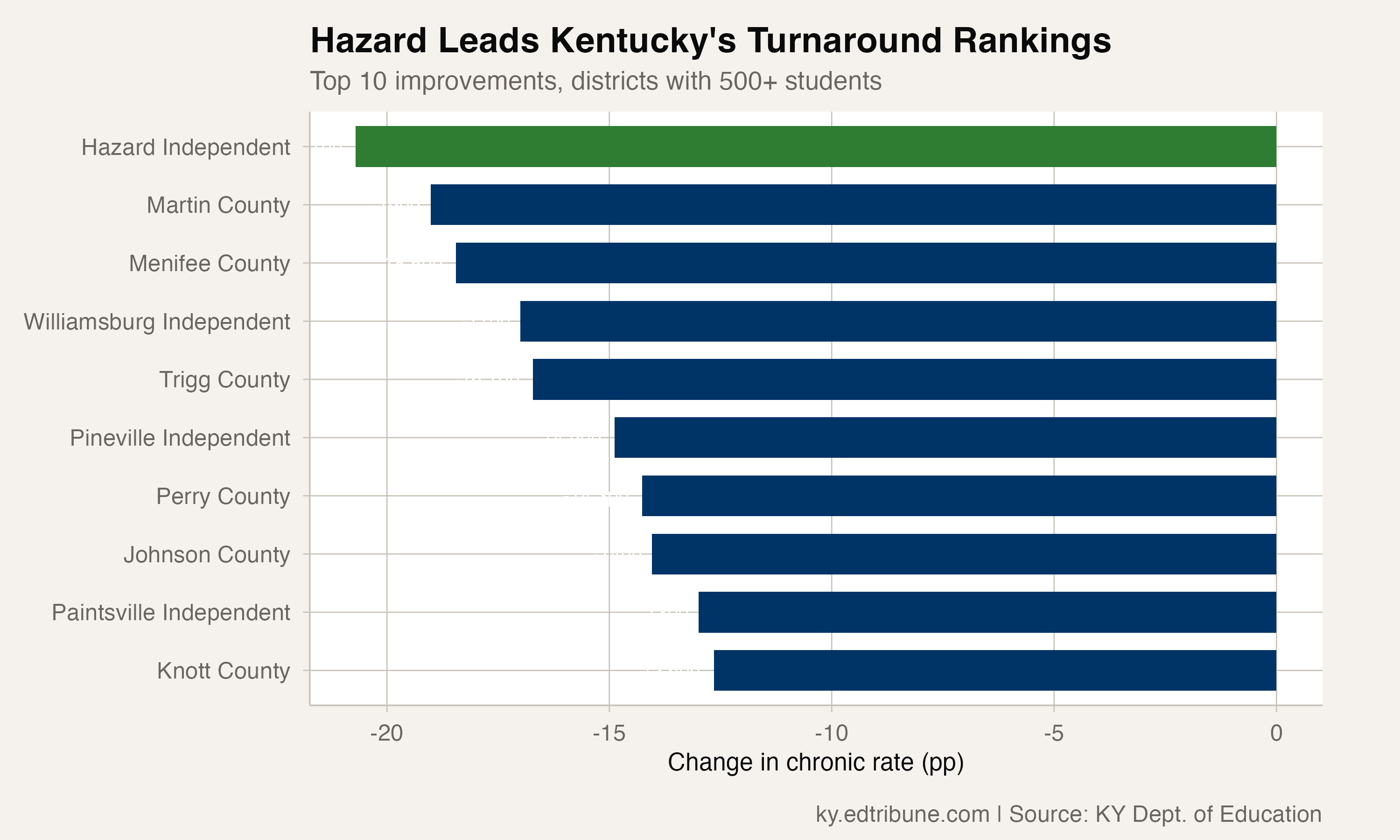
These districts share Appalachian Kentucky's structural challenges: high poverty, limited transportation infrastructure, the lasting effects of the coal economy's decline, and the opioid crisis. Hazard shares all of those. It also improved more than any of its neighbors. Over the same two years, Perry County's rate fell 14.3 points, Knott's 12.7, Letcher's 12.4, Breathitt's 9.2 and Leslie's 5.4.
The data cannot explain why. Independent school districts in Kentucky, of which Hazard is one, are generally smaller and have different governance structures than the county districts that surround them. Hazard Independent's 993 students attend school in the city of Hazard, the seat of Perry County. The district's smaller footprint may make family-by-family intervention more feasible, though the neighboring county districts closest to it in size (Breathitt at 1,831 students, Leslie at 1,530) did not achieve comparable improvement.
What could have changed
Without direct reporting from the district, only speculation is possible, and speculation is not evidence. Several potential mechanisms fit the data.
The small district effect is the most straightforward. With 993 students in three schools, a concerted push from district leadership can reach every family. In Perry County, with 3,468 students spread across a larger geography, the same effort diffuses. Whether Hazard launched a specific attendance initiative, hired an attendance coordinator, or benefited from a community partner cannot be determined from the data.
Statewide attendance and truancy policy applies to every Kentucky district, and the statewide rate fell 4.8 points over the same two years. Hazard's fell 20.7 points, 4.3 times as much, which suggests something beyond statewide policy.
The SEEK funding formula provides every Kentucky district with a fiscal incentive to improve attendance, and for a small district operating on thin margins, the per-pupil revenue impact of chronic absenteeism may create more urgency than it does in larger systems.
993 students, 225 fewer chronically absent
The drop from 448 chronically absent students to 223 over two years is the story. Not the percentage, not the comparison chart, not the policy context. Those are elementary, middle and high school students in a small mountain district who, on net, are missing far less school than their predecessors did.
Perry County, surrounding Hazard on all sides, was still at 42.9% in 2024-25. If Hazard's turnaround came from a single attendance coordinator, or a partnership with a local church, or a superintendent who personally called every family with three consecutive absences, Perry County could try the same thing. If it came from being a 993-student independent district where everyone knows everyone, the kind of social pressure that is harder to sustain across 3,468 students in a mountain county, then it is less a model than a reminder of what smallness makes possible. Either way, Hazard had 225 fewer chronically absent students in 2024-25 than in 2022-23, a number equal to 22.7% of its 2024-25 enrollment. In a district this size, that is not a rounding error.
Detailed code that reproduces the analysis and figures in this article is available exclusively to EdTribune subscribers.
Discussion
Sign in to join the discussion.
Loading comments...