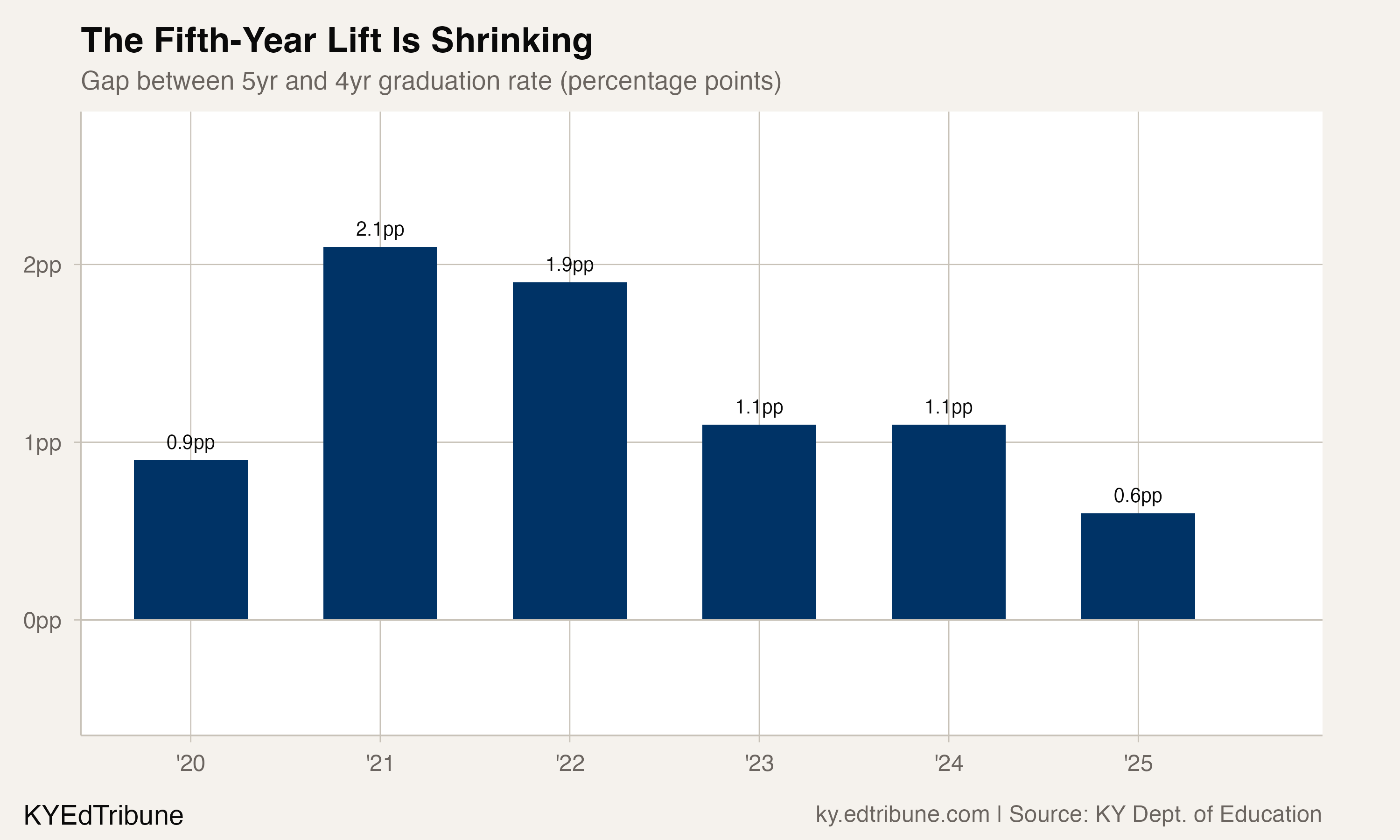
In 2021, one in every 50 Kentucky seniors who walked across a graduation stage that spring had needed a fifth year to get there. The COVID-disrupted Class of 2021 produced a 2.1 percentage-point gap between the state's four-year and five-year graduation rates, the widest in the six years of available data. By 2025, that gap had collapsed to 0.6 points. Kentucky's four-year rate climbed to 93.6%, nearly catching its own five-year rate of 94.2%.
The convergence is not because the five-year rate stalled. It rose, too, from 92.0% in 2020 to 94.2% in 2025. The four-year rate simply rose faster, gaining 2.5 percentage points over the same span while the five-year rate gained 2.2 points. Fewer students need extra time because more are finishing on schedule.
A COVID spike, then compression
The gap's trajectory tells a compact pandemic story. Before COVID, the Class of 2020 showed a modest 0.9 percentage-point lift from the fifth year. Then the pandemic knocked the four-year rate down to 90.2% for the Class of 2021 while the five-year rate, drawn from an earlier cohort that had mostly completed coursework before disruptions, held steady at 92.3%. The result was a 2.1-point chasm.
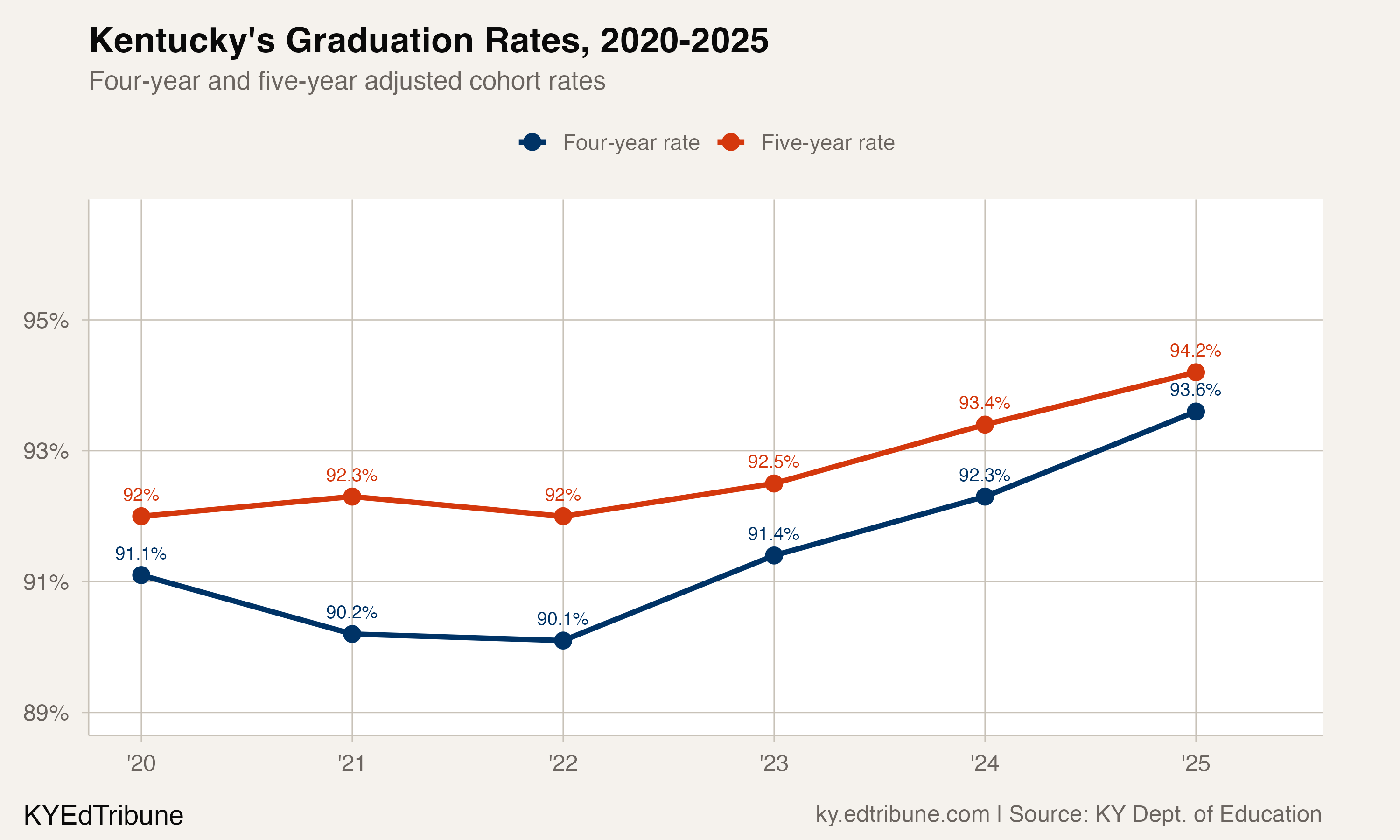
Each subsequent year shrank the distance. The gap fell to 1.9 points in 2022, then 1.1 in both 2023 and 2024, before reaching 0.6 in 2025. The four-year rate's acceleration, from 90.1% to 93.6% over three years, is the steepest sustained climb in the dataset.
Kentucky's Persistence to Graduation Initiative, launched in 2015, assigns every student a GRAD score based on attendance, behavior, grades, and enrollment history. The early warning dashboard lets schools flag at-risk students and build watchlists in real time. Education Commissioner Robbie Fletcher credited the state's literacy and numeracy investments for broader gains, telling Spectrum News that students "performed at proficient or distinguished levels at a higher rate during the 24-25 school year in reading and mathematics than they have in previous years."
English learners: the fifth year still matters
The statewide average obscures a stark divide. For English learners, the fifth year added 6.7 percentage points in 2025, lifting their rate from 79.0% to 85.7%. Hispanic students gained 4.4 points (86.2% to 90.6%), and students experiencing homelessness gained 3.1 points (88.5% to 91.6%). For white students, the lift was 0.1 points.
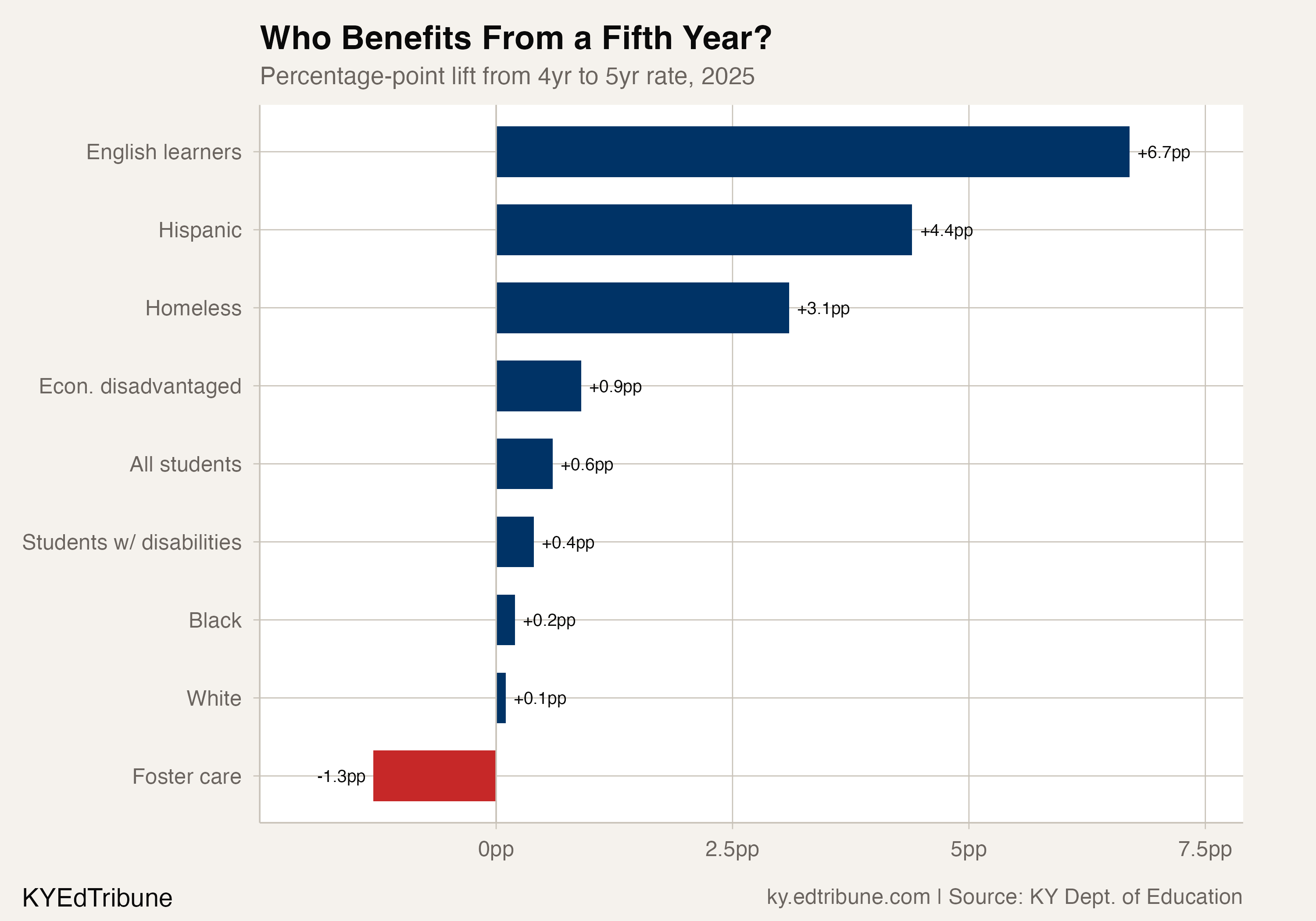
The EL pattern is volatile in ways that deserve caution. In 2024, the four-year EL rate actually exceeded the five-year rate by 1.6 points, an anomalous inversion. The following year it swung back to a 6.7-point lift. Small cohort sizes in the EL subgroup can produce year-to-year noise that looks like dramatic policy shifts but reflects statistical variation.
Still, the structural logic holds. Students acquiring English while completing high school coursework face a compounding challenge. A fifth year provides time for both language proficiency and credit recovery, and the data consistently shows EL students extracting more value from that extra time than any other subgroup. The Prichard Committee for Academic Excellence has emphasized that Kentucky's literacy initiatives "are beginning to work," with early evidence from Kentucky Reading Academies showing measurable gains for students in tested grades.
The disability gap compressed to near zero
Students with disabilities tell a different story of convergence. Their fifth-year lift fell from 2.8 percentage points in 2021 to just 0.4 points in 2025. The mechanism was almost entirely a rising four-year rate: it climbed from 78.0% in 2020 to 83.1% in 2025, a 5.1-point gain. The five-year rate barely moved over the same period, from 79.3% to 83.5%.
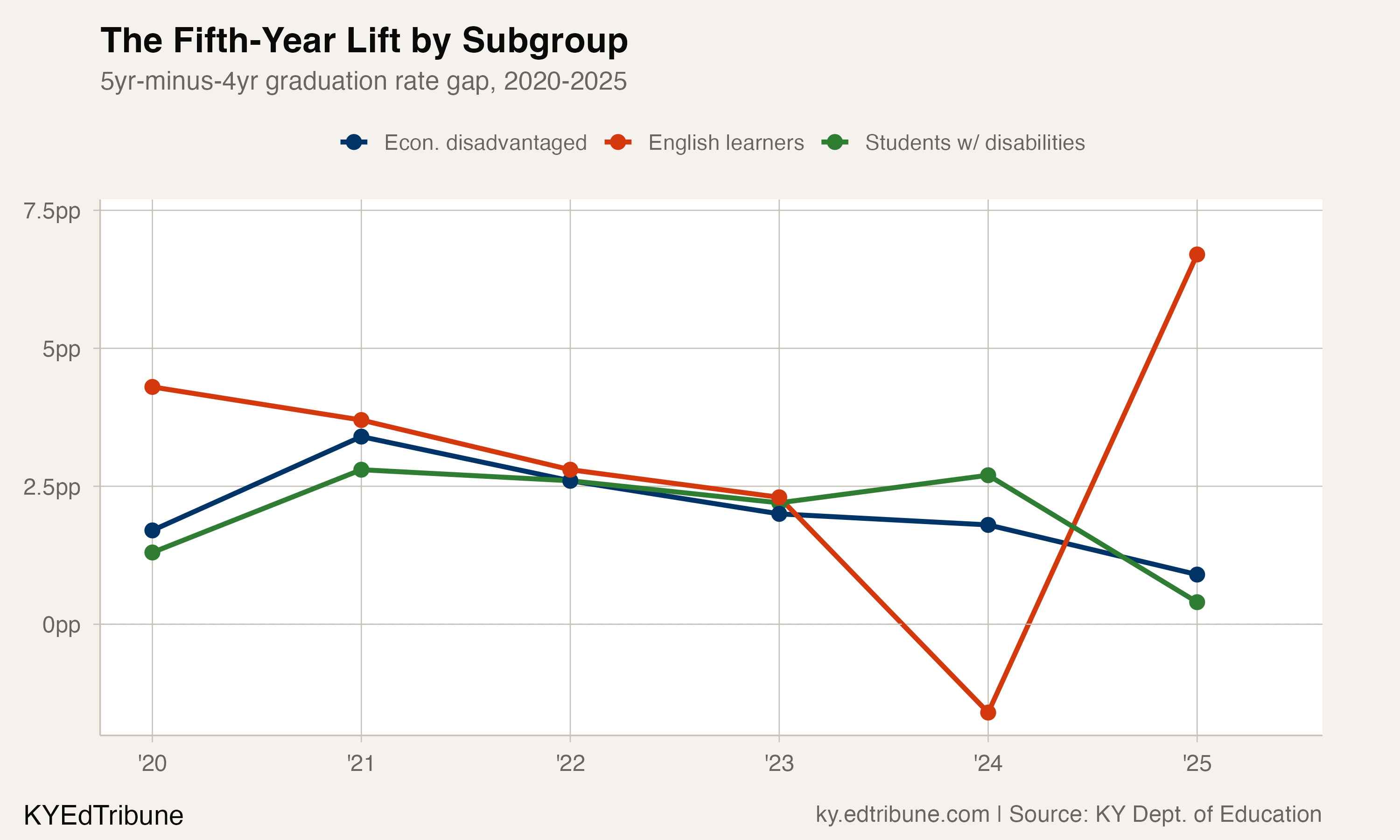
Economically disadvantaged students followed a similar path. Their fifth-year lift shrank from 3.4 points in 2021 to 0.9 in 2025, driven by a four-year rate that climbed 4.6 points over five years (88.1% to 92.7%).
The largest four-year rate gains since 2020 came from subgroups that historically graduated at the lowest rates. Black students gained 7.8 points (83.3% to 91.1%), students with disabilities gained 5.1 points, and English learners gained 5.1 points. The overall statewide gain of 2.5 points was less than half the improvement seen in these groups, a closing of historical gaps that is compressing the need for a fifth year from the bottom up.
Half the state's districts show no fifth-year benefit at all
The district-level picture complicates the narrative. In 2025, nearly half of Kentucky's 168 districts (48.8%) showed a five-year rate that equaled or trailed their four-year rate. In 72 districts, the five-year rate was actually lower.
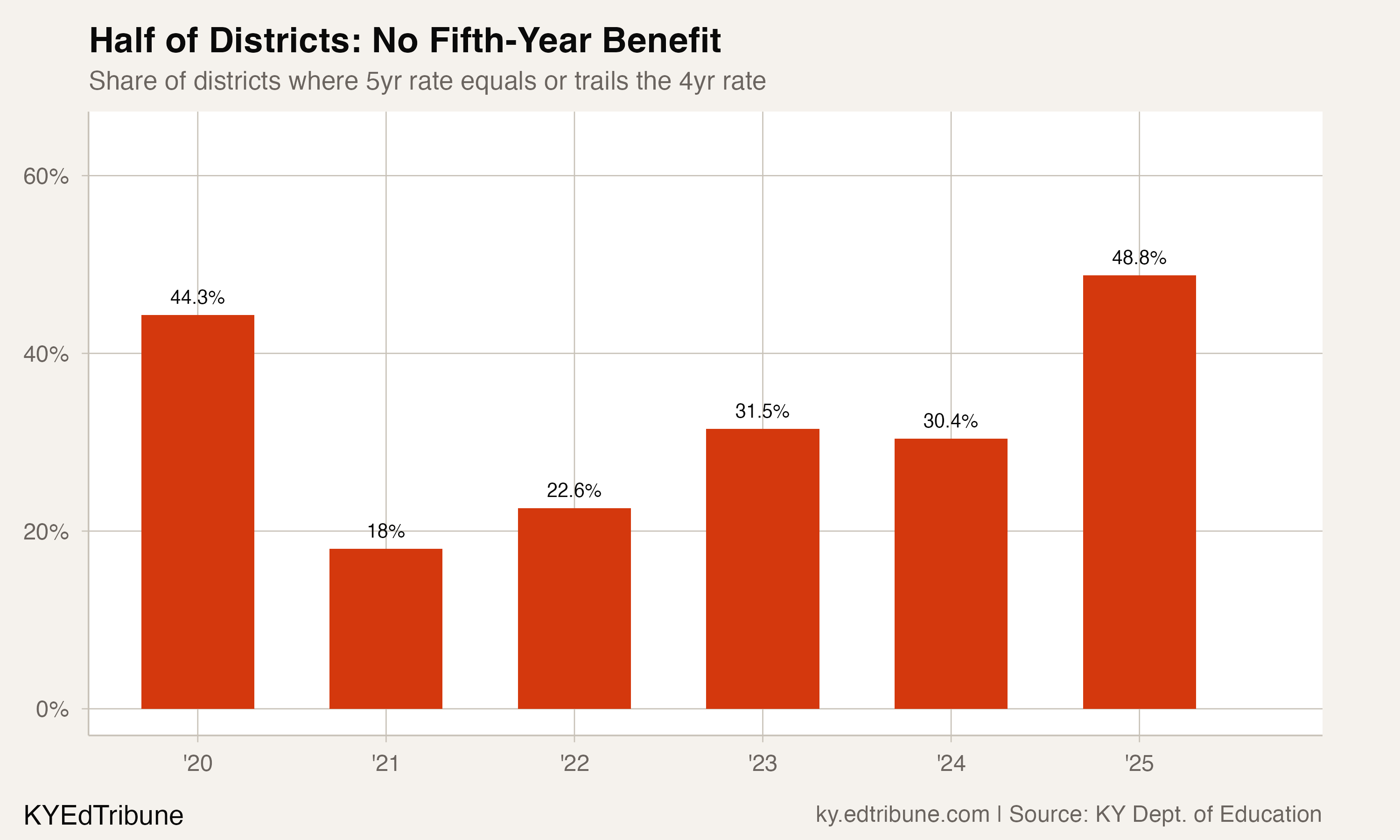
A five-year rate lower than the four-year rate is not a data error. The two rates measure different cohorts: the 2025 four-year rate tracks students who entered ninth grade in 2021, while the 2025 five-year rate tracks the cohort that entered in 2020. In small districts, a handful of students who drop out during a fifth year can drag the rate below what the next cohort achieves in four years.
The 2021 COVID year is instructive. Only 18.0% of districts showed no fifth-year benefit that year, the lowest share in the data. When the four-year rate cratered during COVID disruptions, the fifth year recovered a meaningful number of students nearly everywhere. As the four-year rate has risen, the fifth year has become less universally necessary, but more concentrated in districts and subgroups where students face language, housing, or disability barriers.
Jefferson County Public Schools, the state's largest district, maintained a consistent 1.0 percentage-point fifth-year lift in 2025 (88.7% to 89.7%), near its six-year average. JCPS carries a disproportionate share of the students for whom extra time matters. The district's graduation rate has climbed 5.0 percentage points since 2020, and local reporting noted that 41 of 53 schools statewide in comprehensive support and improvement status are located in Jefferson County.
What this data cannot show
The adjusted cohort graduation rate does not distinguish between a student who needed one extra semester of English coursework and a student who spent 18 months cycling through credit recovery. The fifth year is a blunt instrument in the data, measuring whether a diploma arrived within five years without revealing the path. Kentucky's dropout data reports that students who leave cite being "pushed out" (49% in one multi-decade study) more often than academic failure (14%). Whether the shrinking fifth-year cohort reflects better academic support or earlier dropout is a question the graduation rate alone cannot answer.
The question for Kentucky's next graduating class is whether 93.6% represents a ceiling or a step. Three consecutive years of four-year rate increases have absorbed most of the students who previously needed a fifth year. The subgroups still extracting meaningful value from extra time, English learners at 6.7 points, Hispanic students at 4.4 points, are precisely the populations growing fastest in Kentucky schools. If those cohorts expand, the statewide fifth-year lift could widen again even as the overall rate continues to climb.
Detailed code that reproduces the analysis and figures in this article is available exclusively to EdTribune subscribers.
Discussion
Sign in to join the discussion.
Loading comments...