Perry County dropped its chronic absenteeism rate by 14.3 percentage points in two years. That is one of the largest improvements of any district in Kentucky. It also means 42.9% of Perry County's students are still chronically absent.
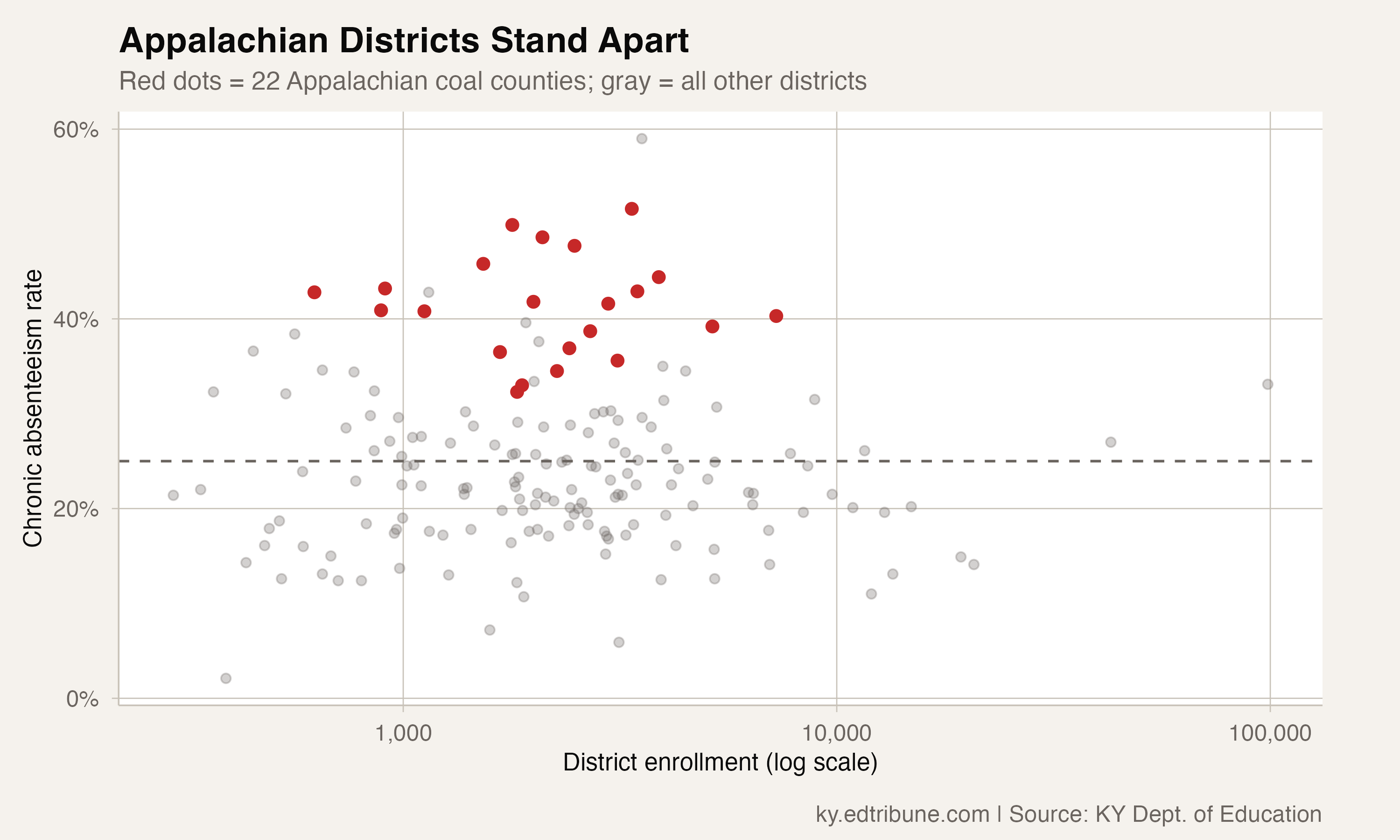
That paradox defines eastern Kentucky's relationship with school attendance. The 22 Appalachian coal counties have improved dramatically since 2022-23, many dropping 10 to 20 points. Every single one improved. And 14 of them still exceed 40% chronic absenteeism -- meaning nearly half their students miss at least 10% of the school year.
The gap that won't close
The 22 Appalachian districts averaged 41.3% chronic absenteeism in 2024-25, compared to 25.0% statewide. That 16.3-point gap has barely narrowed: it was 19.8 points in 2022-23. The region improved by 8.3 points over two years, compared to 4.8 points statewide. The improvement is faster in absolute terms but not fast enough to converge.
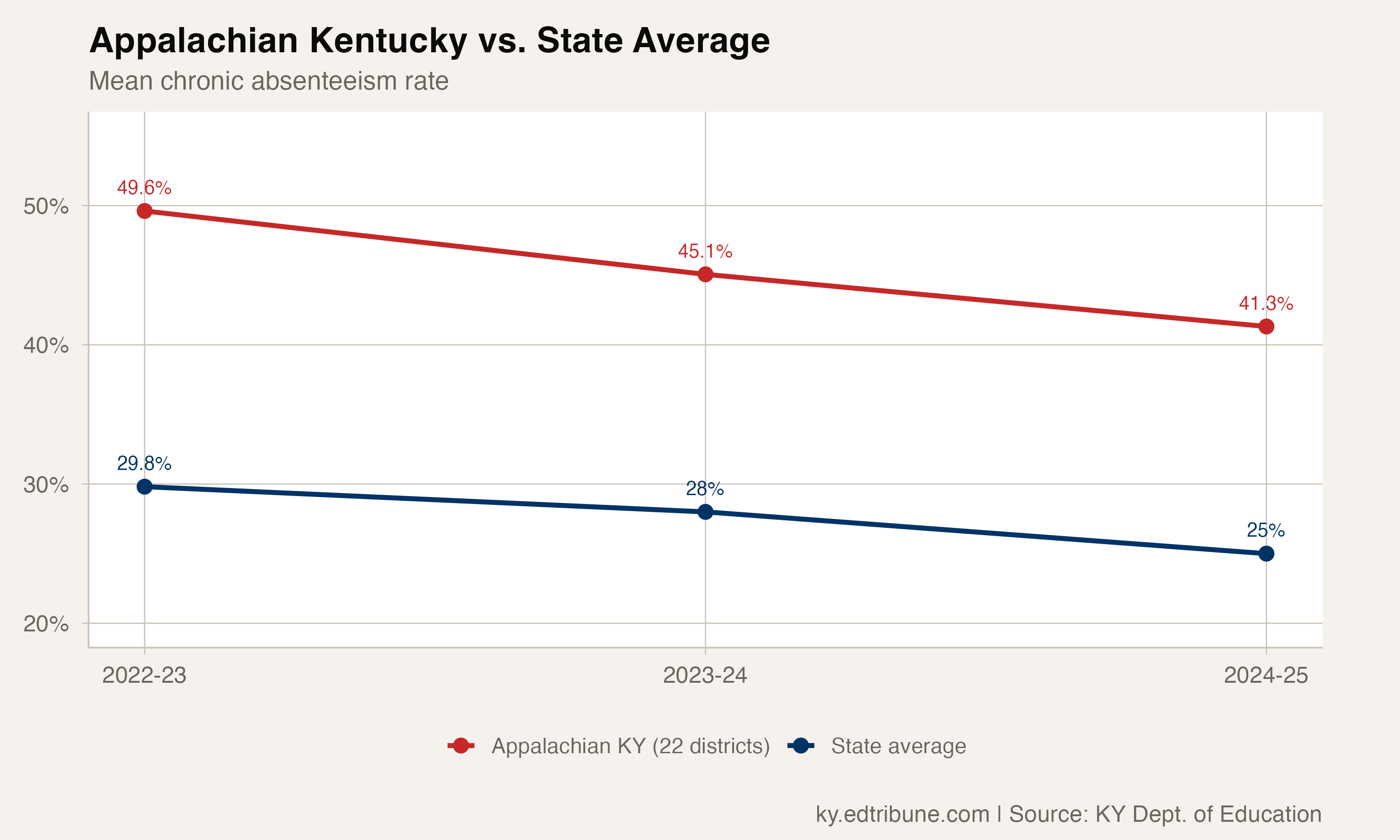
Harlan County leads the region at 51.6%, meaning more than half its 3,367 students are chronically absent. Magoffin County (49.9%), Knott County (48.6%), and Letcher County (47.7%) are close behind. These are districts where chronic absenteeism is not a tail-end problem affecting a vulnerable subgroup -- it is the dominant experience of attending school.
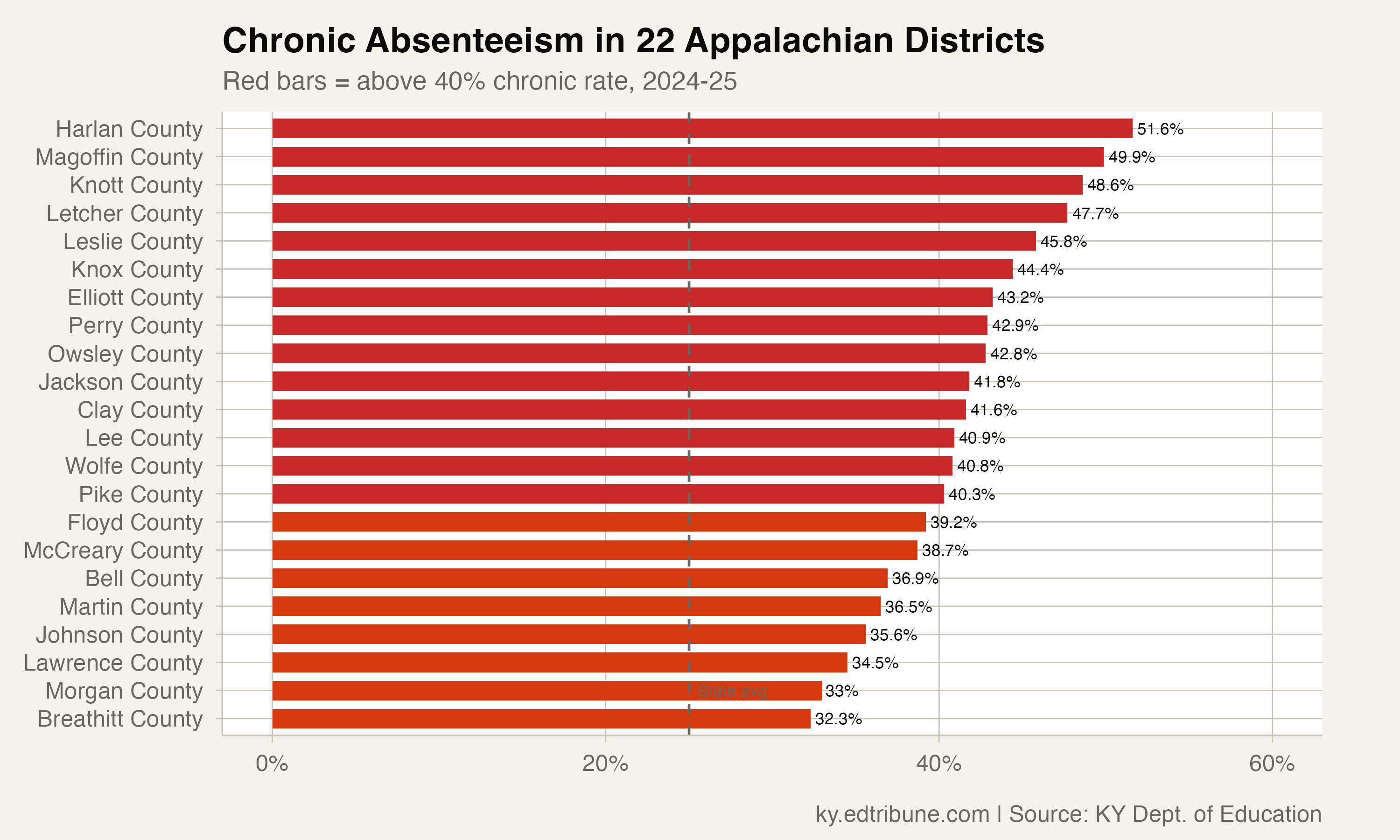
The 55,425 students in these 22 districts account for 8.5% of state enrollment but a disproportionate share of the attendance crisis. Approximately 22,900 are chronically absent, representing 14% of Kentucky's total chronically absent population.
Why eastern Kentucky is different
The poverty-attendance correlation is visible at every level of the data, but Appalachian Kentucky concentrates multiple risk factors in ways that go beyond income. County poverty rates in the region exceed 30%, and in some counties approach 40%. Educational attainment among adults is among the lowest in the nation. Transportation across mountainous terrain is a structural barrier that flat-county districts do not face -- missing a bus in Pike County can mean missing school entirely when the next option is a 40-minute drive on winding mountain roads.
The coal economy's collapse compounded these factors. Districts that once had stable employment bases tied to mining now face depopulation, declining tax bases, and the intergenerational effects of economic dislocation. The opioid crisis has hit Appalachian Kentucky harder than almost any other region in the country, and its effects on family stability -- and therefore student attendance -- are well documented.
"Chronic absenteeism in Appalachia isn't just about kids not wanting to come to school. It's about transportation, housing instability, family health crises, and a lack of the support systems that other communities take for granted." -- Appalachian Regional Commission, Economic Assessment, 2024
Kentucky's SEEK funding formula makes the situation self-reinforcing. Because SEEK is based on average daily attendance, districts with high chronic absenteeism receive less per-pupil funding. The districts that most need resources to address attendance barriers receive less money precisely because of those barriers.
The bright spot within the crisis
Hazard Independent, a small district of 993 students in Perry County, dropped from 43.2% to 22.5% in two years -- the largest improvement in the state. What distinguishes Hazard from its neighbors is unclear from the data alone. Perry County, which surrounds Hazard Independent, dropped 14.3 points but remains at 42.9%. The same geography, the same poverty, the same opioid challenges -- but a 20-point difference in outcomes.
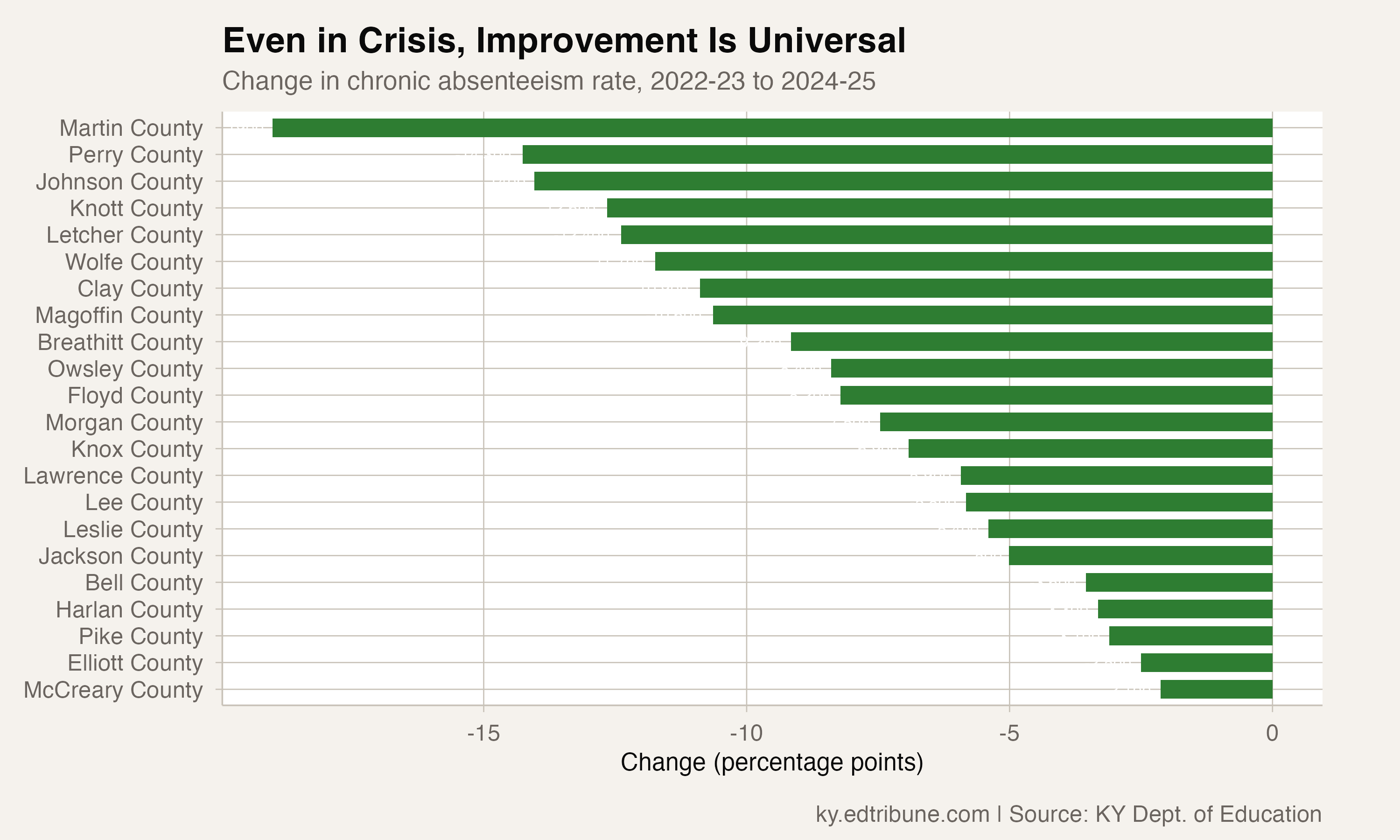
Other notable improvers include Martin County (-19.0pp to 36.5%) and Johnson County (-14.0pp to 35.6%). Both remain well above the state average, but the trajectory is undeniably positive.
What improvement means at these levels
Dropping from 50% to 40% chronic absenteeism is significant improvement by any statistical measure. It is also still a crisis. At 40%, nearly half the student body is missing enough school to put academic progress at risk. Research consistently finds that chronic absenteeism at these levels correlates with lower reading proficiency by third grade, higher dropout rates, and reduced lifetime earnings.
The region's improvement suggests that the floor is not fixed -- that even the most challenged districts can move their numbers. But the pace needed to reach anything resembling the state average, let alone the KDE's 15% target, would require decade-sustained intervention at a scale these small, underfunded districts have never seen. Harlan County would need to cut its rate by more than half. With 3,367 students and a budget constrained by the very attendance formula it needs to improve, the path from 51.6% to 25% is not a trend line -- it is a transformation.
Detailed code that reproduces the analysis and figures in this article is available exclusively to EdTribune subscribers.
Discussion
Sign in to join the discussion.
Loading comments...