In 2024, Black students at Jefferson County Public Schools graduated at a higher rate than white students. It lasted one year. But the fact that it happened at all, in a district that enrolls roughly 90,000 students across 170 schools, says something about the trajectory Louisville has been on.
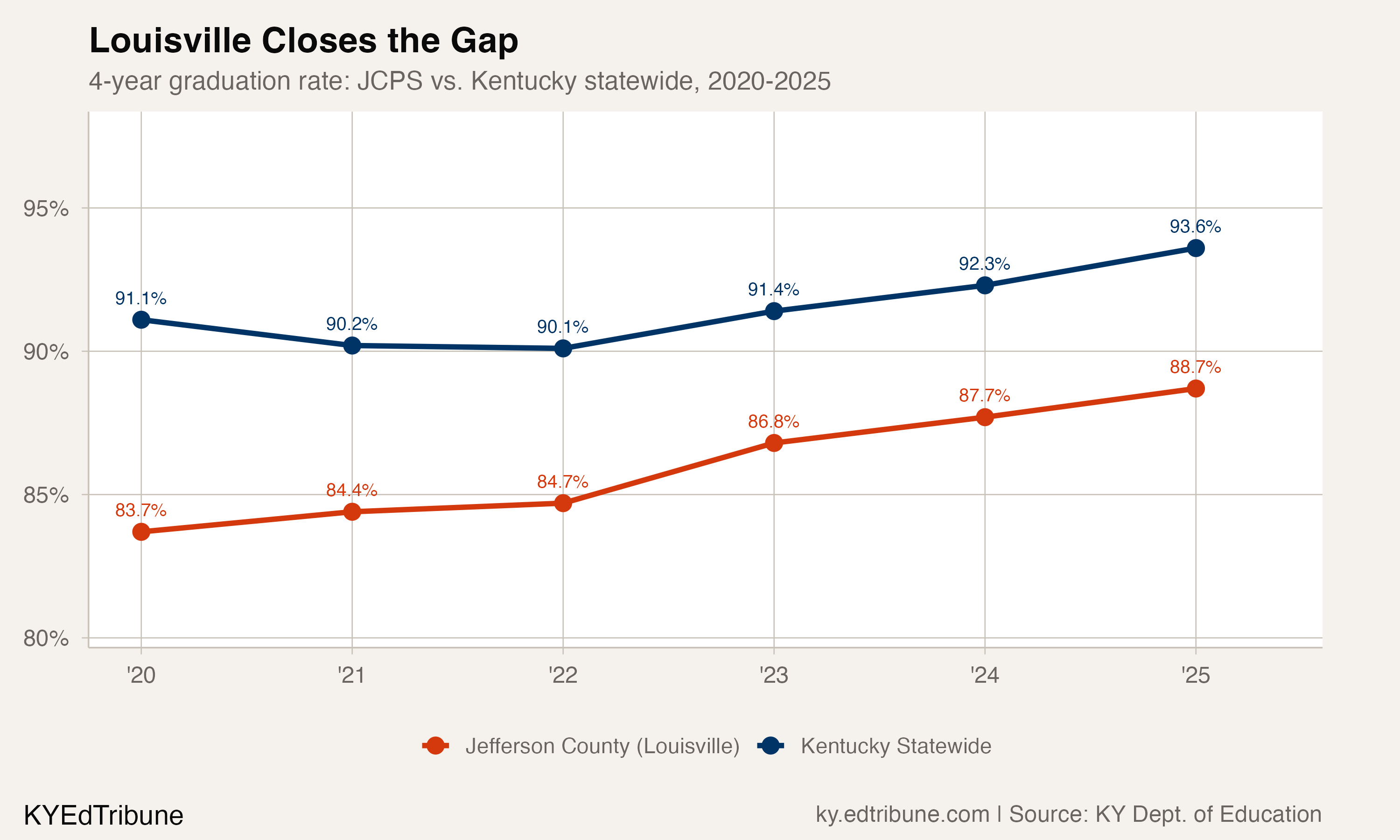
JCPS's four-year graduation rate has risen every year since 2020, climbing from 83.7% to 88.7%, a five-point gain that outpaced the median Kentucky district by more than five to one. The district started the period as one of just five in the state below 85%. It is still below the state average of 93.6%, still last among Kentucky's eight largest districts. But the gap is narrowing, and the way it has narrowed tells a more specific story than the overall number.
Black students drove the improvement
The headline number, 88.7%, obscures who moved it. Black students at JCPS gained 8.9 percentage points over five years, from 81.6% to 90.5%. White students gained 5.3 points over the same period, from 86.3% to 91.6%. The Black-white gap collapsed from 4.7 points to 1.1.
In 2024, it briefly inverted: Black students graduated at 89.1% while white students graduated at 88.2%. The gap reversed by 0.9 points before white students pulled slightly ahead again in 2025.
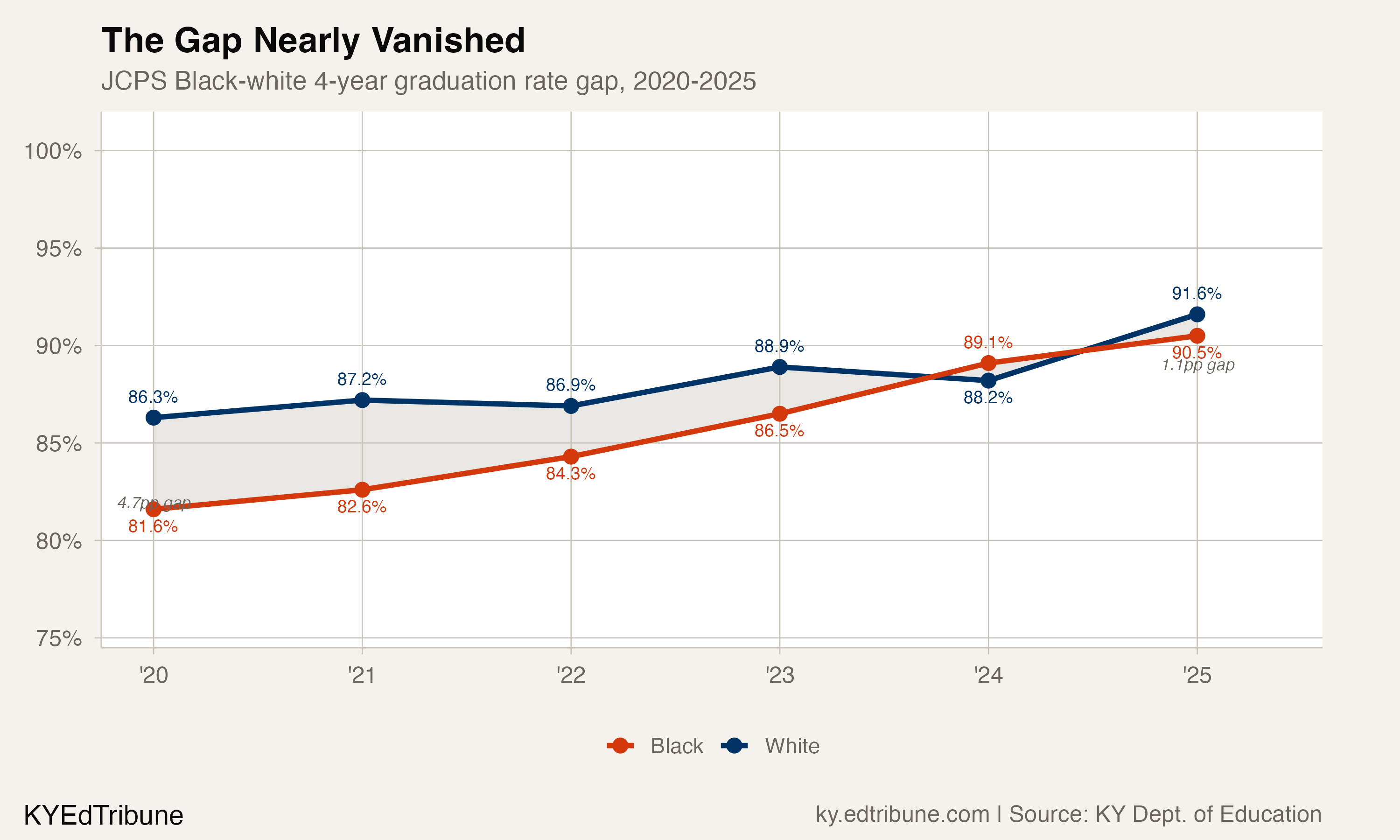
That trajectory is unusual for a large urban district. JCPS Board Chair Corrie Shull and Vice Chair James Craig wrote in a joint op-ed that the graduation rate "has gone from 82% to 88% with the gap between white and Black students virtually erased." Their numbers track closely with the state data.
The Academies model
The largest structural change during this period was the expansion of the Academies of Louisville, a career-focused redesign of JCPS high schools that organizes students into industry-aligned pathways with employer partnerships, dual-credit courses, and work-based learning.
"When students have something they look forward to during school, they come and perform well." -- Joe Ellison, JCPS Assistant Superintendent of High Schools, Spectrum News 1, May 2025
In the class of 2024, 4,493 students graduated through the Academies model, with 1,544 earning industry certifications and 1,404 qualifying for career and technical education college credit. JCPS credits the program with a 55% increase in postsecondary readiness since adoption.
The connection between career pathways and graduation rates is suggestive rather than proven. Multiple forces act on a graduation rate simultaneously: credit recovery programs, attendance interventions, adjusted cohort definitions, and targeted case management all contribute. JCPS sent 4.5 million text messages about attendance in 2024-25 and processed more than 4,000 elementary truancy referrals through the Jefferson County Attorney's office. An Academies program and a truancy apparatus are not competing explanations; they work different parts of the problem.
Five consecutive years, no interruptions
What stands out in the JCPS trend is the consistency. Every year since 2020 produced a gain: 0.7 points, then 0.3, then 2.1, then 0.9, then 1.0. No dips. No plateaus.
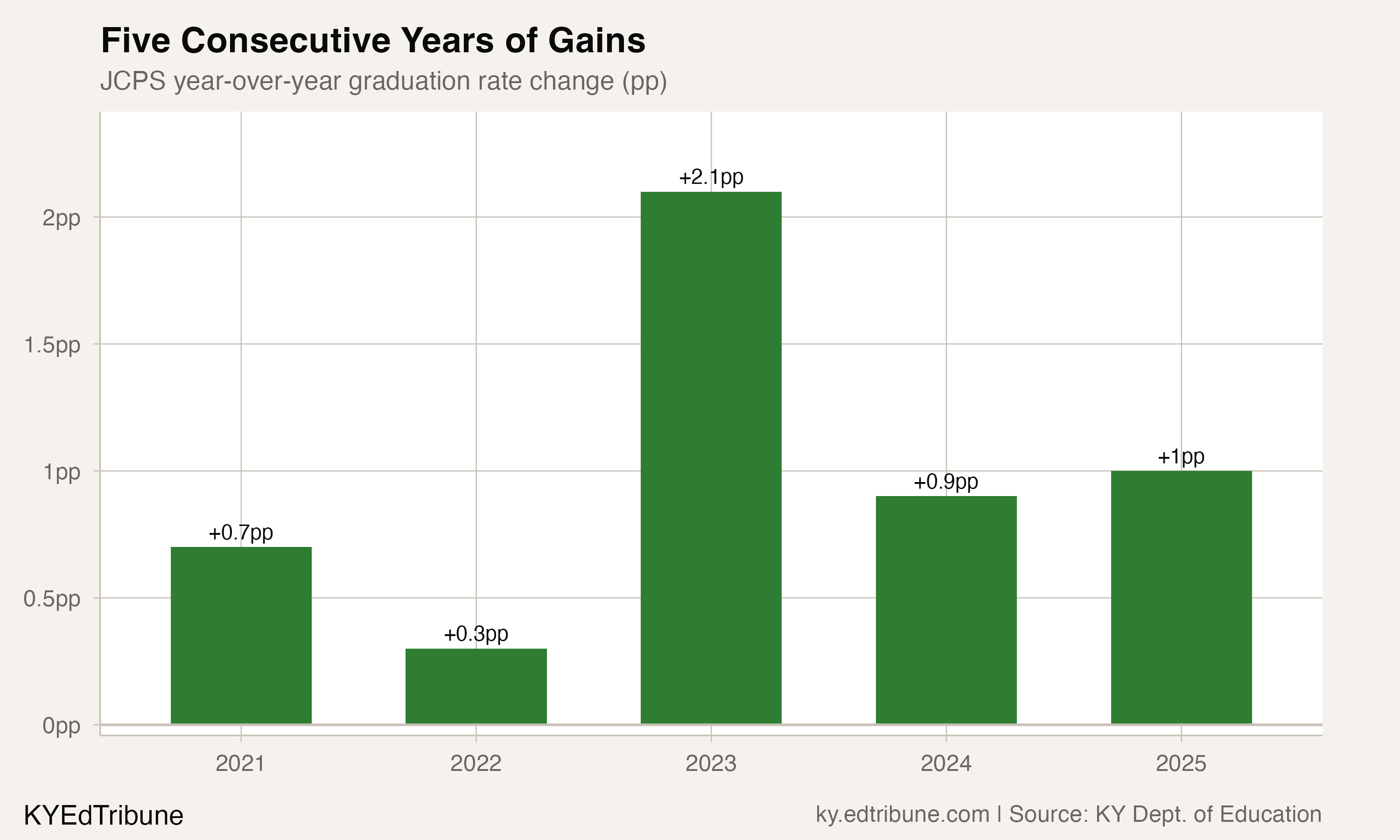
The biggest single jump came in 2023, a 2.1-point gain that coincided with JCPS fully emerging from pandemic-era disruptions. The state also posted its largest year-over-year gain that year, 1.3 points, but Louisville's jump was nearly twice the statewide rate.
Among 167 Kentucky districts with data in both 2020 and 2025, JCPS's five-point improvement ranked 29th. The median district gained just 0.9 points. Only 30 districts managed gains of five points or more, and most of those were small districts where a few additional graduates shift the rate by several points. JCPS did it with cohorts exceeding 7,000 students.
Still last among the largest
The gains have not erased the structural gap. Among Kentucky's eight largest districts, JCPS graduated the smallest share of its cohort in 2025. Kenton County led at 98.4%. Fayette County, the state's second-largest district, graduated 92.6%. Louisville trailed them all at 88.7%.
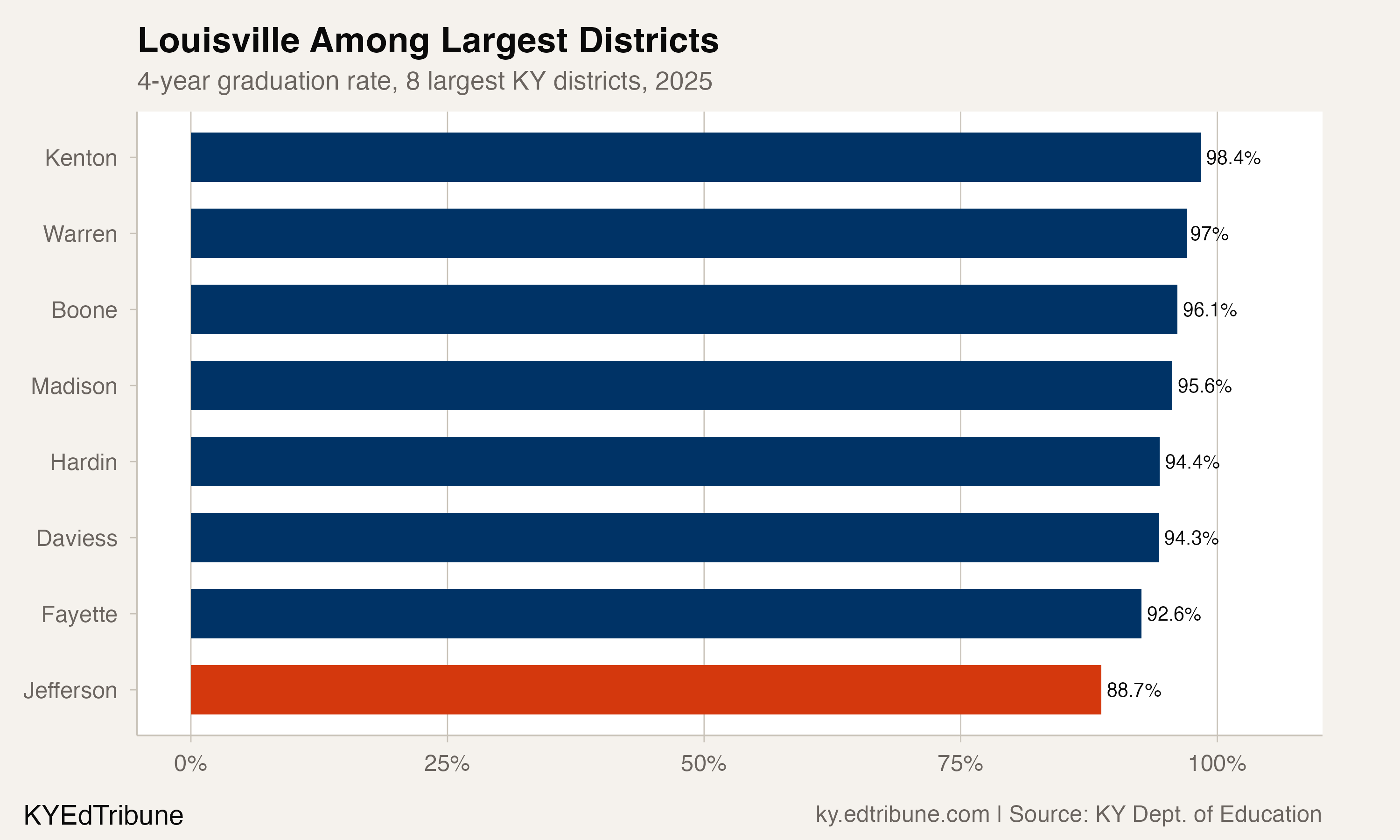
The gap between Louisville and the state average stood at 4.9 points in 2025. That is narrower than the 7.4-point chasm in 2020, but wider than the 4.6 points recorded in both 2023 and 2024. The state itself accelerated in 2025, jumping 1.3 points to 93.6%, which means Louisville had to run faster just to keep the gap from growing.
Where the gaps remain
At the subgroup level, JCPS's improvement has been uneven. Black students and white students now graduate at nearly identical rates, but other groups lag further behind.
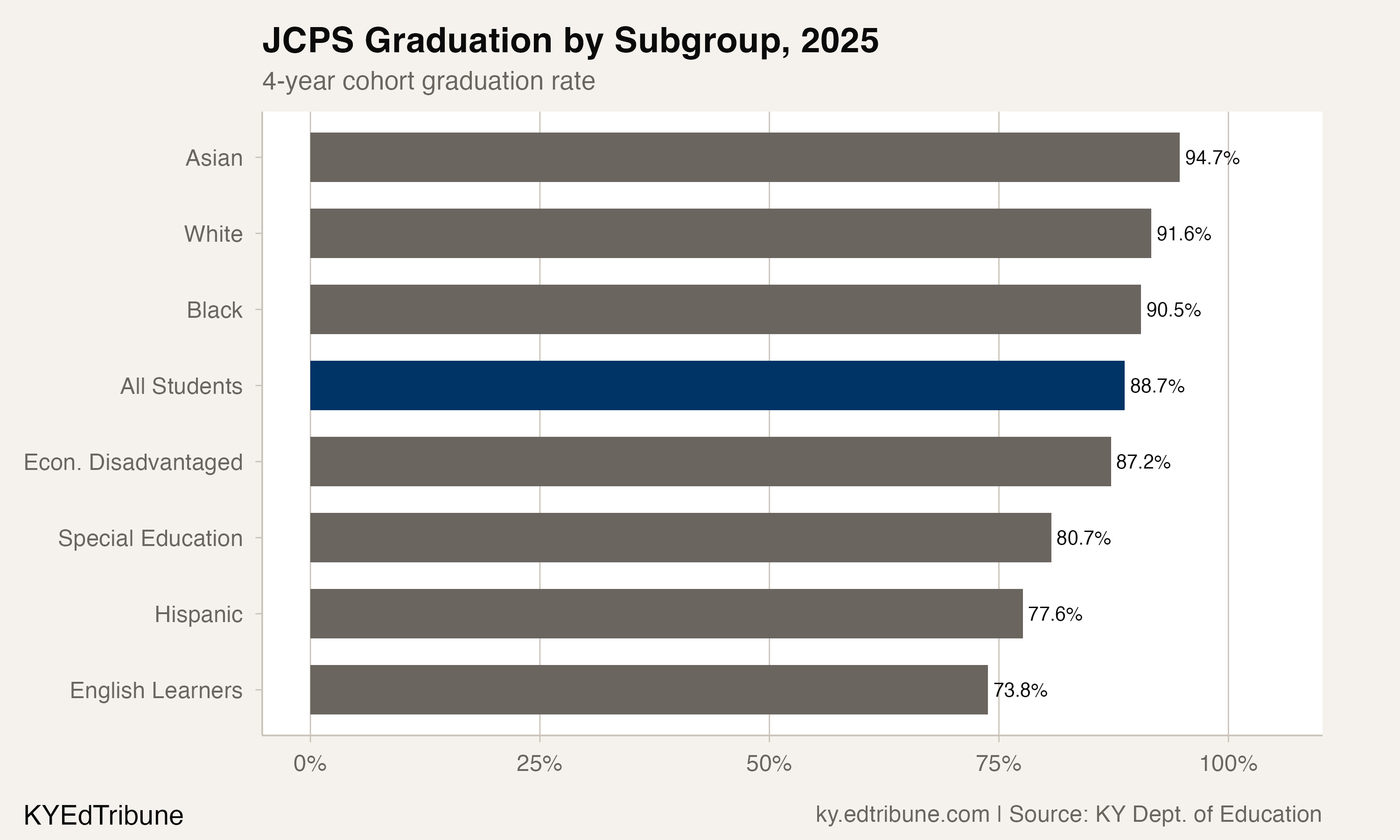
English learners graduated at 73.8%, a 14.9-point gap below the district average. Hispanic students graduated at 77.6%, an 11.1-point gap. Students with disabilities graduated at 80.7%. Students who are currently homeless graduated at 75.1%, and students in foster care at 74.5%.
The English learner and Hispanic rates are particularly volatile. Hispanic graduation at JCPS has bounced between 75.0% and 81.1% over the past six years with no clear trend. English learner graduation spiked to 79.1% in 2024 before falling back to 73.8% in 2025, the same rate it posted in 2023. These swings likely reflect small cohort sizes, where a handful of students can move the rate by several points in either direction.
Special education showed the clearest sustained improvement among service populations: from 69.7% in 2020 to 80.7% in 2025, an 11-point gain.
A superintendent's final year
The 2025 results represent the last graduating class under Superintendent Marty Pollio, who announced his retirement in September 2024 after eight years leading the district. During his tenure, the graduation rate rose from approximately 82% to 89%, and postsecondary readiness climbed from 50% to 82%.
The question for his successor is whether 89% represents a launchpad or a ceiling. Louisville has been on a five-year run of gains, but the rate of improvement has been uneven, with the largest jump already three years in the past. The district's 2024-25 graduates earned over $87 million in scholarships, and 75% were considered postsecondary ready. Those numbers measure something real. Whether the graduation rate itself can close the remaining 4.9-point gap to the state depends in part on whether the programs that lifted Black students so substantially can do the same for English learners, Hispanic students, and students with disabilities who have not yet shared in the same trajectory.
RELATED: Louisville's One-in-Three Attendance ProblemET
Detailed code that reproduces the analysis and figures in this article is available exclusively to EdTribune subscribers.
Discussion
Sign in to join the discussion.
Loading comments...