Correction (2026-07-23): An earlier version of this article said the next-lowest reporting district after Cloverport and Paris was Jefferson County. Fulton Independent (87.5%) and Shelby County (87.8%) both sit below Jefferson County (88.7%).
Black students in Kentucky graduated at 83.3% five years ago. In 2025, the rate was 91.1%, an improvement of 7.8 percentage points that nearly erased a gap most states treat as structural. The white-Black graduation gap in Kentucky fell from 9.5 points to 3.9, one of the narrowest in the country, achieved while the state's overall rate climbed to 93.6%.
That statewide number puts Kentucky roughly 6.6 points above the most recent national average of 87%, according to the National Center for Education Statistics. It has never dipped below 90% in the six years of available data. But the headline rate obscures a more interesting story beneath it: who is catching up, who is not, and what the state's early-warning infrastructure may have to do with both.
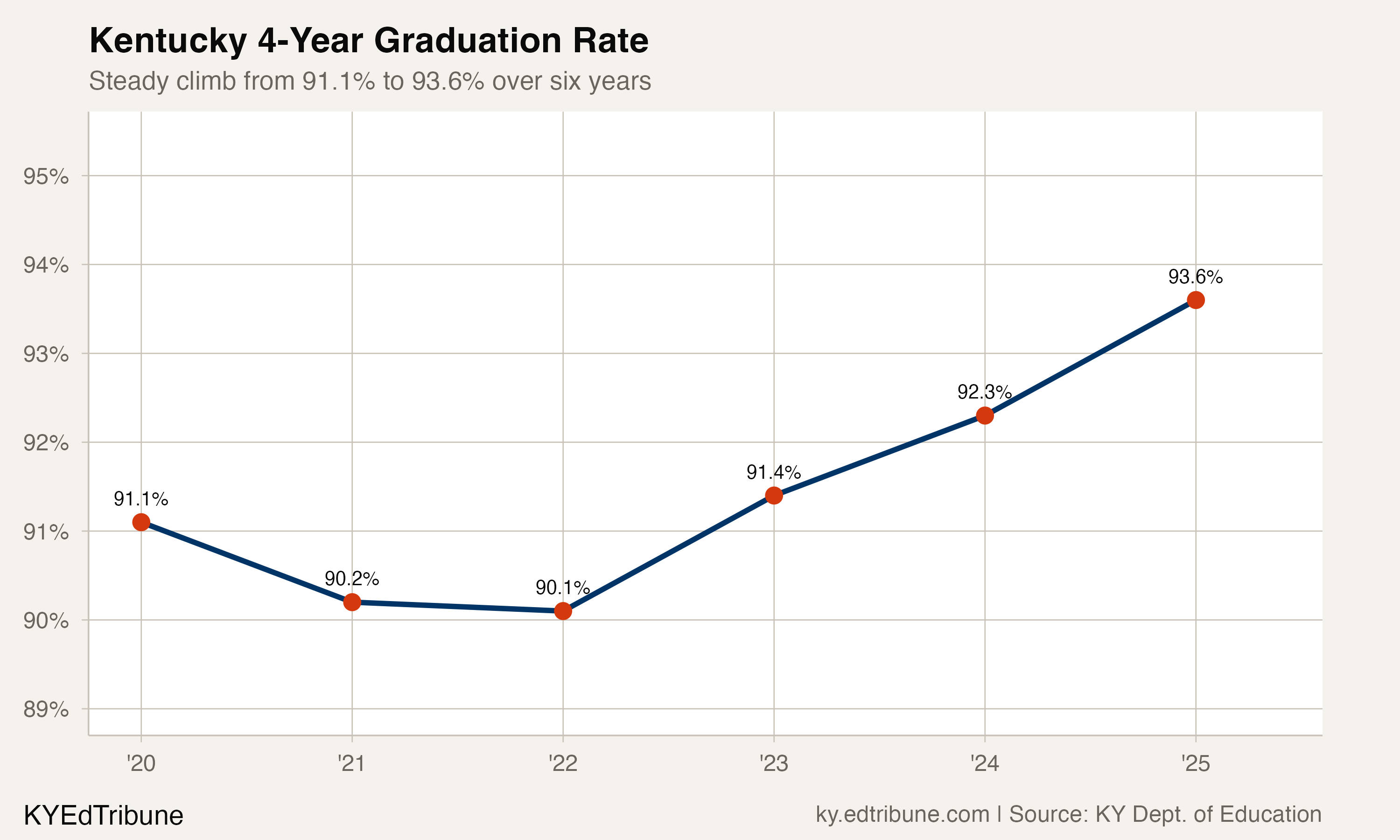
The pandemic dip barely registered
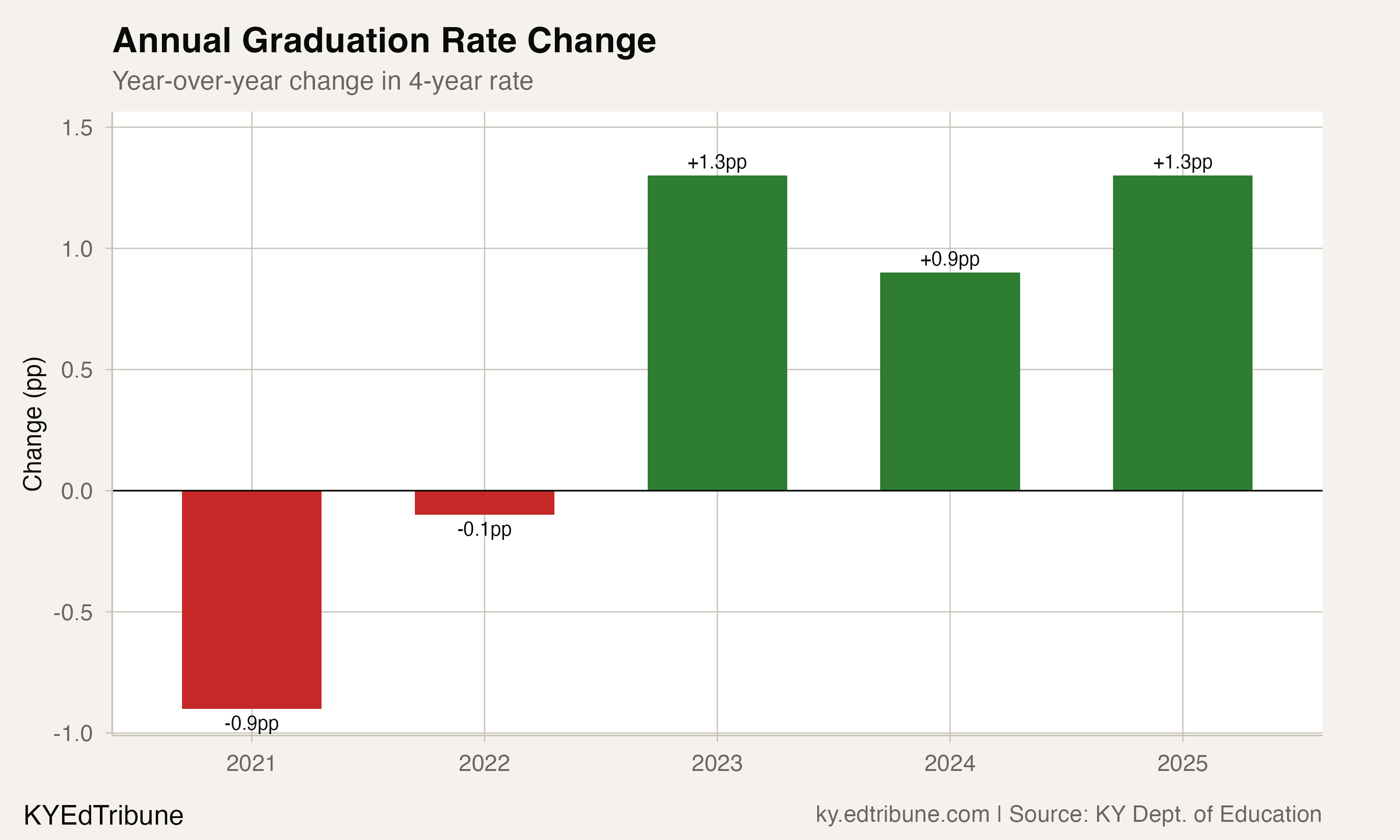
Kentucky's graduation rate sagged from 91.1% in 2019-20 to 90.2% in 2020-21 and bottomed at 90.1% in 2021-22. A one-point pandemic dip. Then three consecutive years of gains: 1.3 points in 2022-23, 0.9 in 2023-24, and 1.3 in 2024-25. The 2025 rate of 93.6% is the highest in the data, and the three-year climb of 3.5 points is steeper than anything in the pre-COVID baseline.
The five-year rate tells a similar story. At 94.2% in 2025, it runs just 0.6 points ahead of the four-year rate, meaning very few students need a fifth year to finish. That gap peaked at 2.1 points in 2021, when the COVID-disrupted Class of 2020 was picking up diplomas a year late. It has since collapsed. Whatever mechanisms are pushing students to on-time completion are working for the students who used to need the extra runway.
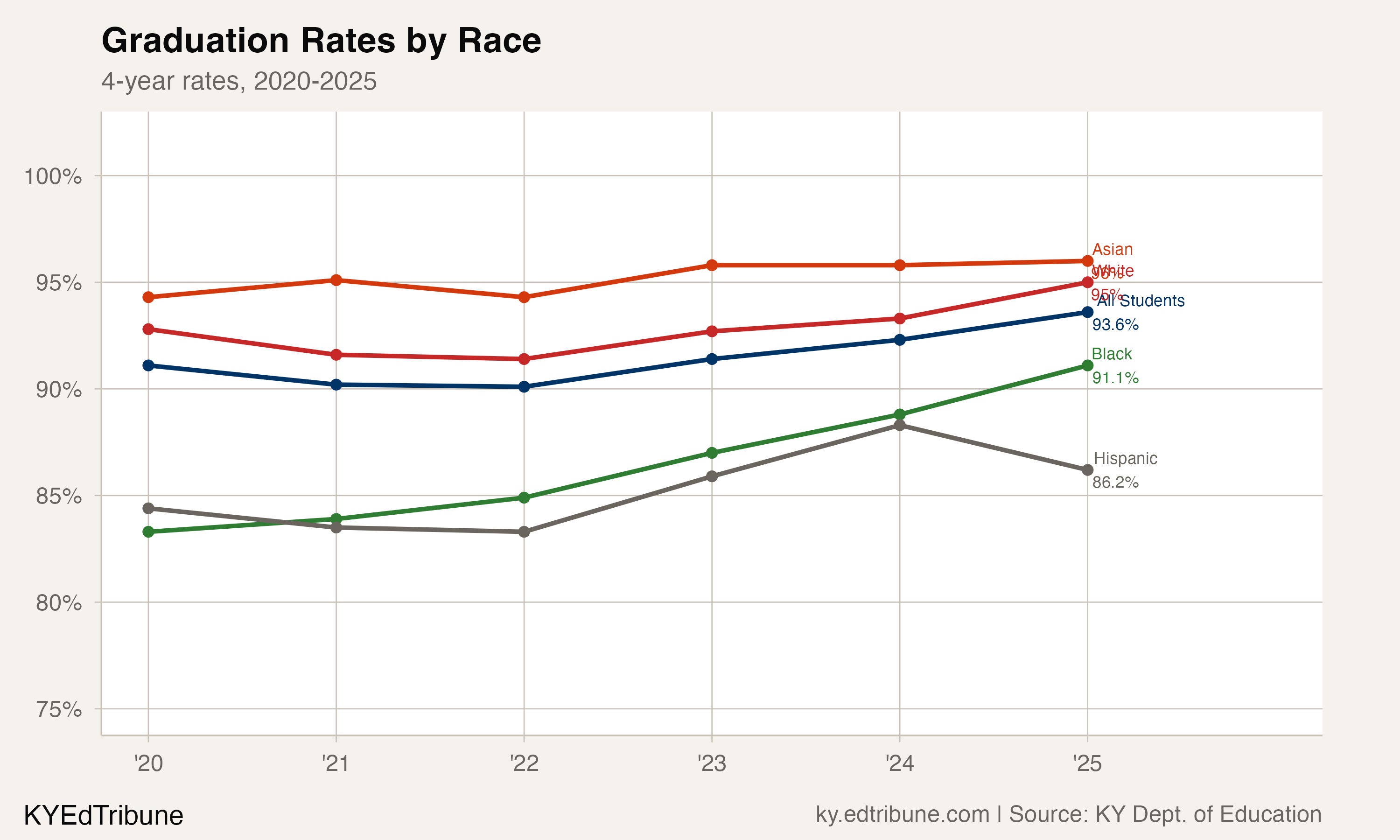
Black students gained nearly 8 points in five years
The most striking movement in the data belongs to Black students, whose four-year rate climbed from 83.3% in 2020 to 91.1% in 2025. That 7.8-point gain is more than triple the statewide improvement. In Louisville's Jefferson County Public Schools, where the majority of Kentucky's Black students are enrolled, the graduation rate for Black students reached 90.8% in 2025, nearly matching white students in the district, with the gap narrowing from three points to half a point in just two years.
White students also improved, from 92.8% to 95.0%, a 2.2-point gain. But the convergence is real. At 3.9 points, the white-Black gap is now smaller than the gender gap was two years ago.
Asian students lead all groups at 96.0%. Multiracial students gained 4.9 points to reach 94.0%. The one reversal: Hispanic students, who climbed steadily from 83.3% in 2022 to 88.3% in 2024, dropped to 86.2% in 2025. A 2.1-point year-over-year decline in a state where every other racial group improved. Whether that reflects a cohort anomaly, a data reporting change in how English learners are classified, or something more structural is not yet clear from the available data.
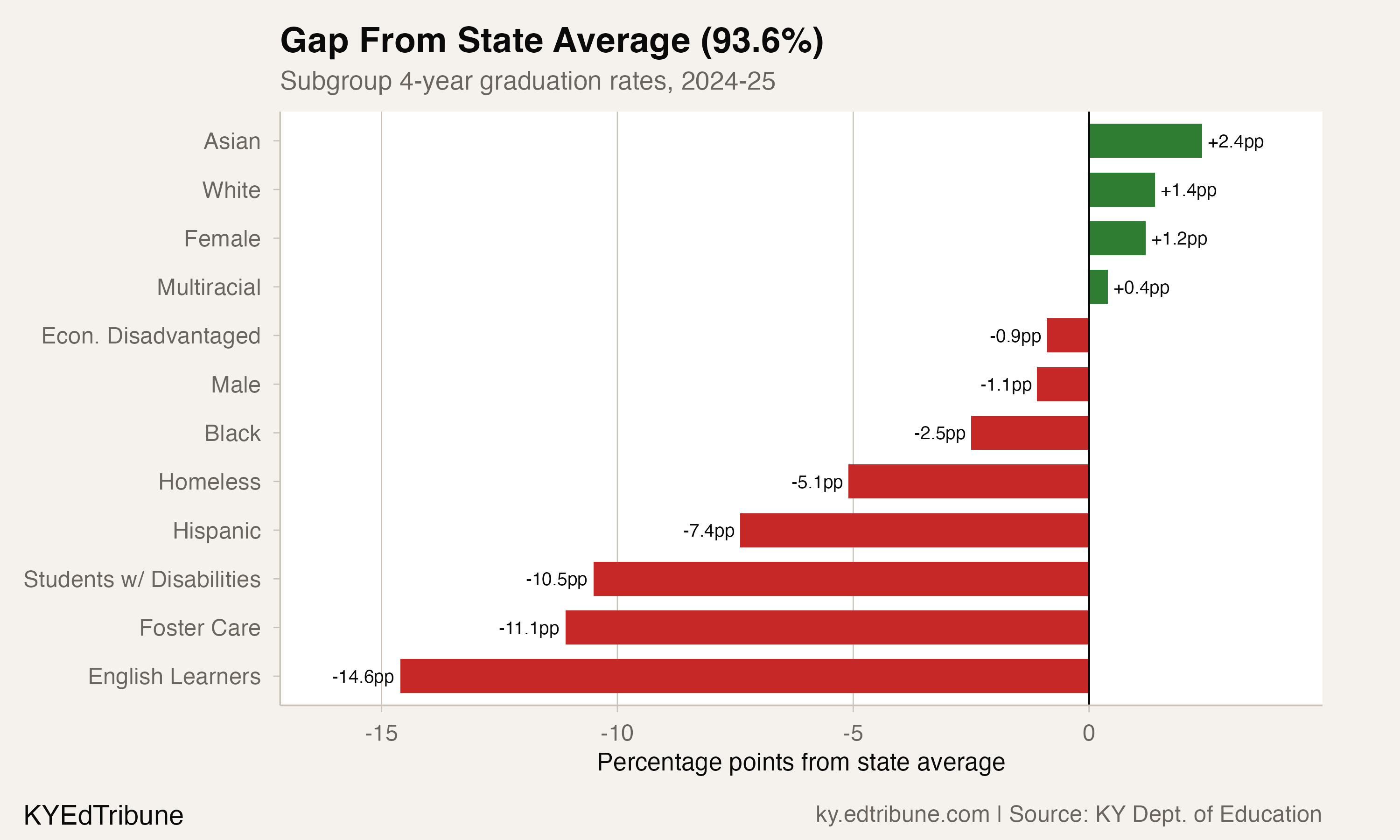
The gaps that remain
A 93.6% statewide rate lifts the floor. But for some student populations, the floor is still substantially lower.
English learners graduate at 79.0%, a 14.6-point gap from the state average and the widest equity gap in Kentucky's data. Foster care students graduate at 82.5%, an 11.1-point gap. Students with disabilities graduate at 83.1%, 10.5 points below average. Hispanic students are 7.4 points below.
The service-population trajectories are more encouraging than the snapshot suggests. Foster care students improved from 67.2% in 2021 to 82.5% in 2025, a gain of 15.3 points in four years. Students with disabilities gained 5.1 points over the full period. Economically disadvantaged students sit at 92.7%, just 0.9 points below the state average, a gap that has effectively closed.
The English learner trajectory is uneven. The rate climbed from 73.9% in 2020 to 82.4% in 2024, then fell back to 79.0% in 2025. The same cohort year that saw the Hispanic reversal. These two patterns likely overlap: Hispanic students account for a large share of the EL population, and the simultaneous dip in both groups suggests a common factor, possibly related to how recently arrived immigrant students are counted in graduation cohorts.
What the infrastructure looks like
Kentucky's Persistence to Graduation program, run through KDE's Division of Student Success, assigns every student a risk score based on attendance, behavior, course performance, and demographics. The system feeds an early warning tool that flags students before they disengage, giving school counselors and Family Resource Centers a structured way to intervene.
The timing of the state's gains aligns with broader investments in early literacy. The Read to Succeed Act (Senate Bill 9), passed in 2022, created the Kentucky Reading Academies, which train K-5 teachers in evidence-based literacy instruction. Third-party evaluators found statistically significant reading gains among students taught by LETRS-trained teachers. The connection between early literacy and graduation is well-established: students who cannot read proficiently by third grade are four times more likely to drop out.
The Prichard Committee for Academic Excellence, however, has raised a pointed counterargument to the graduation headline. Their report, "Kentucky's Edge: A Diploma That Means More," notes that just 12% of Kentucky employers report strong confidence in graduates' workforce readiness. The graduation rate measures completion, not preparation. At 93.6%, Kentucky gets students across the finish line. Whether the finish line is in the right place is a separate question the Prichard Committee wants the state to answer.
"Our Kentucky students performed at proficient or distinguished levels at a higher rate during the 24-25 school year." -- Education Commissioner Robbie Fletcher, Spectrum News 1, Nov. 2025
Nearly every district is above 90%
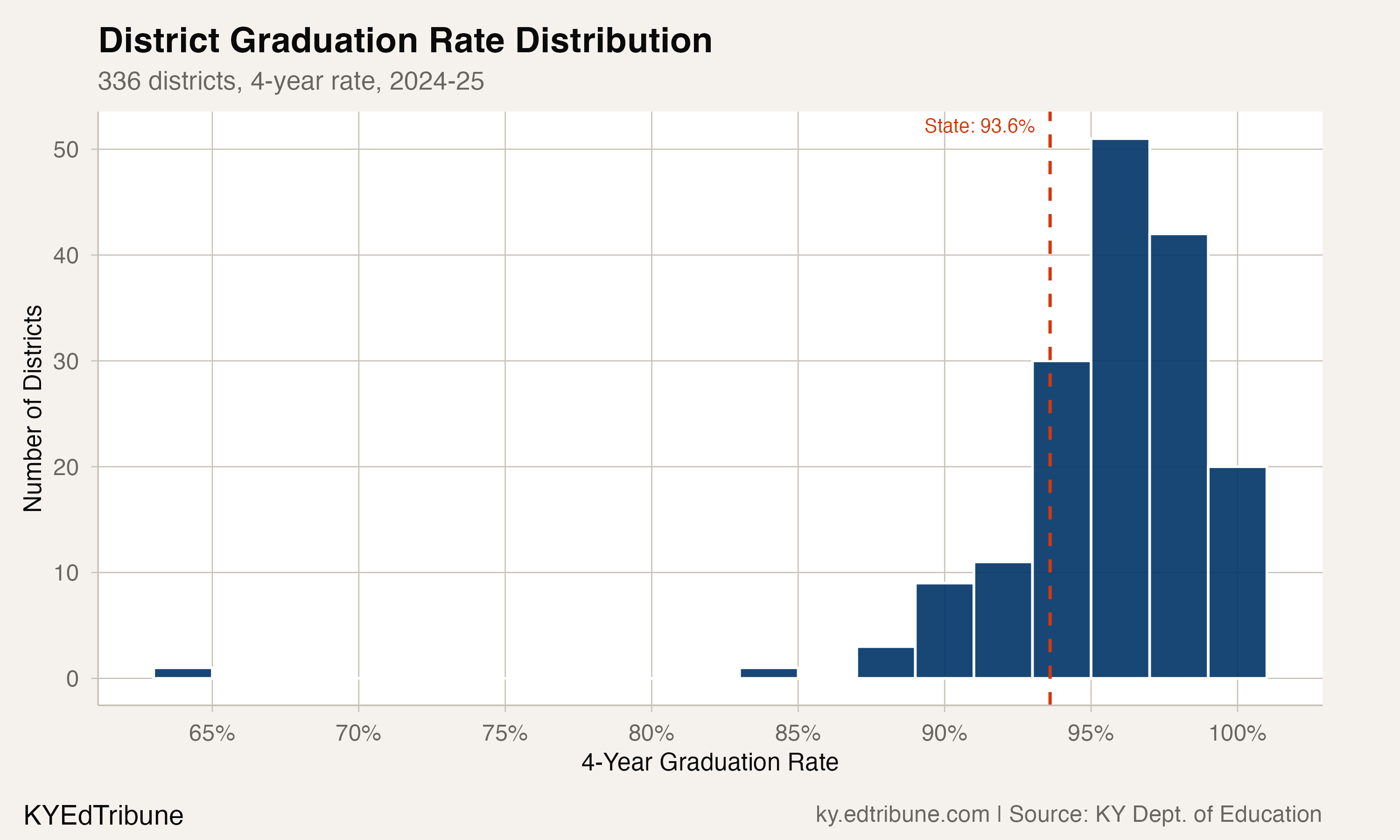
Of 168 districts reporting four-year graduation data in 2025, 160 are at or above 90%. More than two-thirds, 117, are at or above 95%. Only two districts fall below 85%.
The distribution is strikingly compressed. Twelve districts reported a perfect 100% rate. At the other end, Cloverport Independent, with a very small cohort, reported 64.1%. Paris Independent sits at 84.9%, followed by Fulton Independent at 87.5% and Shelby County at 87.8%. Jefferson County, the state's largest district, is close behind at 88.7%.
Jefferson County's position is worth isolating. As the state's largest district, with roughly 90,000 students, JCPS has improved from 83.7% to 88.7% over five years, a 5.0-point gain. Its gap to the state average narrowed from 7.4 points in 2020 to 4.9 in 2025. The improvement is steady: gains in every year. But 4.9 points below the state average in a state this strong still places JCPS closer to the bottom of the distribution than the middle.
The biggest district-level turnarounds came from smaller systems. Eminence Independent jumped from 75.8% to 94.9%, a 19.1-point gain. Covington Independent climbed from 75.3% to 90.4%, adding 15.1 points. Paducah Independent gained 13.2 points to reach 92.9%.
The gender gap is closing fast
In 2022, female students graduated at 92.8% compared to 87.4% for males, a 5.4-point gap. By 2025, that gap had narrowed to 2.3 points, with females at 94.8% and males at 92.5%. The improvement is almost entirely male-driven: male students gained 5.1 points in three years while female students gained 2.0.
That pace of male improvement is worth watching. If it continues, Kentucky's gender gap could effectively close within two years. For a metric that has been stubbornly wide in most states, 2.3 points is already unusually narrow.
The question behind the number
Kentucky's 93.6% graduation rate is real, it is improving, and it is broad-based. The gains are not concentrated in one district or one demographic. Black students, economically disadvantaged students, students with disabilities, foster care youth, and male students all improved. The white-Black gap has more than halved in five years. The state's early warning and intervention systems appear to be reaching the students who historically fell through the cracks.
The open question is the one the Prichard Committee raised. Postsecondary readiness stands at 83% of seniors, up from 81% the prior year, but that measure is broad: it includes academic benchmarks, career certifications, and the military. Kentucky employers' low confidence in graduate readiness suggests the diploma's signal value has not kept pace with its completion rate. The state is graduating more students than almost anywhere in the country. The next measure is whether what they learn on the way to that diploma matches what comes after.
Detailed code that reproduces the analysis and figures in this article is available exclusively to EdTribune subscribers.
Discussion
Sign in to join the discussion.
Loading comments...