In most states, the question about foster care students and high school graduation is whether the rate will crack 60%. In Kentucky, the question is different: whether it will crack 85%.
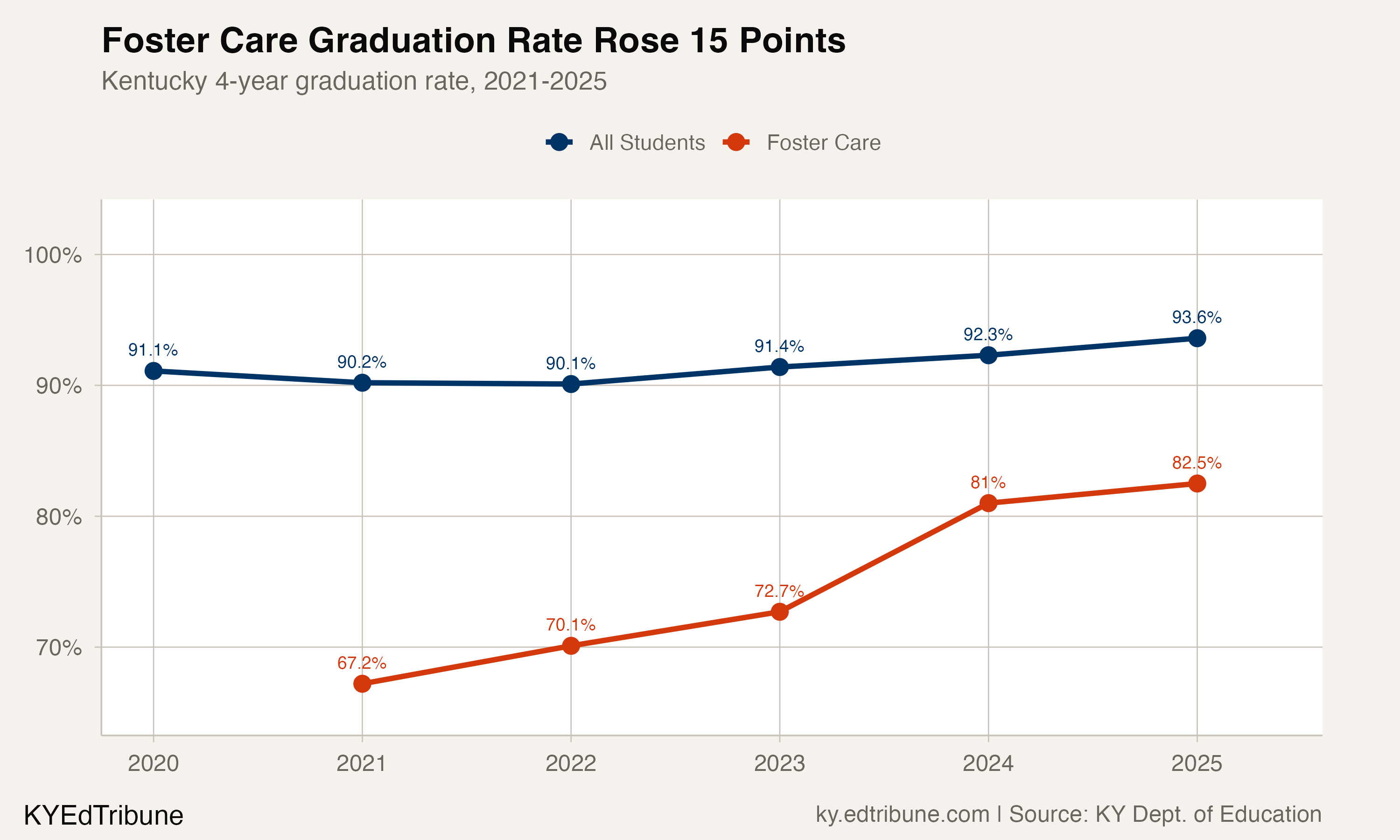
Kentucky's foster care students graduated at an 82.5% four-year rate in 2024-25, up from 67.2% just four years earlier. That 15.3-percentage-point climb cut the gap between foster youth and their peers nearly in half, from 23 points to 11.1. The rate sits roughly 20 points above what most states report for the same population, a gap so large it demands explanation.
What 82.5% means in context
The national picture for foster care graduation is bleak. Nine states reported four-year rates below 50% in recent years, according to an analysis by the Foundation for Research on Equal Opportunity. California, the largest state reporting the metric, posted 66.6% for foster youth in 2024-25. Washington's five-year rate hovered at 49%. Montana, previously cited as a national leader, reached 71%.
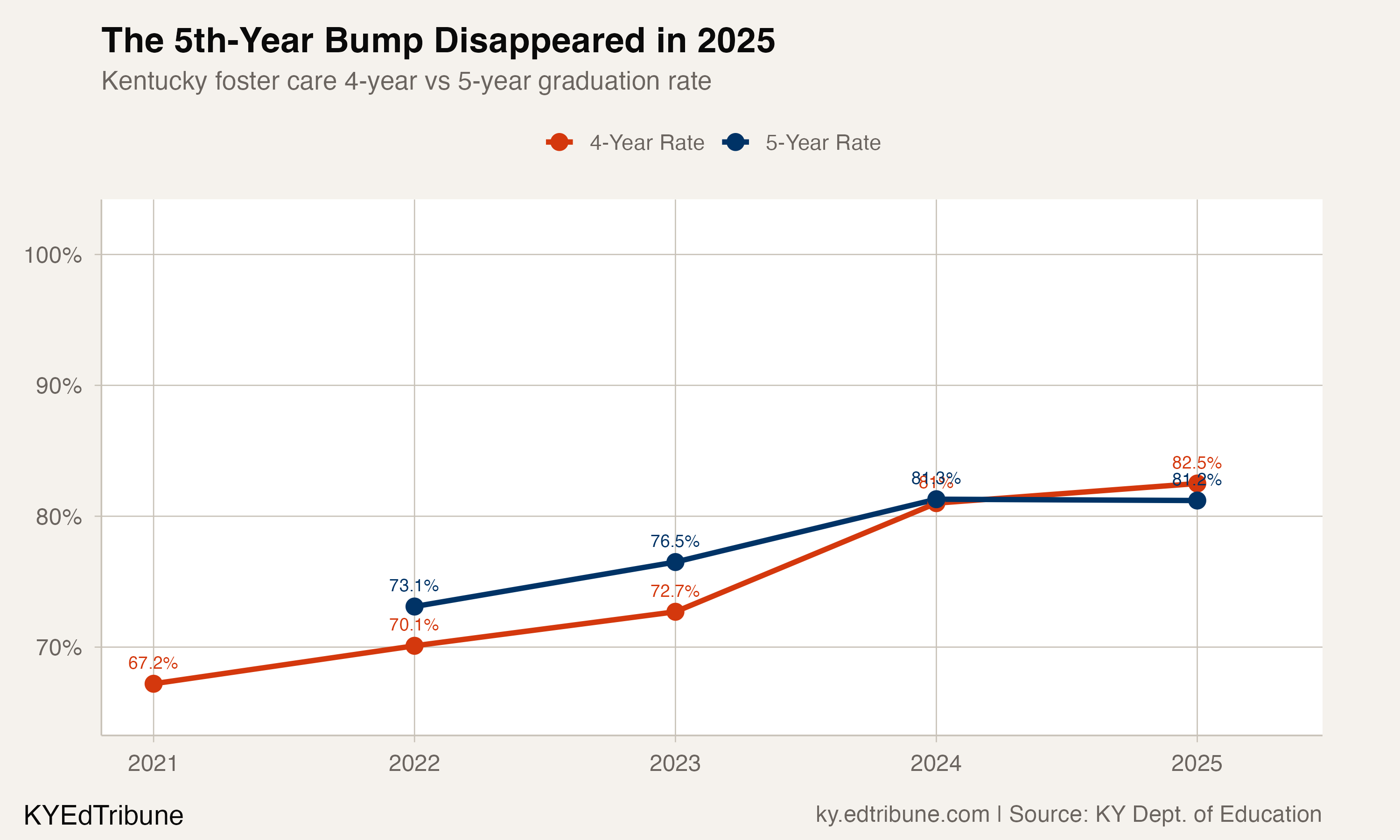
Kentucky's 82.5% is not a rounding artifact. The rate has climbed steadily each year since the state began reporting it in 2020-21: 67.2%, 70.1%, 72.7%, 81.0%, 82.5%. The biggest single-year jump came between 2022-23 and 2023-24, when the rate vaulted 8.3 points from 72.7% to 81.0%.
The gap that halved itself
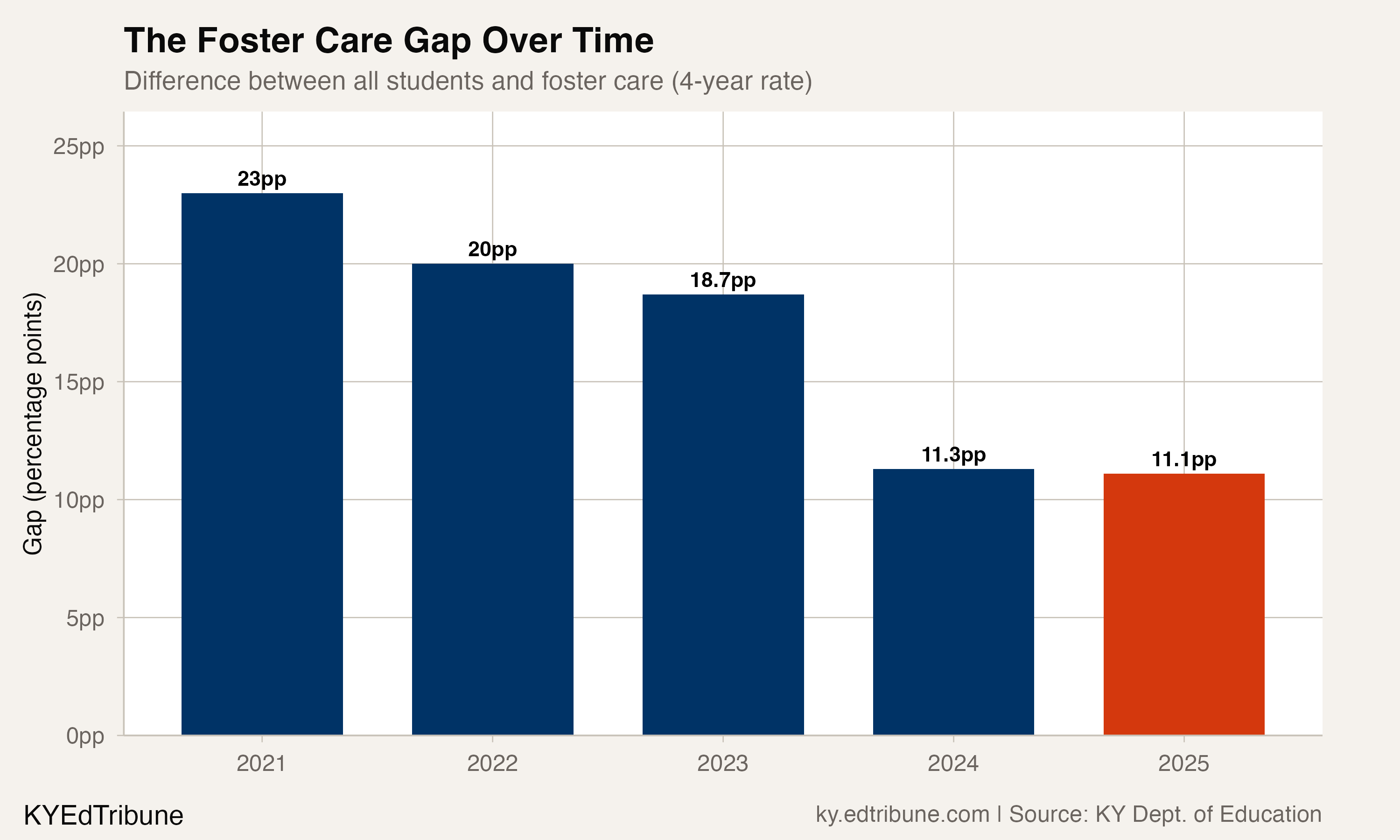
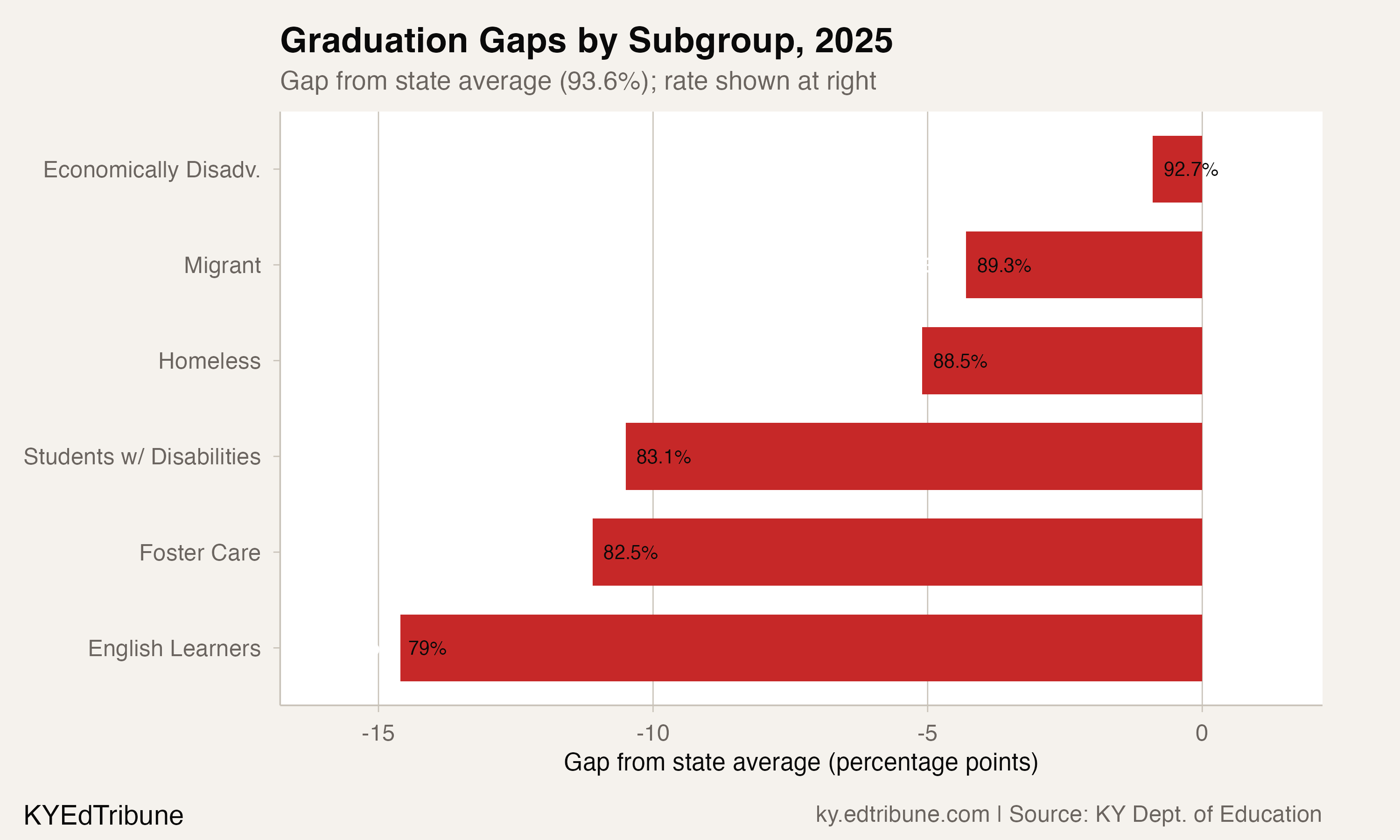
The 11.1-point gap between foster care students and Kentucky's overall 93.6% rate is real, persistent, and the second-widest equity gap the state reports, behind only English learners at 14.6 points. But four years ago it was 23 points. The compression happened because foster care students improved at six times the pace of the overall student body: 15.3 points of gain versus 2.5 for all students combined.
Among the state's vulnerable populations in 2024-25, foster care students (82.5%) sit between English learners (79.0%) and students with disabilities (83.1%). Economically disadvantaged students, by contrast, graduate at 92.7%, just 0.9 points below the state average. These categories overlap substantially: many foster youth are also classified as economically disadvantaged or receiving special education services.
Why Kentucky's number looks so different
Two structural factors likely explain why Kentucky outperforms the national norm by such a wide margin, though neither fully accounts for the four-year surge.
The first is the rising tide. Kentucky's statewide graduation rate of 93.6% is among the highest in the country. When the overall rate is that high, the floor for even the most disadvantaged subgroups rises with it. Every support system, credit recovery program, and graduation coach that lifts the all-student rate also catches foster youth who might otherwise fall through.
The second is school stability policy. Under the Every Student Succeeds Act, Kentucky districts are required to keep foster children enrolled in their school of origin when a placement changes, rather than transferring them to whatever school is nearest to their new home. The Kentucky Department of Education publishes transportation guidance specifying that districts must coordinate with child welfare agencies to fund and arrange transportation so that foster youth do not lose continuity. Research consistently links school changes to lower graduation rates, and Kentucky's implementation of these stability provisions coincides with the period of steepest improvement.
Neither explanation accounts for the 8.3-point jump in a single year between 2022-23 and 2023-24. It is possible the state tightened identification practices, expanded credit recovery access, or benefited from cohort-level variation in a population that numbers roughly 500 students statewide. The 2020-21 cohort, the only year with published counts, included 515 students in the four-year cohort. A population that small is more susceptible to year-over-year swings than a subgroup like economically disadvantaged students, which includes hundreds of thousands.
Where JCPS falls behind
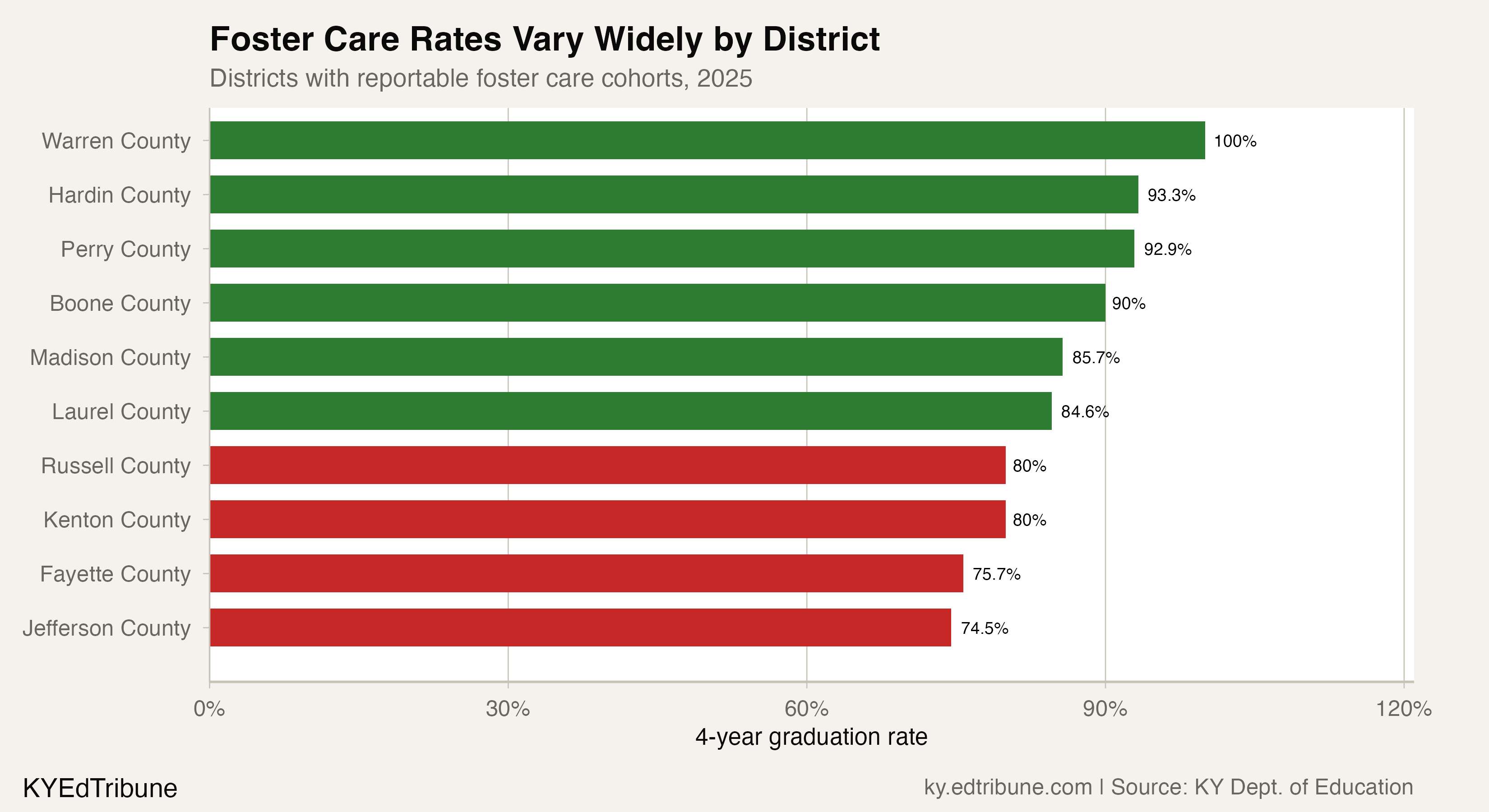
Only 10 of Kentucky's 171 districts have foster care cohorts large enough to report. Jefferson County Public Schools, the state's largest district at roughly 93,000 students and home to Louisville, posts the lowest reportable rate at 74.5%, trailing the state foster care average by 8 points and the statewide all-student rate by 19.1 points.
The gap is not surprising. JCPS has the largest concentration of foster youth in the state and operates in a metro area that Kentucky's Cabinet for Health and Family Services has identified as a high-need region. The district runs a dedicated foster care program through its central office, but the sheer volume of placement changes, caseworker turnover, and housing instability in Louisville creates friction that smaller districts with a handful of foster students do not face.
Fayette County, home to Lexington and the state's second-largest district, reports 75.7%. Together, the two urban anchors sit 7 to 8 points below the state foster care average.
At the other end, six districts post rates at or above the state foster care average, including Warren County at 100%, Hardin County at 93.3%, and Perry County at 92.9%. Small cohort sizes in these districts make the rates volatile from year to year, but the pattern holds: smaller, more stable districts tend to report higher foster care graduation rates.
The vanishing fifth-year bump
One data point complicates the good-news narrative. In most years and for most subgroups, the five-year graduation rate exceeds the four-year rate, capturing students who needed an extra year to finish. For foster care students, the five-year rate added 3 to 3.8 points in 2021-22 and 2022-23, consistent with a population that benefits from extended timelines.
In 2024-25, the relationship inverted: the five-year rate (81.2%) fell below the four-year rate (82.5%) by 1.3 points. The five-year cohort is a different group of students than the four-year cohort. The class whose five-year rate was measured in 2025 started as the four-year cohort of 2024, which graduated at 81.0%. These students gained just 0.2 points with the extra year, compared to the 3.8-point bump the 2023 cohort received.
This could signal that the students who do not graduate in four years are increasingly the ones who face barriers too severe for one additional year to resolve, or it could reflect normal small-cohort variation. The trend is worth watching.
The 8,600 in the background
The graduation data captures a narrow slice of Kentucky's foster care population. As of mid-2025, more than 8,600 children were in state custody, a number driven upward by the opioid crisis that has defined eastern Kentucky for more than a decade. Only a fraction of those children are high school seniors in any given year. The 515-student cohort reported in 2020-21 represents perhaps 6% of the total foster care population.
Kentucky's foster care system is itself in crisis. A March 2026 audit by State Auditor Allison Ball found that more than 300 children were placed in government office buildings, hotels, and state parks between January 2023 and October 2024 because no licensed placement could be found. The Kentucky House in 2025 passed a sweeping child welfare reform bill aimed at streamlining placement and empowering foster parents.
The graduation rate is the outcome that matters most for these children's long-term prospects. An 82.5% rate means roughly one in six foster youth still does not finish high school in four years. Whether the rate continues climbing toward 85% or plateaus where it stands will depend on whether the system that surrounds these students, from caseworkers to school liaisons to foster families, can hold together under the weight of a caseload that shows no sign of shrinking.
Detailed code that reproduces the analysis and figures in this article is available exclusively to EdTribune subscribers.
Discussion
Sign in to join the discussion.
Loading comments...