
Matthew D. Engel did not apply anywhere else.
"Being able to lead the district that raised me means everything...I was only going to be the Superintendent of the Erlanger/Elsmere Independent School district," he wrote in response to questions from The KYEdTribune. "I never had any aspirations to leave, apply or work elsewhere, so had I not been chosen to lead in this capacity, I would have continued to serve our students in my former role of Assistant Superintendent."
He became superintendent of Erlanger-Elsmere Independent↗ET on July 1, after several weeks as interim in June while his predecessor finished out a retirement.
The district he took over is one of the steadier ones in Kentucky, and Engel has a specific explanation for why.
"As a landlocked district, our enrollment remains remarkably steady," he wrote.
The record supports the characterization. Across the six-year window Kentucky reports on a consistent basis, Erlanger-Elsmere moved between 2,619 and 2,749 students, a spread of 130 on a base of roughly 2,650. It enrolled 2,650 in 2024-25, the most recent comparable published year.
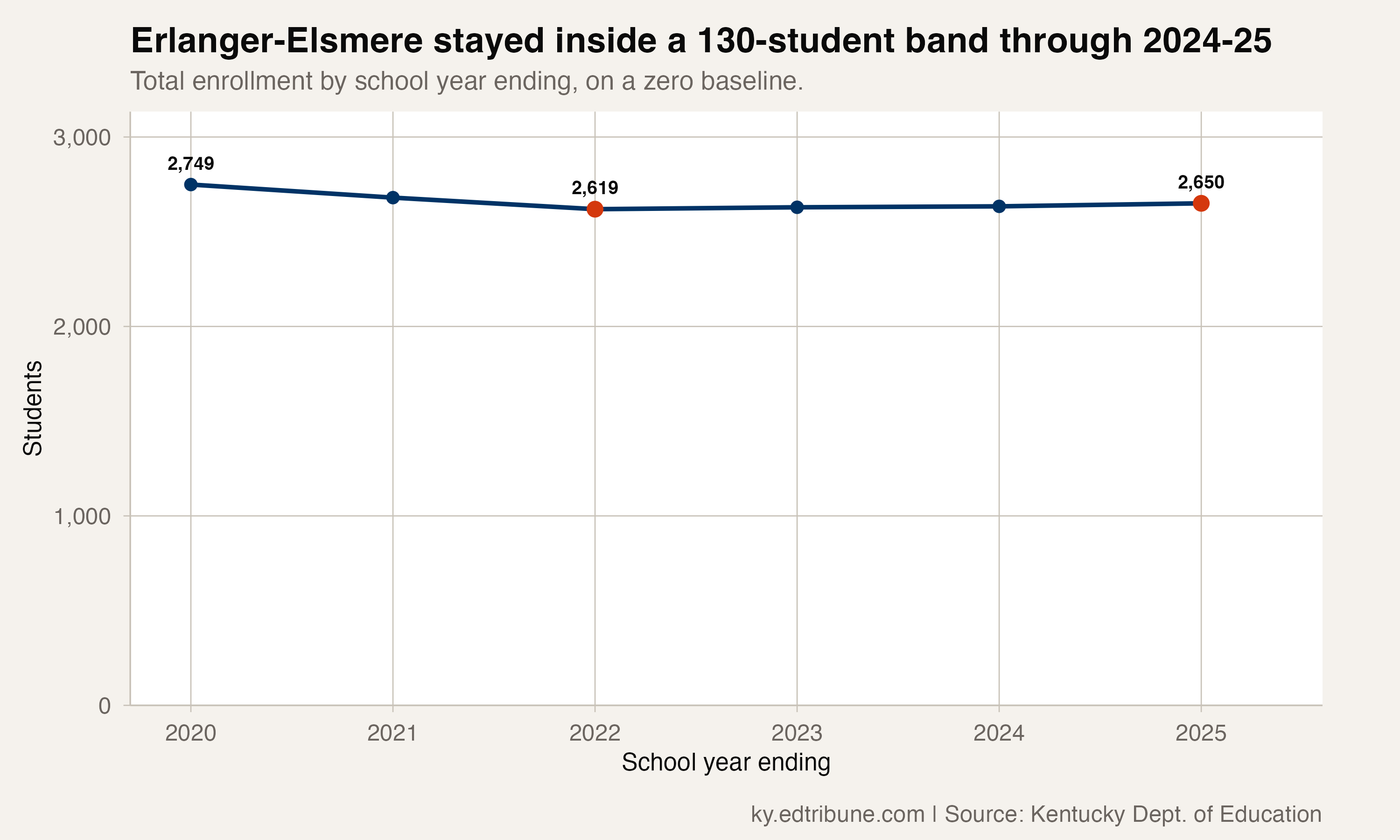
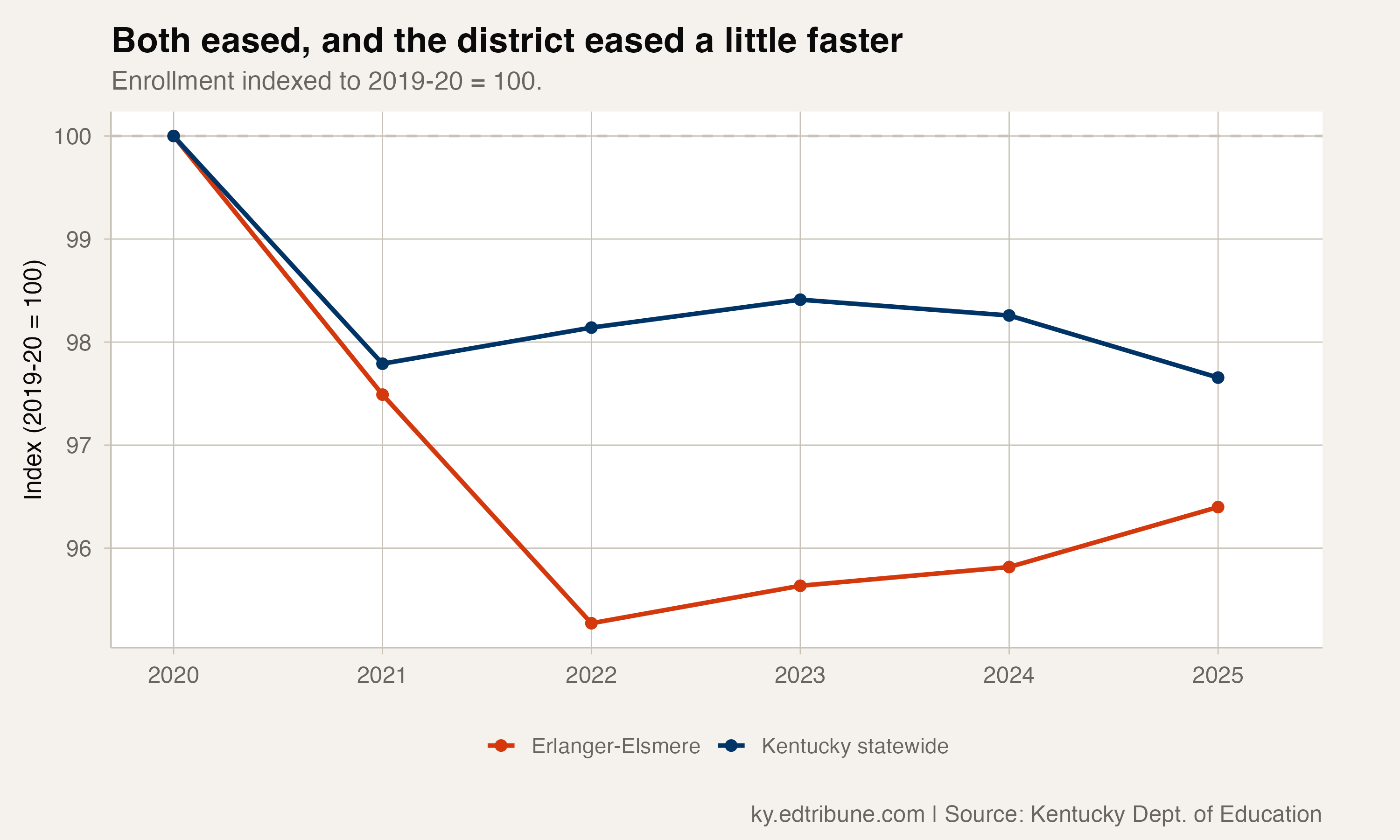
Steady is not the same as flat, and the direction is worth stating plainly. The district is 99 students below where it stood in 2019-20, a decline of 3.6 percent. Kentucky as a whole fell 2.3 percent over the same six years, so Erlanger-Elsmere eased slightly faster than the state did, not slower.
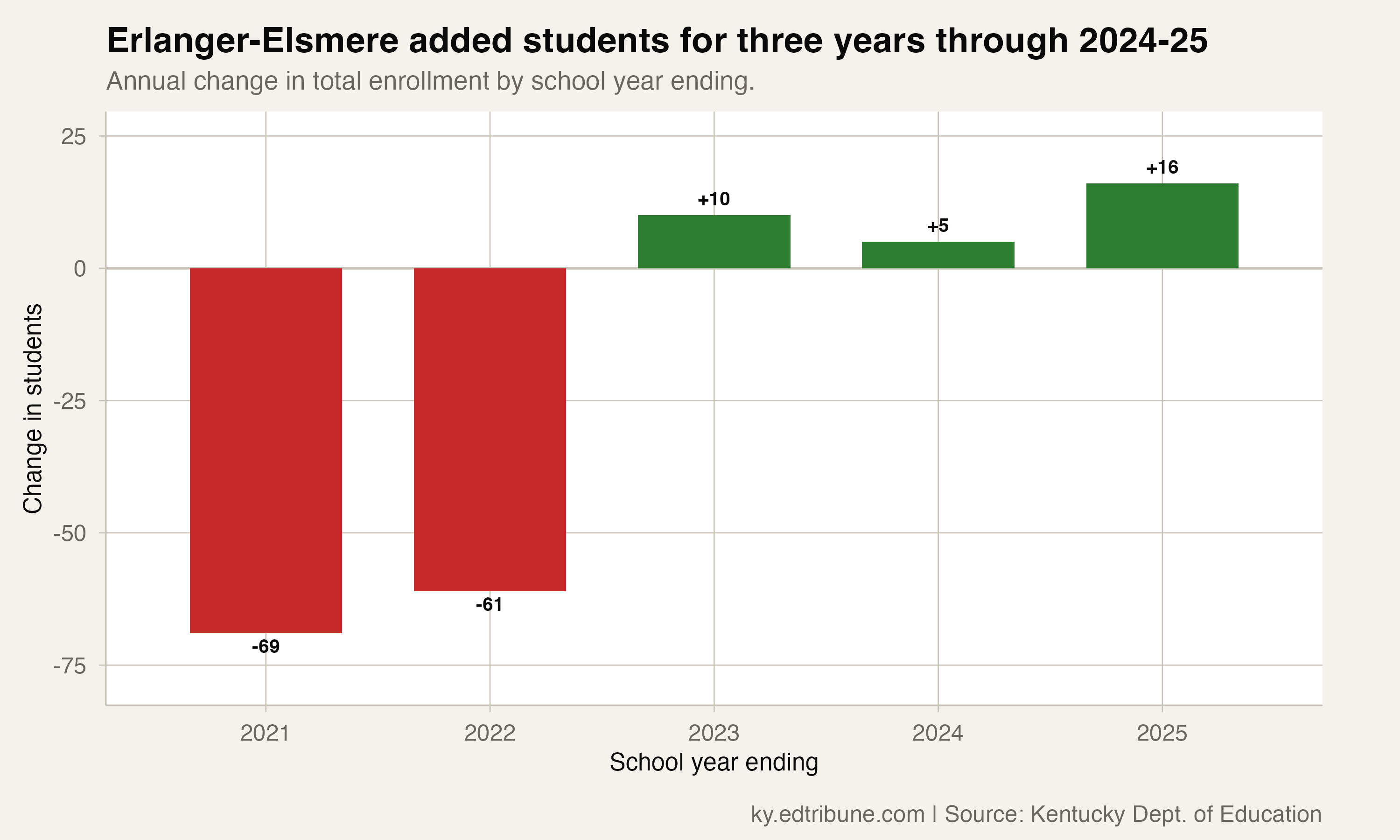
The recent movement in that published window runs the other way. The district bottomed at 2,619 in 2021-22 and rose in each of the next three years through 2024-25, adding 31 students.
Why steadiness is a budget argument
Engel's reading of that record is a practical one. Steady attendance, he wrote, is what lets the district plan and budget nearly year to year, short of a significant change in the state funding formula or something catastrophic in the district.
"What that provides us as a district is the ability to plan and predict budgets with relative certainty so that we are not facing surprises from year to year," he wrote. "Money isn't everything, but when you have time to plan and apply money to large budget items like capital projects; staff raises; bus purchases or field overhauls, your staff, your families and your taxpayers certainly appreciate it."
He connected that directly to the thing he says matters most.
"We can generally map out the 'big ticket' items over time so not one single budget cycle feels a hit," he wrote. "With that, you are almost guaranteeing the best opportunity to recruit/retain staff, which is the most impactful thing I can give students--that quality teacher. If that staff member knows that raises are things our district regularly does, I am able to keep my best student resource here in my district."
Engel credited a single earlier job with teaching him how the pieces connect.
"There's no doubt that each stop of the journey helped shape my approach to leadership--none more than leading Arnett Elementary for six years," he wrote. "Being a building Principal, and overseeing every aspect of that operation gave me the most insight into learning how ALL of the systems that exist in schools have to work together. If one aspect of the system is off or experiencing difficulty, it starts to impact the other cogs in the wheel. And so when I eventually was promoted to Central Office roles, that context that I built and acquired at Arnett was immediately applicable to district-wide initiatives or needs."
Asked what he expects of the people who work for him, he set the bar in terms of effort rather than outcomes.
"We have the amazing responsibility to be able to improve outcomes for our kids," he wrote. "And to do that, you have to show up every day; you have to work hard; and you have to commit to the mission and vision of this district. Every day, we need to grow--whether that is as students acquiring and applying new learning, or as staff members learning new pedagogical practices, there is a focus on each day being better than we were yesterday."
Whether the district stays landlocked in the way Engel means it, bounded and therefore predictable, is not something the enrollment record can settle. What it can show is that for six years the number has barely moved, and that the last three years moved up.
Enrollment figures come from the Kentucky Department of Education public enrollment record. The window is 2019-20 through 2024-25, the years Kentucky reports on a consistent basis for this district; earlier years are published at a coarser grain and the most recent file is a different, earlier-in-year collection, so neither is compared here. Statewide figures use Kentucky's published state total. Engel responded in writing.
Detailed code that reproduces the analysis and figures in this article is available exclusively to EdTribune subscribers.
Discussion
Sign in to join the discussion.
Loading comments...