
On the last day of school, Dylan Smith handed every teacher in Walton-Verona three note cards and asked them to write down the core values that drive the work.
He was counting. By his own tally, roughly a third of the words that came back were about culture rather than achievement: family, community, pride.
"It was a very nice surprise to learn that educators here prioritize those things so highly," he wrote in response to questions from The KYEdTribune.
Smith became superintendent of Walton-Verona Independent↗ET on July 1, succeeding Matthew Baker. He came from Oldham County, after earlier stops as far afield as New Orleans and Washington state.
"I've had great professional experiences in small school networks," he wrote. "My superintendent in Oldham County came from a nearby county and spoke highly of Walton-Verona. As I learned about this opportunity, I saw it as a strong fit for my skills."
A district that has held its size
The Walton-Verona that Smith inherits is, on the state's own numbers, remarkably level. Across the six years Kentucky reports enrollment on a consistent basis, the district has moved between 1,936 and 1,994 students, a spread of 58. It enrolled 1,952 in 2024-25.
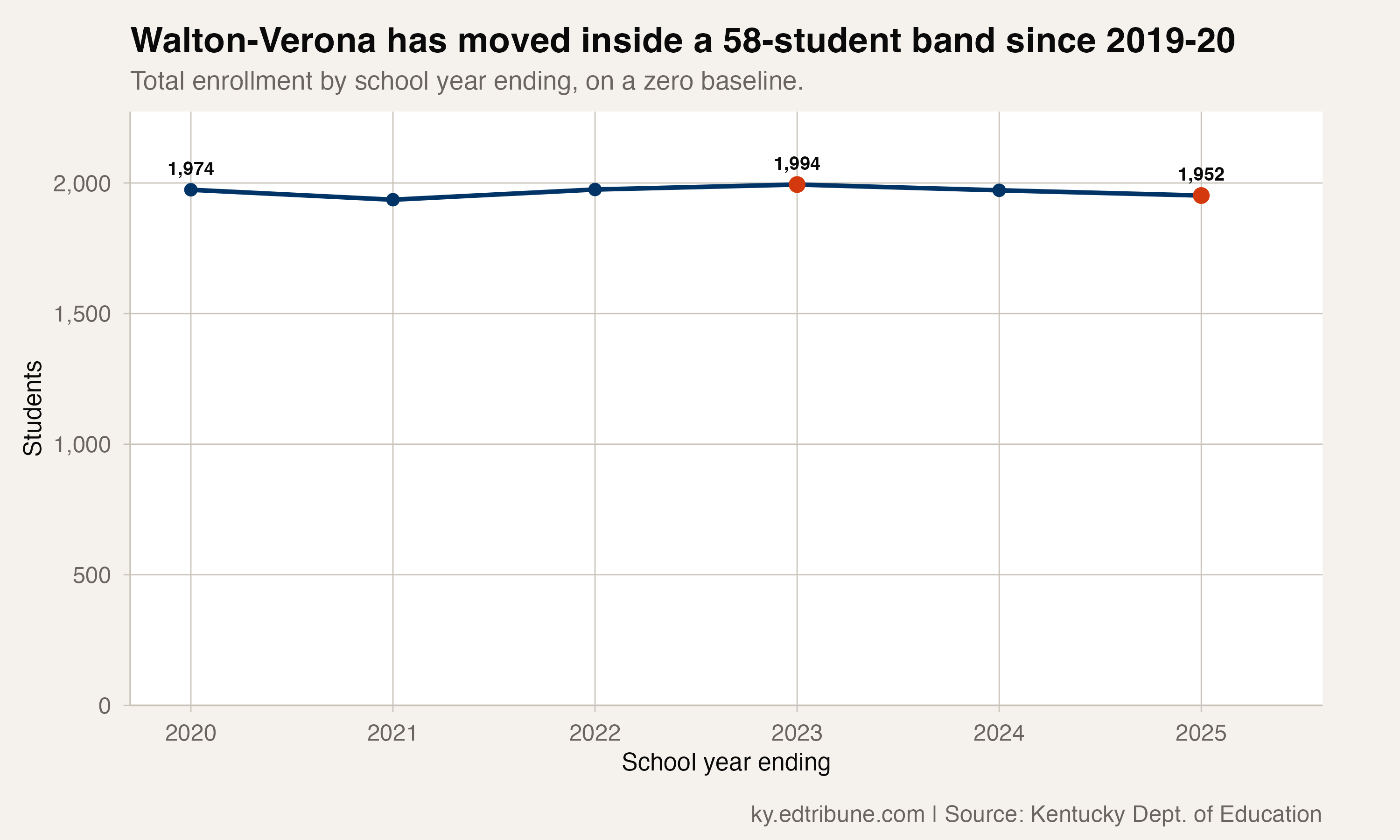
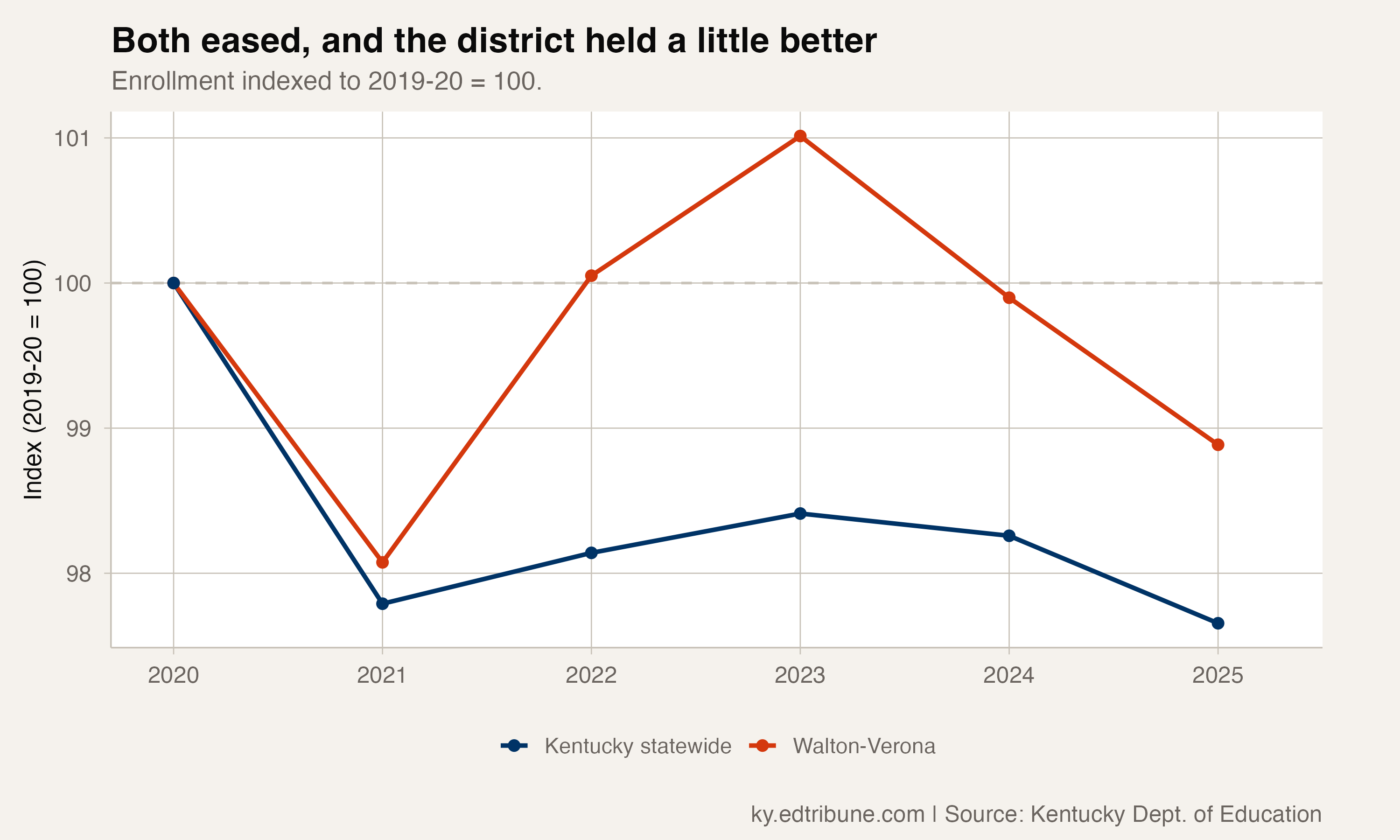
Level is not the same as rising, and the direction is worth stating plainly. The district is 22 students below where it stood in 2019-20, a decline of about 1 percent. Kentucky as a whole fell 2.3 percent over the same six years, so Walton-Verona held a little better than the state did. It peaked at 1,994 students in 2022-23 and has slipped in each of the two years since, ending 42 students below that high.
A note on the window. Kentucky changes what a district total counts at 2019-20: earlier years report a single total with no prekindergarten row, and later years report the full grade spine with prekindergarten included. Comparisons across that seam measure two different things, so this article does not make one.
The growth he is planning for
Smith's own account of the district's trajectory reaches further back than the comparable record does, and it is the frame he is using to plan.
"The surge in growth from 2014 to 2023 was much faster than most district alumni expected," he wrote. He credits a board that bought the land the intermediate school now sits on, expanded those holdings, and started the first phase of a three-phase project for Walton-Verona High School. It is planning generations out, he wrote, so that "the grandchildren of our current students will have access to a top-quality education."
The intermediate school he describes now holds 293 of the district's 1,952 students, the smallest of its four graded buildings.
What he is watching next is upstream of the enrollment file entirely.
"I'm watching the growth in housing permits as Walton's sewage capacity expands," he wrote, naming it first among the trends on his desk.
That is a reasonable thing for a superintendent in Boone County to track, and it is not something the state enrollment record can confirm or refute. Building permits are not students until they are.
The signal that runs the other way
Inside the building, the near-term pipeline points down rather than up.
Walton-Verona enrolled 117 kindergarteners in 2024-25 and 143 twelfth-graders. The youngest class in the district is 26 students smaller than the one walking out the door.
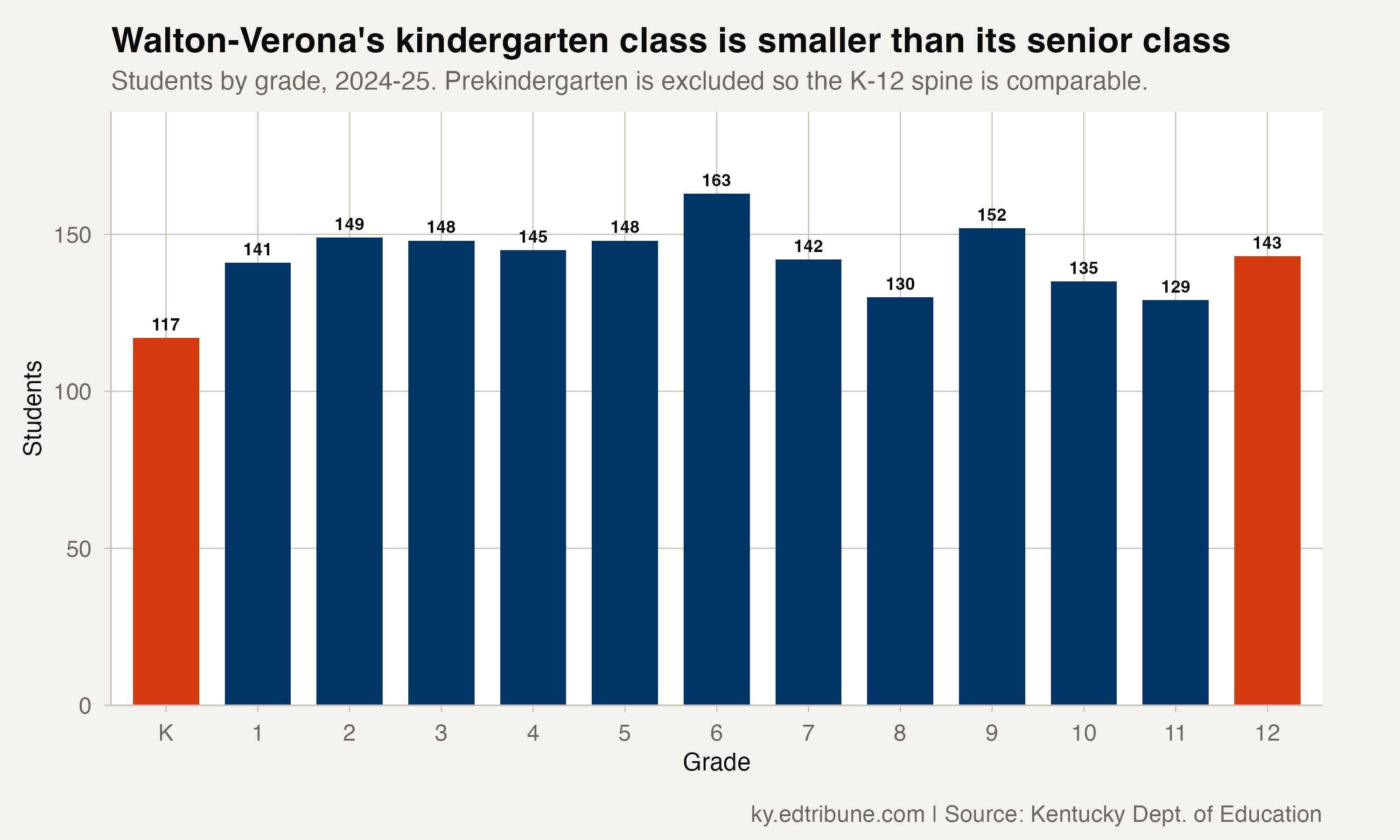
The gap narrows when the comparison widens. Kindergarten through third grade holds 555 students against 559 in grades nine through twelve, close to even. So the story here is a small kindergarten cohort rather than a hollowing elementary end, and one cohort in a district this size can move on a single year's births or a single subdivision opening. It is a planning signal, not a forecast.
But it sets up the decision Smith will actually face. A three-phase high school project and a sewer-gated housing pipeline are both bets on students who are not enrolled yet, and the classes currently entering the system are smaller than the ones leaving it. Which of those two facts turns out to govern the next decade is the open question in Walton-Verona, and it will be answered by kindergarten registration numbers long before it is answered by a ribbon cutting.
Staffing and the year ahead
Smith's other two watch items are closer in.
"I'm looking for creative ways to recruit foreign language teachers, which has been a hard-to-fill position at our high school," he wrote. He is also interested in "finding efficiencies across our departments using technology tools."
Neither is unusual for a district of this size and profile. Walton-Verona is 88.6 percent white, with about 42 percent of students qualifying for free or reduced-price meals and 16.3 percent receiving special education services.
For now, though, he describes the job mostly as listening.
"Year one is about listening," he wrote. "I'm meeting students, families, and educators across the district to understand their top priorities. Then I'll synthesize what I'm hearing and organize it in a way that benefits our school district in the future."
Asked what he most wants families to understand, he did not reach for a strategic plan.
"I want families to know that I center students in every decision I make," he wrote. "Like all families, I want their child to be known, valued, and supported in school. I believe teachers do the most important work in our school system, inspiring children to reach their full potential."
The note cards suggest his teachers were already thinking along similar lines. Whether that shared vocabulary survives contact with a building program, a hiring market, and a kindergarten class of 117 is the part nobody can write down on an index card.
Enrollment figures are from the Kentucky Department of Education. Dylan Smith responded to written questions from The KYEdTribune on August 5 and August 24, 2026.
Detailed code that reproduces the analysis and figures in this article is available exclusively to EdTribune subscribers.
Discussion
Sign in to join the discussion.
Loading comments...