
M. Kent Mayfield did not have to learn Pulaski County↗ET to run it. He has worked there for 28 years.
"Pulaski County has been home for most of my professional life," Mayfield wrote in answer to questions from The KYEdTribune. "I have spent 28 years working in this school district, serving in a number of different roles and getting to know our students, families, and communities."
He became superintendent of Pulaski County Schools on July 1, a date he confirmed in writing. He succeeded Patrick Richardson, whose retirement WYMT reported in April; the same report named Mayfield as his replacement and noted that he had spent the previous year as the district's assistant superintendent.
"So, for me, becoming superintendent wasn't about being drawn to a new place," he wrote. "It was about having the opportunity to give back to a school system that has given me so much."
Mayfield describes a first year built around listening rather than announcements.
"My approach to leadership is rooted in servant leadership," he wrote. "My job is to support the people who work with our students every day and remove barriers that keep them from doing their best work."
The list of things he intends to work on is long and, by his own account, deliberately unranked: student achievement, school safety, student well-being, employee morale, communication, and what he called responsible stewardship of the district's resources.
The landscape he inherits
The district has been getting smaller for a while.
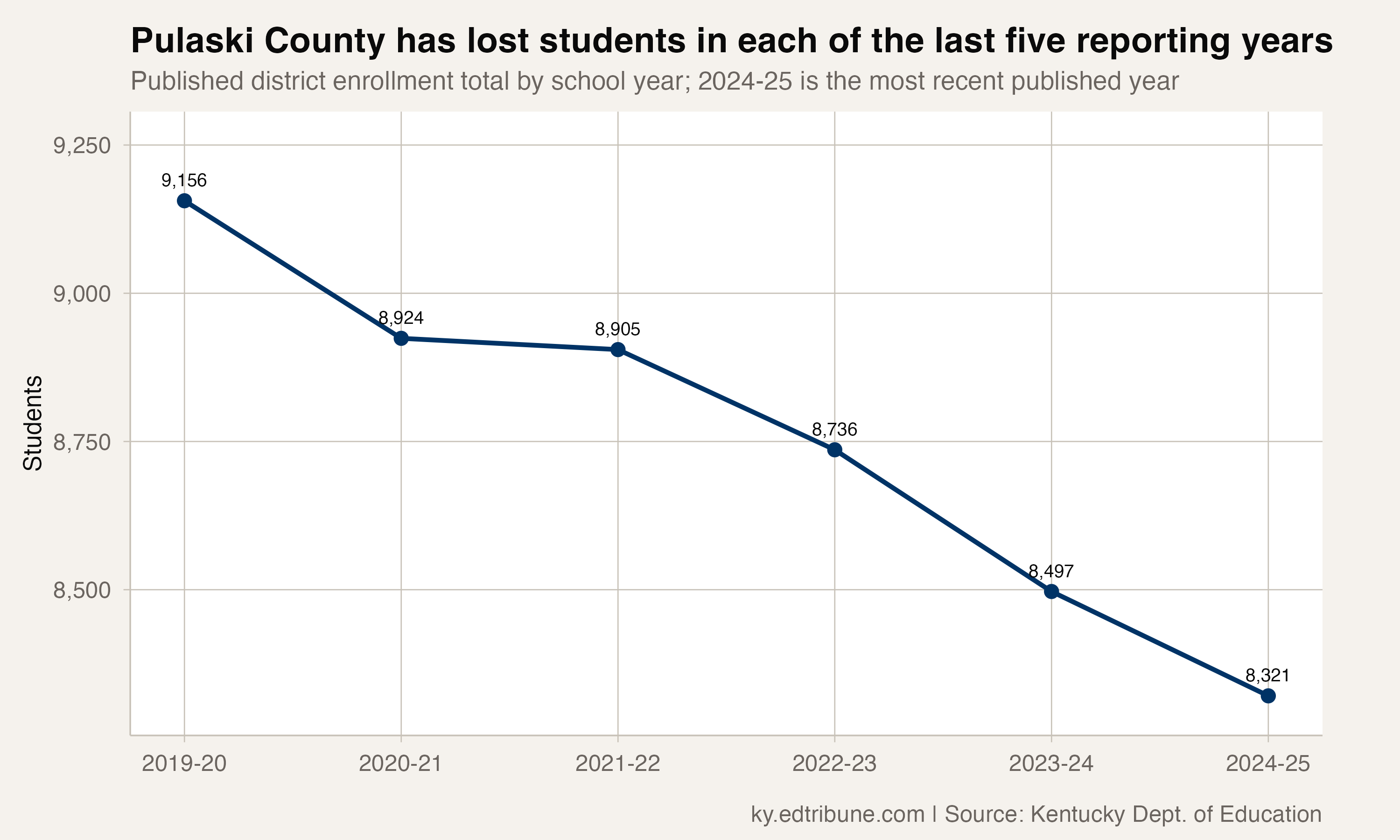
Pulaski County enrolled 8,321 students in 2024-25, the most recent school year in Kentucky's published enrollment record. That is 835 fewer students than the 9,156 the state published for 2019-20, a drop of 9.1 percent. Counts for the current 2026-27 school year are not in the published record and will differ.
The decline has been unbroken. Each of the five annual transitions in that window moved down, across six reporting years, with no flat year and no rebound. The largest single-year loss was 239 students in 2023-24. The most recent was 176 students, or 2.1 percent.
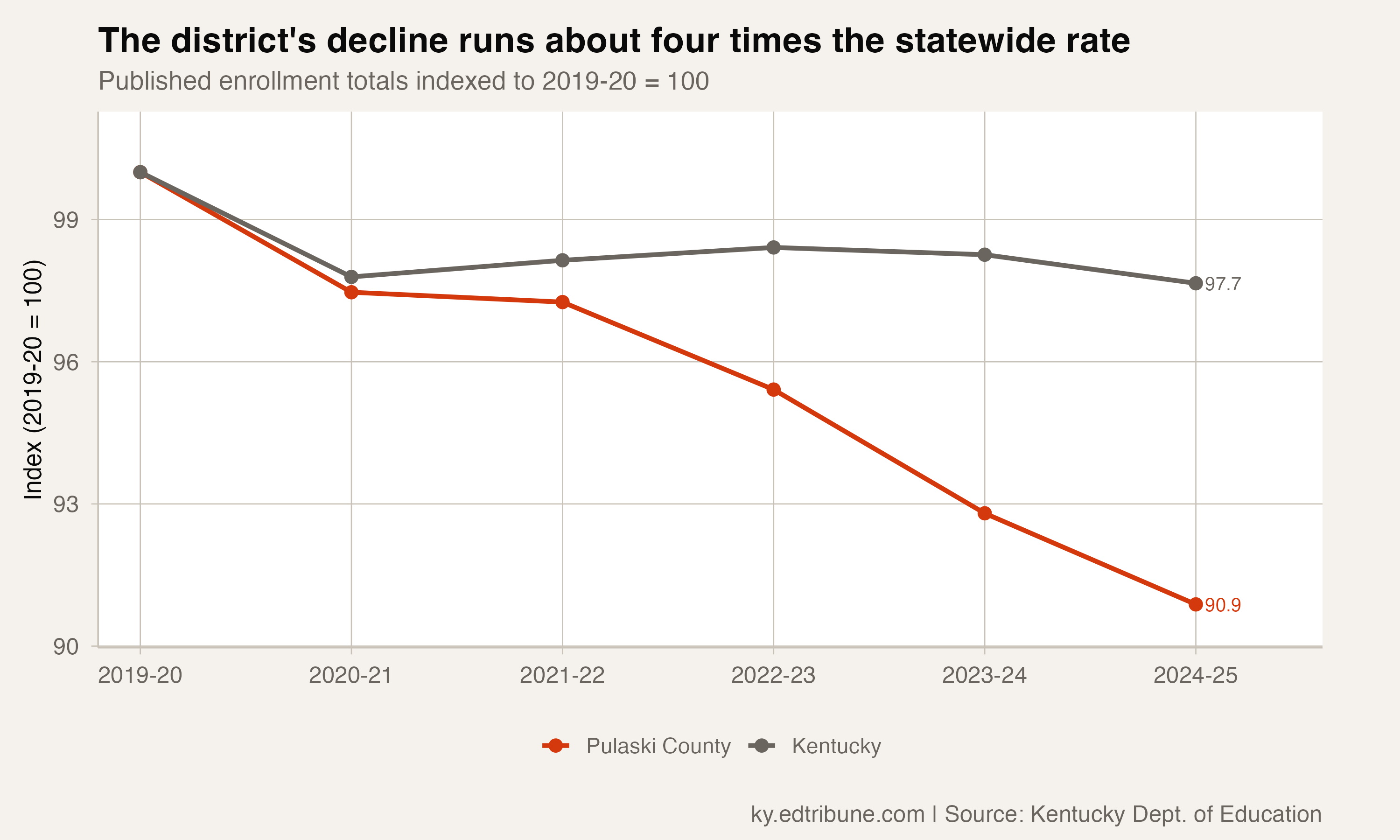
That is a steeper path than the state's. Kentucky's published statewide enrollment fell 2.3 percent over the same six years, so Pulaski County's rate of loss is roughly four times the statewide rate.
The record establishes the movement. It does not explain it. Nothing in the state's enrollment files identifies why a family left, stayed, or arrived, and this article does not assign a cause to a pattern the data cannot speak to.
Scale matters here too. Even after six years of losses, Pulaski County is the 15th largest of the 175 district-level records Kentucky published for 2024-25. This is a big district with a shrinking headcount, which is a different management problem from a small district with the same percentage.
Where the students are
The more immediate question for staffing and buildings is not the total. It is how that total is distributed across grades.
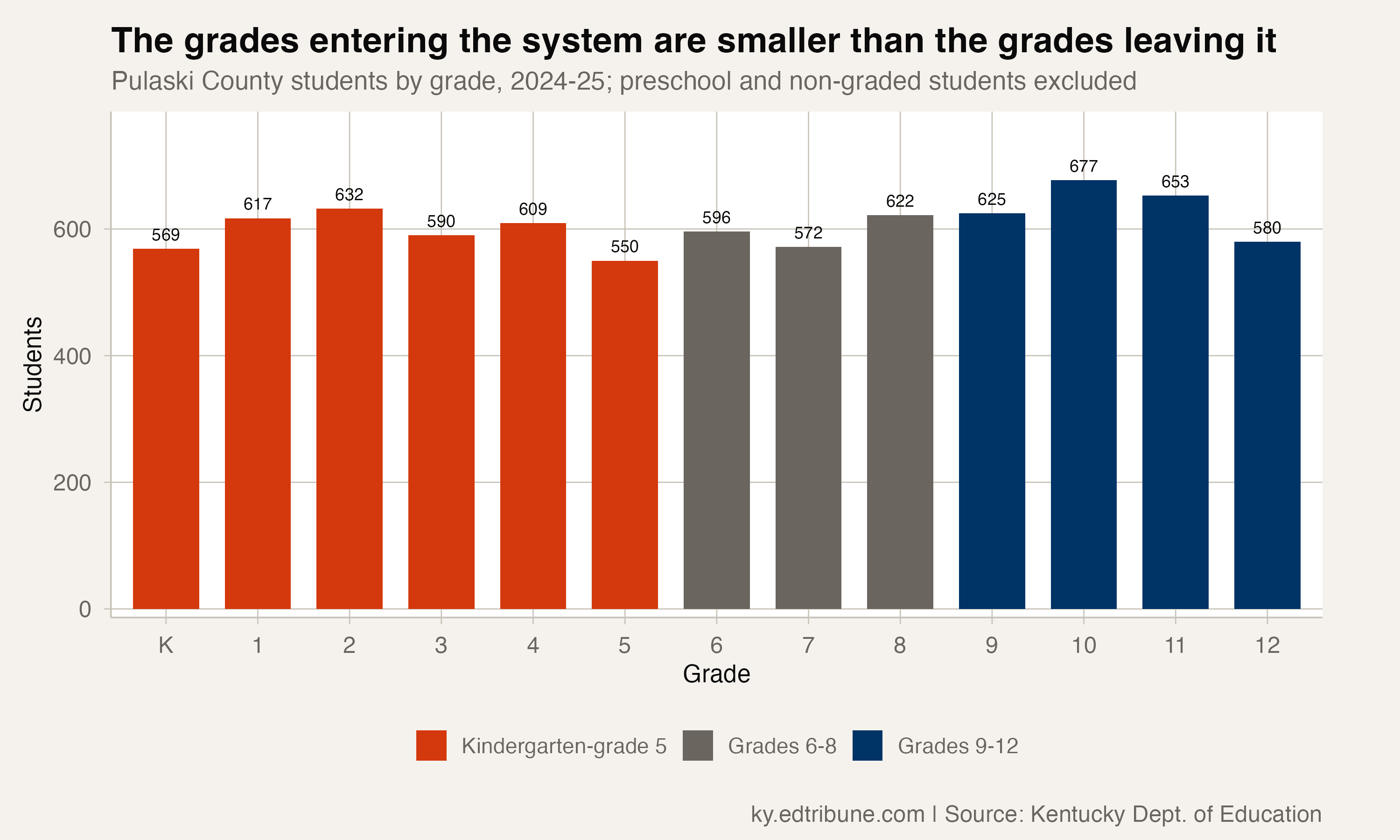
In 2024-25 the district enrolled 7,892 students across kindergarten through the senior year, plus 419 in preschool. The lower grades are thinner than the upper ones. Kindergarten through grade 5 averaged 595 students per grade; the four high school grades averaged 634. Kindergarten enrolled 569 students and the senior class enrolled 580.
The gap is not dramatic, and a single year of grade counts is a planning signal rather than a forecast. But it points in a consistent direction: the classes moving into the system are slightly smaller than the classes moving out of it, which is the shape a district sees before its high schools feel what its elementary schools already have.
Mayfield's own read of the next few years is cautious in both directions.
"I think enrollment will fluctuate somewhat over the next few years, and we need to be prepared to respond to those changes without overreacting to any one year's numbers," he wrote. "At the same time, there is significant economic growth and development in our area, and I believe that could create change over time."
That leaves him planning against two possibilities at once, and he named the tension directly.
"We have to be responsible with staffing and make sure our facilities and programs match the students we serve," he wrote. "But I also want to be careful not to make short-term decisions that limit our ability to respond when growth comes."
It is the harder version of the problem. Cutting to fit a declining count is straightforward arithmetic. Cutting in a way that can be undone if the arithmetic reverses is not, and it constrains which staffing categories, buildings, and programs a district is willing to touch.
What he does not want to change
Asked what families and staff most want the district to keep doing well, Mayfield answered about culture rather than programs.
"I think they want us to keep being a district that knows its students and cares about them," he wrote. "We have strong relationships between our schools, our families, and our communities, and that matters."
He said the pride he hears from staff is consistent and specific.
"Our staff also takes great pride in serving kids and doing things the right way. I hear that consistently," he wrote. "We have good people who care deeply about their students, and I want to make sure we protect that culture as we continue to improve."
That is the frame he puts around the whole first year.
"We don't need to change everything," he wrote. "We need to recognize what is working, protect it, and build on it."
Twenty-eight years in one district is an unusual amount of context to bring into a superintendent's office. Mayfield was inside the system for the entire stretch the enrollment record covers, in a succession of roles that ended with the assistant superintendency, so he takes the job already knowing which buildings and which grade levels the losses have landed in. That is a real advantage in a decision that turns on local detail, and it also means the listening year he describes is aimed at something other than orientation.
What comes next is a stated method for deciding and a district whose numbers will keep testing it. The years ahead will bring either the fluctuation he expects or the growth he is holding room for, and the staffing and facility choices made before that is clear are the ones that will be hardest to reverse.
"The goal is to stay flexible, monitor trends, and make decisions based on reliable data," he wrote.
Enrollment and grade-level figures come from the Kentucky Department of Education published enrollment record covering the 2019-20 through 2024-25 school years. Quotes are from M. Kent Mayfield's written answers to The KYEdTribune. Appointment and predecessor details are attributed to the linked WYMT report.
Detailed code that reproduces the analysis and figures in this article is available exclusively to EdTribune subscribers.
Discussion
Sign in to join the discussion.
Loading comments...